

CUDC-907 (Synonyms: CUDC-907) |
Catalog No.GC12115
 One-Click Copy Product Info
|

CUDC-907 is a dual inhibitor of PI3K and HDAC with IC50 values of 19, 54, and 39nM for PI3Kα, PI3Kβ, and PI3Kδ, respectively.
Products are for research use only. Not for human use. We do not sell to patients.
Cas No.: 1339928-25-4
Sample solution is provided at 25 µL, 10mM.
_1-3.$$$39978408@51.jpg');)
_1-9.$$$38538795@65.jpg');)
_1-9.$$$39112701@51.jpg');)
_1-7.$$$37316672@70.jpg');)
_366-372.$$$36198801@70.jpg');)
.$$$38565142@65.jpg');)
_1867-1883.$$$33248023@67.jpg');)
_eads6055.$$$39977546@45.jpg');)
_eadm9805.$$$40080571@45.jpg');)
_eadj3020.$$$39666821@45.jpg');)
_1-20.$$$39757301@28.jpg');)
_1-24.$$$38898113@28.jpg');)
_273-287.$$$36806353@46.jpg');)
_1-16.$$$37156877@44.jpg');)
_1-19.$$$37460805@44.jpg');)
_1291-1307.$$$34518654@46.jpg');)
CUDC-907 is a dual inhibitor of PI3K and HDAC with IC50 values of 19, 54, and 39nM for PI3Kα, PI3Kβ, and PI3Kδ, respectively[1]. CUDC-907 provides durable inhibition of the PI3K-AKT-mTOR pathway and compensatory signaling molecules such as MYC, MEK, MAPK and STAT-3 and upstream receptor tyrosine kinases by the integrated HDAC inhibitory activity[2]. CUDC-907 has been widely used to increase the level of H3K9Ac and inhibit the colony formation of neuroblastoma clones[3].
In vitro, CUDC-907 treatment for 48h markedly decreased the viability of LN229, A172, and T98G cells, with IC50 values of 9.82, 9.93, and 18.01nM, respectively[4]. The migration and invasion of TPC-1 cells were significantly inhibited after treatment with 50nM CUDC-907 for 24 hours, and E-cadherin expression was upregulated[5]. After 24 hours treatment with 50nM CUDC-907, SKOV3 cells were arrested in G2/M phase, the protein expression related with cell cycle (cyclinB1 and cyclinD1) was downregulated and the number of apoptotic cells was increased[6].
In vivo, CUDC-907 treatment via oral administration at a dose of 50mg/kg dose, 5 times a week for 2 weeks, resulted in a downregulation of collagen expression and production in the bleomycin-induced mouse pulmonary fibrosis model[7]. Intraperitoneal administration of CUDC-907 at a dose of 10mg/kg/day, twice a week for 3 weeks, significantly inhibited tumor growth in the BxPC-3 xenograft mouse model without affecting the body weight[8].
References:
[1] Qian C, Lai C J, Bao R, et al. Cancer network disruption by a single molecule inhibitor targeting both histone deacetylase activity and phosphatidylinositol 3-kinase signaling[J]. Clinical cancer research, 2012, 18(15): 4104-4113.
[2] Sun K, Atoyan R, Borek M A, et al. Dual HDAC and PI3K inhibitor CUDC-907 downregulates MYC and suppresses growth of MYC-dependent cancers[J]. Molecular cancer therapeutics, 2017, 16(2): 285-299.
[3] Chilamakuri R, Agarwal S. Dual targeting of PI3K and HDAC by CUDC-907 inhibits pediatric neuroblastoma growth[J]. Cancers, 2022, 14(4): 1067.
[4] Fang C, Gou P, Zhang D, et al. CUDC-907 inhibits glioblastoma and enhances glioblastoma sensitivity to temozolomide by inhibiting DNA damage repair[J]. Genes & Diseases, 2025: 101948.
[5] Kotian S, Zhang L, Boufraqech M, et al. Dual inhibition of HDAC and tyrosine kinase signaling pathways with CUDC-907 inhibits thyroid cancer growth and metastases[J]. Clinical Cancer Research, 2017, 23(17): 5044-5054.
[6] Wang Y, Wen J, Sun X, et al. CUDC-907 exhibits potent antitumor effects against ovarian cancer through multiple in vivo and in vitro mechanisms[J]. Cancer chemotherapy and pharmacology, 2024, 93(4): 295-306.
[7] Zhang W, Zhang Y, Tu T, et al. Dual inhibition of HDAC and tyrosine kinase signaling pathways with CUDC-907 attenuates TGFβ1 induced lung and tumor fibrosis[J]. Cell Death & Disease, 2020, 11(9): 765.
[8] Liu S, Zhao S, Dong Y, et al. Antitumor activity and mechanism of resistance of the novel HDAC and PI3K dual inhibitor CUDC-907 in pancreatic cancer[J]. Cancer chemotherapy and pharmacology, 2021, 87(3): 415-423.
| Cell experiment [1]: | |
|
Cell lines |
A172 cells |
|
Preparation Method |
A172 cells were cultivated in DMEM medium supplemented with 10% heat-inactivated fetal bovine serum (FBS), 100units/ml penicillin, and 100mg/ml streptomycin at 37°C in an incubator with 5% CO2. Cells were seeded in a 96-well plate at a density of 3×10³ cells/well for 24h, with three replicates for each treatment. Cells were treated with CUDC-907 at a range of concentrations (0, 0.1, 1, 10, 20, and 100nM). After 48h of treatment, the cell viability was determined. |
|
Reaction Conditions |
0, 0.1, 1, 10, 20, and 100nM; 48h |
|
Applications |
CUDC-907 treatment inhibited cell viability of A172 cells in a dose-dependent manner. |
| Animal experiment [2]: | |
|
Animal models |
Female BALB/c nude mice |
|
Preparation Method |
Female BALB/c nude mice (6 weeks old; 18-22g) were maintained in a controlled environment at 22±3°C and 60% relative humidity under a 12h light/dark cycle, and were given free access to standard rodent nutrition and water. BxPC-3 cells were adjusted to a density of 2×10⁷ cells/ml with matrigel and then subcutaneously inoculated into the right axilla of the mice (0.1ml/mouse). Once the tumor diameter reached approximately 0.5cm, the tumor was isolated and cut into small pieces (1mm in diameter). The right axilla skin of the mice was then punctured to form a 5-mm-long sinus tract, where the tumor fragment was subcutaneously inserted. When the xenografts reached a volume of 169.8±7.1mm3, the mice were randomized into two groups (7 mice in the vehicle control group and 6 mice in the CUDC-907 group). The mean tumor volumes were 171.9±10.6 and 167.3±10.1mm3 for the vehicle control and CUDC-907 group, respectively. The mice in the vehicle control and CUDC-907 groups were treated with (i) vehicle control (0.5% methyl cellulose+1% DMSO+sterile water) and (ii) 10mg/kg CUDC-907, administered by intraperitoneal injection, for 3 weeks, respectively. Both control and experimental mice were treated twice a week. The tumor diameters and mice body weights were measured every 1-3 days. |
|
Dosage form |
10mg/kg; twice a week; 3 weeks; i.p. |
|
Applications |
CUDC-907 treatment significantly inhibited tumor growth in the BxPC-3 xenograft mouse model without affecting the body weight. |
References: [1] Fang C, Gou P, Zhang D, et al. CUDC-907 inhibits glioblastoma and enhances glioblastoma sensitivity to temozolomide by inhibiting DNA damage repair[J]. Genes & Diseases, 2025: 101948. [2] Liu S, Zhao S, Dong Y, et al. Antitumor activity and mechanism of resistance of the novel HDAC and PI3K dual inhibitor CUDC-907 in pancreatic cancer[J]. Cancer chemotherapy and pharmacology, 2021, 87(3): 415-423. | |
| Cas No. | 1339928-25-4 | SDF | |
| Synonyms | CUDC-907 | ||
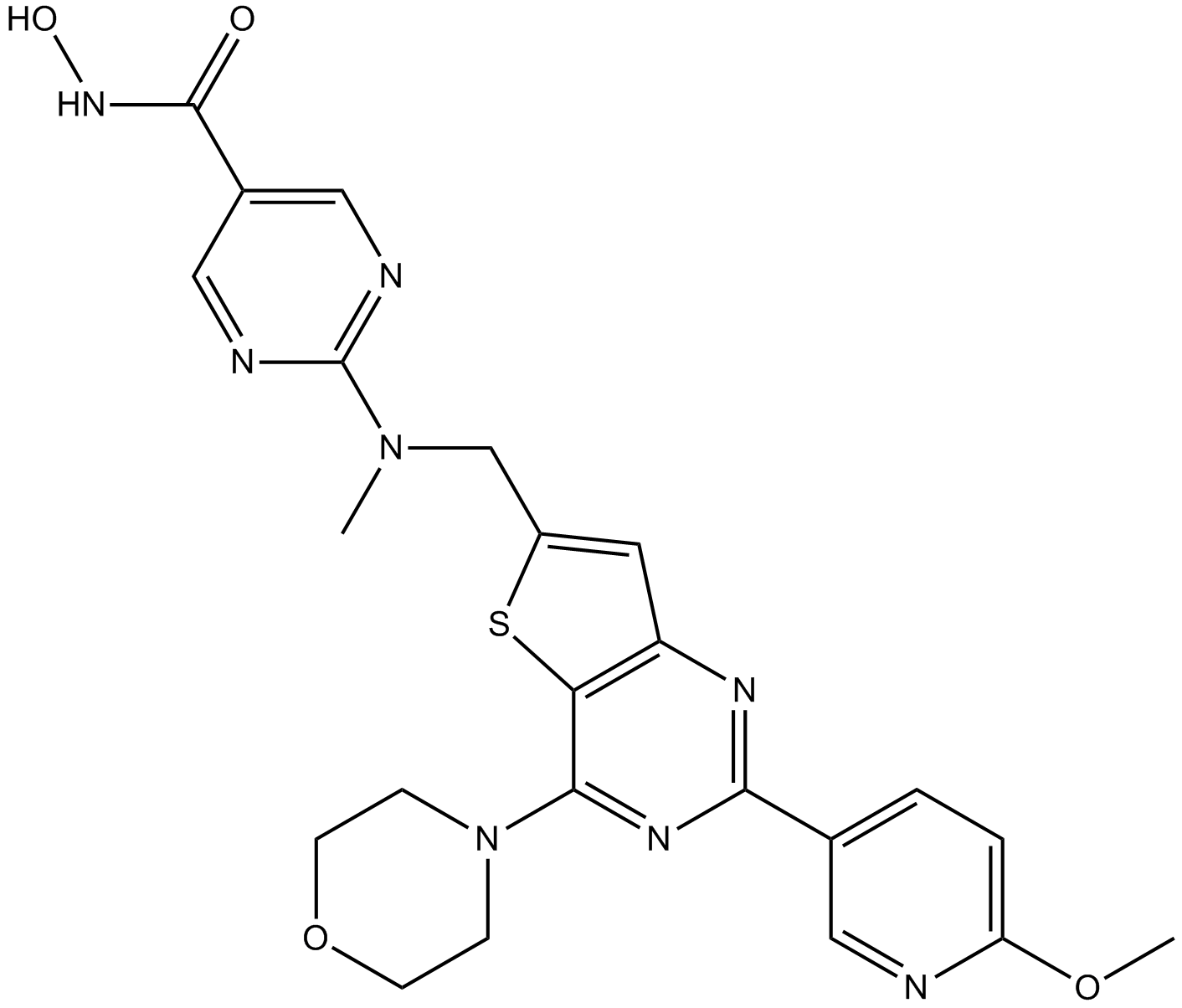
| Chemical Name | N-hydroxy-2-[[2-(6-methoxypyridin-3-yl)-4-morpholin-4-ylthieno[3,2-d]pyrimidin-6-yl]methyl-methylamino]pyrimidine-5-carboxamide | ||
| Canonical SMILES | CN(CC1=CC2=C(S1)C(=NC(=N2)C3=CN=C(C=C3)OC)N4CCOCC4)C5=NC=C(C=N5)C(=O)NO | ||
| Formula | C23H24N8O4S | M.Wt | 508.55 |
| Solubility | ≥ 25.45 mg/mL in DMSO | Storage | Store at -20°C |
| Shipping Condition | Evaluation sample solution: shipped with blue ice. All other sizes available: with RT, or with Blue Ice upon request. | ||
| Prepare stock solution | |||

|
1 mg | 5 mg | 10 mg |
| 1 mM | 1.9664 mL | 9.8319 mL | 19.6637 mL |
| 5 mM | 393.3 μL | 1.9664 mL | 3.9327 mL |
| 10 mM | 196.6 μL | 983.2 μL | 1.9664 mL |
Step 1: Enter information below (Recommended: An additional animal making an allowance for loss during the experiment)
 g
μL
g
μL
Step 2: Enter the in vivo formulation (This is only the calculator, not formulation. Please contact us first if there is no in vivo formulation at the solubility Section.)
Calculation results:
Working concentration: mg/ml;
Method for preparing DMSO master liquid: mg drug pre-dissolved in μL DMSO ( Master liquid concentration mg/mL, Please contact us first if the concentration exceeds the DMSO solubility of the batch of drug. )
Method for preparing in vivo formulation: Take μL DMSO master liquid, next addμL PEG300, mix and clarify, next addμL Tween 80, mix and clarify, next add μL saline, mix and clarify.
Method for preparing in vivo formulation: Take μL DMSO master liquid, next add μL Corn oil, mix and clarify.
Note: 1. Please make sure the liquid is clear before adding the next solvent.
2. Be sure to add the solvent(s) in order. You must ensure that the solution obtained, in the previous addition, is a clear solution before proceeding to add the next solvent. Physical methods such as vortex, ultrasound or hot water bath can be used to aid dissolving.
3. All of the above co-solvents are available for purchase on the GlpBio website.
Quality Control & SDS
- View current batch:
- Purity: >99.50% Appearance: A solid
- COA (Certificate of Analysis)
- SDS (Safety Data Sheet)
- Datasheet
Average Rating: 5 (Based on Reviews and 30 reference(s) in Google Scholar.)