

EPZ015666 (Synonyms: GSK3235025) |
Catalog No.GC15302
 One-Click Copy Product Info
|

EPZ015666 is a novel and selective inhibitor of protein arginine methyltransferase 5 (PRMT5) with an IC50 value <10nM.
Products are for research use only. Not for human use. We do not sell to patients.
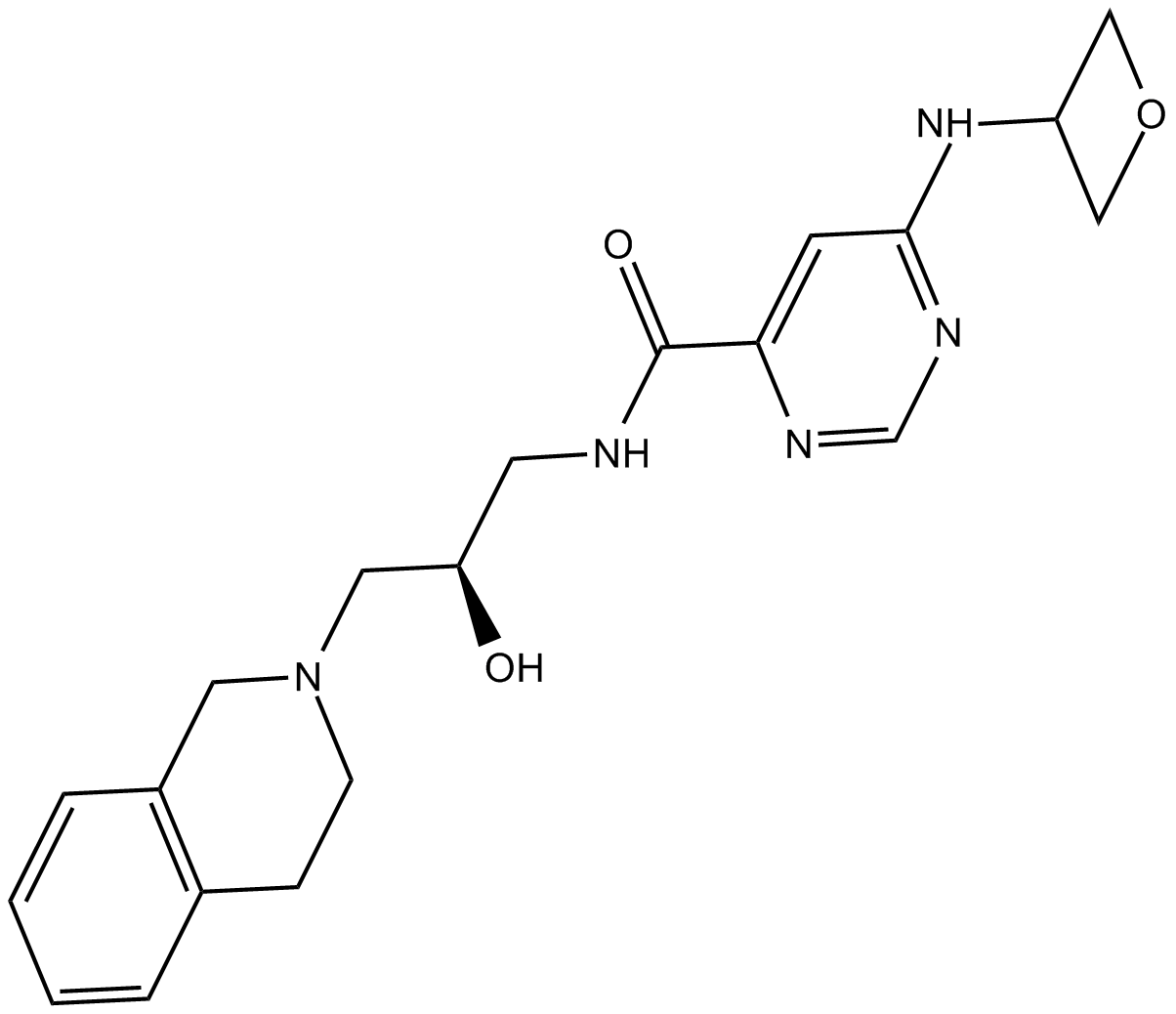
Cas No.: 1616391-65-1
Sample solution is provided at 25 µL, 10mM.
_1-3.$$$39978408@51.jpg');)
_1-9.$$$38538795@65.jpg');)
_1-9.$$$39112701@51.jpg');)
_1-7.$$$37316672@70.jpg');)
_366-372.$$$36198801@70.jpg');)
.$$$38565142@65.jpg');)
_1867-1883.$$$33248023@67.jpg');)
_eads6055.$$$39977546@45.jpg');)
_eadm9805.$$$40080571@45.jpg');)
_eadj3020.$$$39666821@45.jpg');)
_1-20.$$$39757301@28.jpg');)
_1-24.$$$38898113@28.jpg');)
_273-287.$$$36806353@46.jpg');)
_1-16.$$$37156877@44.jpg');)
_1-19.$$$37460805@44.jpg');)
_1291-1307.$$$34518654@46.jpg');)
EPZ015666 is a novel and selective inhibitor of protein arginine methyltransferase 5 (PRMT5)[1] with an IC50 value <10nM[2]. a key member of the protein arginine methyltransferase (PRMTs) family[3]. PRMT5 plays a critical role in various cellular processes, including transcriptional repression, RNA splicing, and signal transduction[4]. EPZ015666 demonstrates potent inhibitory activity against PRMT5 in multiple cancer types[5].
In vitro, treatment of Retinoblastoma (RB) cells with EPZ015666 (0–30μM) for 24–72h significantly inhibited cell proliferation in a time-and dose-dependent manner. This was accompanied by a reduction in Cyclin-Dependent Kinase 2 (CDK2) protein levels and an increase in the expression of key tumor suppressor proteins Cyclin-Dependent Kinase Inhibitor 1A, CDK-interacting protein 1 (P21), Cyclin-Dependent Kinase Inhibitor 1B (P27), andTumor Protein P53 ( P53) [1]. In U14 cells, exposure to EPZ015666 (10μM) did not affect cell viability or proliferation but suppressed PD-L1 expression[6]. Similarly, treatment of iSLK.RGB cells with EPZ015666 (50μM) for 48h resulted in marked inhibition of cell proliferation [7].
In vivo, administration of EPZ015666 (25 mg/kg/day and 75 mg/kg/day) via intraperitoneal injection for 12 days in mice bearing U14 cell xenografts resulted in a reduction in tumor volume, tumor size, and tumor weight in a dose-dependent manner [6]. Furthermore, oral treatment with EPZ015666 (150mg/kg of body weight twice a day) for 21 days in a xenograft mouse model using Retinoblastoma cells (Y79 cells) significantly suppressed tumor growth [1].
References:
[1] Liu X, He J, Mao L, Zhang Y, Cui W, Duan S, Jiang A, Gao Y, Sang Y, Huang G. EPZ015666, a selective protein arginine methyltransferase 5 (PRMT5) inhibitor with an antitumour effect in retinoblastoma. Exp Eye Res. 2021 Jan;202:108286.
[2] Chan-Penebre E, Kuplast KG, Majer CR, Boriack-Sjodin PA, Wigle TJ, Johnston LD, Rioux N, Munchhof MJ, Jin L, Jacques SL, West KA, Lingaraj T, Stickland K, Ribich SA, Raimondi A, Scott MP, Waters NJ, Pollock RM, Smith JJ, Barbash O, Pappalardi M, Ho TF, Nurse K, Oza KP, Gallagher KT, Kruger R, Moyer MP, Copeland RA, Chesworth R, Duncan KW. A selective inhibitor of PRMT5 with in vivo and in vitro potency in MCL models. Nat Chem Biol. 2015 Jun;11(6):432-7.
[3] Zhang S, Ma Y, Hu X, Zheng Y, Chen X. Targeting PRMT5/Akt signalling axis prevents human lung cancer cell growth. J Cell Mol Med. 2019 Feb;23(2):1333-1342.
[4] Liu C, Zou W, Nie D, Li S, Duan C, Zhou M, Lai P, Yang S, Ji S, Li Y, Mei M, Bao S, Jin Y, Pan J. Loss of PRMT7 reprograms glycine metabolism to selectively eradicate leukemia stem cells in CML. Cell Metab. 2022 Jun 7;34(6):818-835.e7.
[5] Zheng J, Li B, Wu Y, Wu X, Wang Y. Targeting Arginine Methyltransferase PRMT5 for Cancer Therapy: Updated Progress and Novel Strategies. J Med Chem. 2023 Jul 13;66(13):8407-8427.
[6] Jiang Y, Yuan Y, Chen M, Li S, Bai J, Zhang Y, Sun Y, Wang G, Xu H, Wang Z, Zheng Y, Nie H. PRMT5 disruption drives antitumor immunity in cervical cancer by reprogramming T cell-mediated response and regulating PD-L1 expression. Theranostics. 2021 Aug 28;11(18):9162-9176.
[7] Niu D, Ma Y, Ren P, Chang S, Li C, Jiang Y, Han C, Lan K. Methylation of KSHV vCyclin by PRMT5 contributes to cell cycle progression and cell proliferation. PLoS Pathog. 2024 Sep 10;20(9):e1012535.
| Cell experiment [1]: | |
Cell lines | Retinoblastoma (RB) cells |
Preparation Method | Retinoblastoma(RB) cells were plated in 96-well plates at 5000 cells per well and were treated with different concentrations of EPZ015666 (0, 5, 10, 20, and 30μM). After incubation for different times(24, 48,and 72h), 20µl of MTT[3-(4,5-dimethyl-2-thiazolyl)-2,5-diphenyl-2-H-tetrazolium bromide] was added, and the cells were incubated for another 4 h. Cell viability was represented by optical density (OD) values after dissolving cells in DMSO. |
Reaction Conditions | 0, 5, 10, 20, and 30μM; 24, 48,and 72h |
Applications | EPZ015666 inhibited retinoblastoma cells proliferation in a concentration- and time-dependent manner. |
| Animal experiment [2]: | |
Animal models | C57BL/6 mice |
Preparation Method | U14 cells in 100 μL (5×10⁶ cells/mouse) were subcutaneously implanted into the right flanks of C57BL/6 mice. At day 3 after inoculation of U14 cells, the PRMT5 inhibitor EPZ015666(0, 25, and 75mg/kg/day) Was intraperitoneally injected for 12 consecutive days.The tumor length (L) and width (W) were monitored by measurement with a digital caliper every day. |
Dosage form | 25mg/kg/day and 75mg/kg/day for12 days; i.p. |
Applications | EPZ015666 therapy on cervical cancer mice model and found that EPZ015666 treatment reduced the tumor volume, tumor size and tumor weight in mice, and this therapeutic effect was dose-dependent |
References: | |
| Cas No. | 1616391-65-1 | SDF | |
| Synonyms | GSK3235025 | ||
| Chemical Name | (R)-N-(3-(3,4-dihydroisoquinolin-2(1H)-yl)-2-hydroxypropyl)-6-(oxetan-3-ylamino)pyrimidine-4-carboxamide | ||
| Canonical SMILES | O=C(C1=CC(NC2COC2)=NC=N1)NC[C@@H](O)CN(CC3)CC4=C3C=CC=C4 | ||
| Formula | C20H25N5O3 | M.Wt | 383.44 |
| Solubility | ≥ 19.17mg/mL in DMSO | Storage | Store at -20°C |
| General tips | Please select the appropriate solvent to prepare the stock solution according to the
solubility of the product in different solvents; once the solution is prepared, please store it in
separate packages to avoid product failure caused by repeated freezing and thawing.Storage method
and period of the stock solution: When stored at -80°C, please use it within 6 months; when stored
at -20°C, please use it within 1 month. To increase solubility, heat the tube to 37°C and then oscillate in an ultrasonic bath for some time. |
||
| Shipping Condition | Evaluation sample solution: shipped with blue ice. All other sizes available: with RT, or with Blue Ice upon request. | ||
| Prepare stock solution | |||

|
1 mg | 5 mg | 10 mg |
| 1 mM | 2.608 mL | 13.0398 mL | 26.0797 mL |
| 5 mM | 521.6 μL | 2.608 mL | 5.2159 mL |
| 10 mM | 260.8 μL | 1.304 mL | 2.608 mL |
Step 1: Enter information below (Recommended: An additional animal making an allowance for loss during the experiment)
 g
μL
g
μL
Step 2: Enter the in vivo formulation (This is only the calculator, not formulation. Please contact us first if there is no in vivo formulation at the solubility Section.)
Calculation results:
Working concentration: mg/ml;
Method for preparing DMSO master liquid: mg drug pre-dissolved in μL DMSO ( Master liquid concentration mg/mL, Please contact us first if the concentration exceeds the DMSO solubility of the batch of drug. )
Method for preparing in vivo formulation: Take μL DMSO master liquid, next addμL PEG300, mix and clarify, next addμL Tween 80, mix and clarify, next add μL saline, mix and clarify.
Method for preparing in vivo formulation: Take μL DMSO master liquid, next add μL Corn oil, mix and clarify.
Note: 1. Please make sure the liquid is clear before adding the next solvent.
2. Be sure to add the solvent(s) in order. You must ensure that the solution obtained, in the previous addition, is a clear solution before proceeding to add the next solvent. Physical methods such as vortex, ultrasound or hot water bath can be used to aid dissolving.
3. All of the above co-solvents are available for purchase on the GlpBio website.
Quality Control & SDS
- View current batch:
- Purity: >99.00% Appearance: A solid
- COA (Certificate of Analysis)
- SDS (Safety Data Sheet)
- Datasheet
Average Rating: 5 (Based on Reviews and 38 reference(s) in Google Scholar.)