

Finasteride (Synonyms: MK-906) |
Catalog No.GC16248
 One-Click Copy Product Info
|

Finasteride is a selective type II 5α-reductase inhibitor with an IC₅₀ value of 4.2nM . Finasteride lowers dihydrotestosterone (DHT) levels and is used to treat male pattern hair loss (androgenetic alopecia).
Products are for research use only. Not for human use. We do not sell to patients.
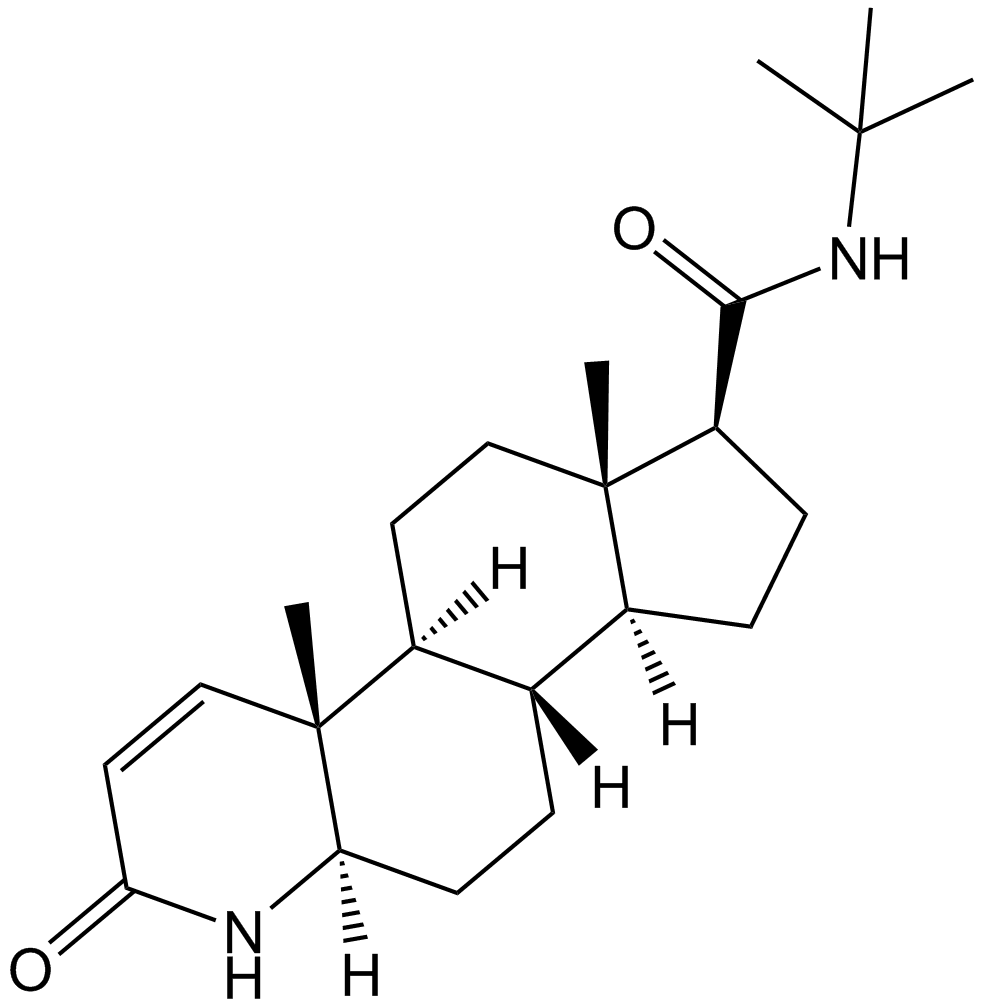
Cas No.: 98319-26-7
Sample solution is provided at 25 µL, 10mM.
_1-3.$$$39978408@51.jpg');)
_1-9.$$$38538795@65.jpg');)
_1-9.$$$39112701@51.jpg');)
_1-7.$$$37316672@70.jpg');)
_366-372.$$$36198801@70.jpg');)
.$$$38565142@65.jpg');)
_1867-1883.$$$33248023@67.jpg');)
_eads6055.$$$39977546@45.jpg');)
_eadm9805.$$$40080571@45.jpg');)
_eadj3020.$$$39666821@45.jpg');)
_1-20.$$$39757301@28.jpg');)
_1-24.$$$38898113@28.jpg');)
_273-287.$$$36806353@46.jpg');)
_1-16.$$$37156877@44.jpg');)
_1-19.$$$37460805@44.jpg');)
_1291-1307.$$$34518654@46.jpg');)
Finasteride is a selective type II 5α-reductase inhibitor with an IC₅₀ value of 4.2nM [1]. Finasteride lowers dihydrotestosterone (DHT) levels and is used to treat male pattern hair loss (androgenetic alopecia)[2]. Additionally, Finasteride can be used to treat female pattern hair loss in patients who have failed local minoxidil treatment [3]. Finasteride has been shown to significantly reduce prostate volume and improve urinary symptoms [4].
In vitro, treatment of human dermal papilla cells (DPCs) with Finasteride (10–100μM) for 5 days significantly increased cell aggregation behavior, upregulated the expression of stem cell transcription factors Nanog and Sox-2, and activated the protein kinase B (AKT), β-catenin, and integrin β-1 signaling pathways, thereby enhancing stem cell properties[5]. Treatment of human prostate cell lines RWPE-1, LNCaP, PC3, and DU145 with Finasteride (10μM and 50μM) for 72 hours significantly downregulated the activities of MMP2 and MMP9, while upregulating the expression of TIMP-2. Moreover, 50μM Finasteride significantly inhibited the invasive potential of all cell lines and also significantly inhibited the migration of RWPE-1 and LNCaP cells [6].
In vivo, Ldlr−/− mice treated orally with Finasteride (1000mg/kg) for 12 weeks showed significant reductions in total cholesterol and triglyceride levels, decreased atherosclerotic plaque area in the aortic arch and root, and reduced macrophage content and necrotic core area in the plaques [7]. In a protein-overload nephropathy chronic kidney disease (CKD) mouse model fed a high-fat diet (HFD), treatment with Finasteride (1.5mg/30g) via gavage for 2 weeks significantly lowered plasma trimethylamine N-oxide (TMAO) levels, improved renal injury, and regulated the composition and distribution of gut microbiota[8].
References:
[1] Flores E, Bratoeff E, Cabeza M, et al. Steroid 5alpha-reductase inhibitors. Mini Rev Med Chem. 2003 May;3(3):225-37.
[2] Piraccini BM, Blume-Peytavi U, Scarci F, et al. Topical Finasteride Study Group. Efficacy and safety of topical finasteride spray solution for male androgenetic alopecia: a phase III, randomized, controlled clinical trial. J Eur Acad Dermatol Venereol. 2022 Feb;36(2):286-294.
[3] Stout SM, Stumpf JL. Finasteride treatment of hair loss in women. Ann Pharmacother. 2010 Jun;44(6):1090-7.
[4] Tacklind J, Fink HA, Macdonald R, et al. Finasteride for benign prostatic hyperplasia. Cochrane Database Syst Rev. 2010 Oct 6;2010(10):CD006015.
[5] Rattanachitthawat N, Pinkhien T, Opanasopit P, et al. Finasteride Enhances Stem Cell Signals of Human Dermal Papilla Cells. In Vivo. 2019 Jul-Aug;33(4):1209-1220.
[6] Moroz A, Delella FK, Almeida R, et al. Felisbino SL. Finasteride inhibits human prostate cancer cell invasion through MMP2 and MMP9 downregulation. PLoS One. 2013 Dec 30;8(12):e84757.
[7] McQueen P, Molina D, Pinos I, et al. Finasteride delays atherosclerosis progression in mice and is associated with a reduction in plasma cholesterol in men. J Lipid Res. 2024 Mar;65(3):100507.
[8] Wang Z, You L, Ren Y, et al. Finasteride Alleviates High Fat Associated Protein-Overload Nephropathy by Inhibiting Trimethylamine N-Oxide Synthesis and Regulating Gut Microbiota. Front Physiol. 2022 Aug 15;13:900961.
| Cell experiment [1]: | |
Cell lines | RWPE-1, LNCaP, PC3, DU145 (human prostate cancer cell line) |
Preparation Method | Cells were maintained in RPMI 1640 medium supplemented with 10% fetal bovine serum (FBS) at 37°C, 5% CO₂. Cells were treated with Finasteride at concentrations of 10μM and 50μM for 72 hours. |
Reaction Conditions | 10μM, 50μM; 72h |
Applications | Finasteride significantly downregulated the activities of MMP2 and MMP9 in RWPE-1 and PC3 cells, and MMP2 in DU145 cells. Finasteride inhibited cell invasion in all tested cell lines. |
| Animal experiment [2]: | |
Animal models | Balb/c mice |
Preparation Method | Chronic kidney disease (CKD) mouse models were generated by intraperitoneal injection of bovine serum albumin (BSA) at 30mg/30g body weight (with 15 and 25mg/30g BSA on the first 2 days). Mice were fed a high-fat diet (HFD) simultaneously with BSA injection for 4 weeks. In the last 2 weeks, mice were treated with Finasteride at 1.5mg/30g body weight via intragastric administration. Mice were sacrificed on Day 35 for evaluation of renal function and histological analysis. |
Dosage form | 1.5mg/30g body weight; i.g. |
Applications | Finasteride significantly alleviated HFD-induced hyperlipidemia and renal injury in CKD mice, as evidenced by reduced levels of serum creatinine, blood urea nitrogen, and urinary protein. |
References: | |
| Cas No. | 98319-26-7 | SDF | |
| Synonyms | MK-906 | ||
| Chemical Name | (1S,3aS,3bS,5aR,9aR,9bS,11aS)-N-tert-butyl-9a,11a-dimethyl-7-oxo-1,2,3,3a,3b,4,5,5a,6,9b,10,11-dodecahydroindeno[5,4-f]quinoline-1-carboxamide | ||
| Canonical SMILES | CC12CCC3C(C1CCC2C(=O)NC(C)(C)C)CCC4C3(C=CC(=O)N4)C | ||
| Formula | C23H36N2O2 | M.Wt | 372.54 |
| Solubility | ≥ 14.65 mg/mL in DMSO, ≥ 76.4 mg/mL in EtOH | Storage | Store at -20°C |
| General tips | Please select the appropriate solvent to prepare the stock solution according to the
solubility of the product in different solvents; once the solution is prepared, please store it in
separate packages to avoid product failure caused by repeated freezing and thawing.Storage method
and period of the stock solution: When stored at -80°C, please use it within 6 months; when stored
at -20°C, please use it within 1 month. To increase solubility, heat the tube to 37°C and then oscillate in an ultrasonic bath for some time. |
||
| Shipping Condition | Evaluation sample solution: shipped with blue ice. All other sizes available: with RT, or with Blue Ice upon request. | ||
| Prepare stock solution | |||

|
1 mg | 5 mg | 10 mg |
| 1 mM | 2.6843 mL | 13.4214 mL | 26.8428 mL |
| 5 mM | 536.9 μL | 2.6843 mL | 5.3686 mL |
| 10 mM | 268.4 μL | 1.3421 mL | 2.6843 mL |
Step 1: Enter information below (Recommended: An additional animal making an allowance for loss during the experiment)
 g
μL
g
μL
Step 2: Enter the in vivo formulation (This is only the calculator, not formulation. Please contact us first if there is no in vivo formulation at the solubility Section.)
Calculation results:
Working concentration: mg/ml;
Method for preparing DMSO master liquid: mg drug pre-dissolved in μL DMSO ( Master liquid concentration mg/mL, Please contact us first if the concentration exceeds the DMSO solubility of the batch of drug. )
Method for preparing in vivo formulation: Take μL DMSO master liquid, next addμL PEG300, mix and clarify, next addμL Tween 80, mix and clarify, next add μL saline, mix and clarify.
Method for preparing in vivo formulation: Take μL DMSO master liquid, next add μL Corn oil, mix and clarify.
Note: 1. Please make sure the liquid is clear before adding the next solvent.
2. Be sure to add the solvent(s) in order. You must ensure that the solution obtained, in the previous addition, is a clear solution before proceeding to add the next solvent. Physical methods such as vortex, ultrasound or hot water bath can be used to aid dissolving.
3. All of the above co-solvents are available for purchase on the GlpBio website.
Quality Control & SDS
- View current batch:
- Purity: >98.00% Appearance: A solid
- COA (Certificate of Analysis)
- SDS (Safety Data Sheet)
- Datasheet
Average Rating: 5 (Based on Reviews and 24 reference(s) in Google Scholar.)