

Maltose |
Catalog No.GC36537
 One-Click Copy Product Info
|

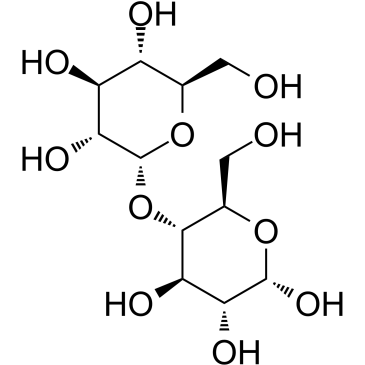
Maltose is a disaccharide composed of two glucose units linked by an α-1,4 glycosidic bond.
Products are for research use only. Not for human use. We do not sell to patients.
Cas No.: 69-79-4
Sample solution is provided at 25 µL, 10mM.
_1-3.$$$39978408@51.jpg');)
_1-9.$$$38538795@65.jpg');)
_1-9.$$$39112701@51.jpg');)
_1-7.$$$37316672@70.jpg');)
_366-372.$$$36198801@70.jpg');)
.$$$38565142@65.jpg');)
_1867-1883.$$$33248023@67.jpg');)
_eads6055.$$$39977546@45.jpg');)
_eadm9805.$$$40080571@45.jpg');)
_eadj3020.$$$39666821@45.jpg');)
_1-20.$$$39757301@28.jpg');)
_1-24.$$$38898113@28.jpg');)
_273-287.$$$36806353@46.jpg');)
_1-16.$$$37156877@44.jpg');)
_1-19.$$$37460805@44.jpg');)
_1291-1307.$$$34518654@46.jpg');)
Maltose is a disaccharide composed of two glucose units linked by an α-1,4 glycosidic bond[1]. Maltose can be produced by the breakdown of starch, is slightly sweet (less sweet than sucrose), soluble in water, and exists in α and β isomers[2]. The applications of Maltose span various fields such as food, biology, and daily chemicals, primarily as a sweetener, fermentation sugar in beer brewing, a carbon source for cell culture, and a humectant in skincare products[3].
In vitro, when barley microspore were cultured with Maltose (40mM) for 6-24h, compared to sucrose, Maltose exhibited slower metabolic rates, lower ethanol accumulation, higher energy status, supported cell survival, and promoted embryogenesis[4]. Maltose (2.5-112mM) incubated with isolated pea thylakoids at -15℃ for 20h protected the activity of the electron transport chain, with a protection rate of 93% at 112mM, significantly outperforming glucose[5]. Treatment of human intestinal epithelial Caco-2/TC7 cells with Maltose (12.5mM) for 24h upregulated the expression of the sucrase-isomaltase (SI) gene in a time-dependent manner[6].
In vivo, male C57BL/6J mice continuously fed a high-fat diet containing 7% Maltose (by weight) for 13 weeks showed more pronounced increases in fasting blood glucose, plasma total cholesterol, high-density lipoprotein (HDL) cholesterol, and non-HDL cholesterol levels compared to mice fed only a high-fat diet[7]. Normal C57BL/6J mice orally administered Maltose (2g/kg) after overnight fasting exhibited a significant postprandial blood glucose elevation, peaking at 30min, and produced a high area under the curve (AUC) for blood glucose[8].
References:
[1] QUIGLEY G J, SARKO A, MARCHESSAULT R H. Crystal and molecular structure of maltose monohydrate[J]. Journal of the American Chemical Society, 1970, 92(20): 5834-5839.
[2] KHAN R. The chemistry of maltose[M]//Advances in Carbohydrate Chemistry and Biochemistry. Academic Press, 1981, 39: 213-278.
[3] CARLSEN M, NIELSEN J. Influence of carbon source on α-amylase production by Aspergillus oryzae[J]. Applied Microbiology and Biotechnology, 2001, 57(3): 346-349.
[4] SCOTT P, LYNE R L, AP REES T. Metabolism of maltose and sucrose by microspores isolated from barley (Hordeum vulgare L.)[J]. Planta, 1995, 197(3): 435-441.
[5] KAPLAN F, GUY C L. β-Amylase induction and the protective role of maltose during temperature shock[J]. Plant Physiology, 2004, 135(3): 1674-1684.
[6] CHENG M W, CHEGENI M, KIM K H, et al. Different sucrose-isomaltase response of Caco-2 cells to glucose and maltose suggests dietary maltose sensing[J]. Journal of Clinical Biochemistry and Nutrition, 2014, 54(1): 55-60.
[7] SHIBAZAKI N, TANAKA W, SUZUKI Y, et al. Maltose consumption exacerbates high-fat diet-induced overweight and related parameters in mice[J]. Functional Foods in Health and Disease, 2022, 12(11): 680-692.
[8] KIM J I, BAEK H J, HAN D W, et al. Autumn olive (Elaeagnus umbellata Thunb.) berry reduces fasting and postprandial glucose levels in mice[J]. Nutrition Research and Practice, 2019, 13(1): 11-16.
| Cell experiment [1]: | |
Cell lines | Caco-2/TC7 cells |
Preparation Method | Treatment of the Caco-2/TC7 cells with the Maltose (12.5mM), expression of SI was measured at different time points using qRT-PCR. |
Reaction Conditions | 12.5mM; 24h |
Applications | Maltose treatment can time-dependently upregulate the expression of the SI gene within 24h. |
| Animal experiment [2]: | |
Animal models | Normal C57BL/6J mice that have been fasted overnight |
Preparation Method | Normal C57BL/6J mice were administered Maltose orally (2g/kg body weight) after an overnight fast. Blood samples were acquired from the tip of tail vein 0-120min after Maltose administration. Glucose levels were measured using the Glucotrend glucometer, and the AUC for glucose were calculated. |
Dosage form | 2g/kg; p.o. |
Applications | Oral administration of Maltose (2g/kg) to normal C57BL/6J mice after overnight fasting induced a significant increase in postprandial blood glucose, which peaked at 30min, and produced a high area under the blood glucose curve. |
References: | |
| Cas No. | 69-79-4 | SDF | |
| Canonical SMILES | O[C@H]1[C@H](O)[C@@H](O)[C@@H](O[C@H]2[C@H](O)[C@@H](O)[C@@H](O)O[C@@H]2CO)O[C@@H]1CO | ||
| Formula | C12H22O11 | M.Wt | 342.3 |
| Solubility | DMSO : 68mg/mL | Storage | Store at -20°C |
| General tips | Please select the appropriate solvent to prepare the stock solution according to the
solubility of the product in different solvents; once the solution is prepared, please store it in
separate packages to avoid product failure caused by repeated freezing and thawing.Storage method
and period of the stock solution: When stored at -80°C, please use it within 6 months; when stored
at -20°C, please use it within 1 month. To increase solubility, heat the tube to 37°C and then oscillate in an ultrasonic bath for some time. |
||
| Shipping Condition | Evaluation sample solution: shipped with blue ice. All other sizes available: with RT, or with Blue Ice upon request. | ||
| Prepare stock solution | |||

|
1 mg | 5 mg | 10 mg |
| 1 mM | 2.9214 mL | 14.6071 mL | 29.2141 mL |
| 5 mM | 584.3 μL | 2.9214 mL | 5.8428 mL |
| 10 mM | 292.1 μL | 1.4607 mL | 2.9214 mL |
Step 1: Enter information below (Recommended: An additional animal making an allowance for loss during the experiment)
 g
μL
g
μL
Step 2: Enter the in vivo formulation (This is only the calculator, not formulation. Please contact us first if there is no in vivo formulation at the solubility Section.)
Calculation results:
Working concentration: mg/ml;
Method for preparing DMSO master liquid: mg drug pre-dissolved in μL DMSO ( Master liquid concentration mg/mL, Please contact us first if the concentration exceeds the DMSO solubility of the batch of drug. )
Method for preparing in vivo formulation: Take μL DMSO master liquid, next addμL PEG300, mix and clarify, next addμL Tween 80, mix and clarify, next add μL saline, mix and clarify.
Method for preparing in vivo formulation: Take μL DMSO master liquid, next add μL Corn oil, mix and clarify.
Note: 1. Please make sure the liquid is clear before adding the next solvent.
2. Be sure to add the solvent(s) in order. You must ensure that the solution obtained, in the previous addition, is a clear solution before proceeding to add the next solvent. Physical methods such as vortex, ultrasound or hot water bath can be used to aid dissolving.
3. All of the above co-solvents are available for purchase on the GlpBio website.
Quality Control & SDS
- View current batch:
- Purity: >98.00% Appearance: A solid
- COA (Certificate of Analysis)
- SDS (Safety Data Sheet)
- Datasheet
Average Rating: 5 (Based on Reviews and 19 reference(s) in Google Scholar.)