

Olprinone |
Catalog No.GC36803
 One-Click Copy Product Info
|

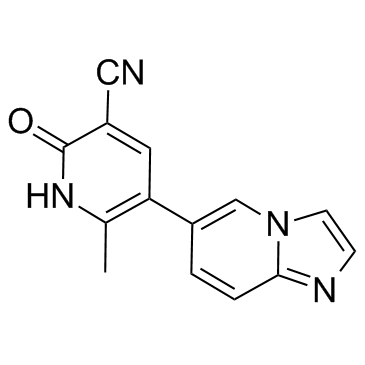
Olprinone (Loprinone) is a potent phosphodiesterase (PDE) 3 inhibitor, with IC50s of 150, 100, 0.35 and 14 μM for PDE1, PDE2, PDE3 and PDE4, respectively.
Products are for research use only. Not for human use. We do not sell to patients.
Cas No.: 106730-54-5
Sample solution is provided at 25 µL, 10mM.
_1-3.$$$39978408@51.jpg');)
_1-9.$$$38538795@65.jpg');)
_1-9.$$$39112701@51.jpg');)
_1-7.$$$37316672@70.jpg');)
_366-372.$$$36198801@70.jpg');)
.$$$38565142@65.jpg');)
_1867-1883.$$$33248023@67.jpg');)
_eads6055.$$$39977546@45.jpg');)
_eadm9805.$$$40080571@45.jpg');)
_eadj3020.$$$39666821@45.jpg');)
_1-20.$$$39757301@28.jpg');)
_1-24.$$$38898113@28.jpg');)
_273-287.$$$36806353@46.jpg');)
_1-16.$$$37156877@44.jpg');)
_1-19.$$$37460805@44.jpg');)
_1291-1307.$$$34518654@46.jpg');)
Olprinone(Loprinone) is a selective phosphodiesterase 3 (PDE3) inhibitor. IC50 value:Target: PDE3Olprinone is used as cardiotonic agent with positive inotropic and vasodilating effects. Olprinone has been reported to improve microcirculation and attenuate inflammation. Olprinone is often used to increase cardiac output after cardiopulmonary bypass (CPB). Olprinone was infused at a rate of 0.2 μg/kg/min when weaning from CPB was started. Olprinone has also shown potent antioxidative and anti-inflammatory effects in the meconium-induced oxidative lung injury.
[1]. Tsubokawa T, Ishizuka S, Fukumoto K, et al. The effect of hemodilution by cardiopulmonary bypass on protein binding of olprinone. J Anesth. 2012 . [2]. Mokra D, Drgova A, Pullmann R Sr, et al. Selective phosphodiesterase 3 inhibitor olprinone attenuates meconium-induced oxidative lung injury. Pulm Pharmacol Ther. 2012 Jun;25(3):216-22. [3]. Yamanaka H, Hayashi Y, Kamibayashi T, Mashimo T. Effect of olprinone, a phosphodiesterase III inhibitor, on balance of cerebral oxygen supply and demand during cardiopulmonary bypass. J Cardiovasc Pharmacol. 2011 May;57(5):579-83. [4]. Mazzon E, Esposito E, Di Paola R, et al. Olprinone, a specific phosphodiesterase (PDE)-III inhibitor, reduces the development of multiple organ dysfunction syndrome in mice. Pharmacol Res. 2011 Jul;64(1):68-79.
| Cas No. | 106730-54-5 | SDF | |
| Canonical SMILES | CC(N1)=C(C=C(C#N)C1=O)C2=CN3C(C=C2)=NC=C3 | ||
| Formula | C14H10N4O | M.Wt | 250.26 |
| Solubility | DMSO : 50mg/mL | Storage | Store at -20°C |
| General tips | Please select the appropriate solvent to prepare the stock solution according to the
solubility of the product in different solvents; once the solution is prepared, please store it in
separate packages to avoid product failure caused by repeated freezing and thawing.Storage method
and period of the stock solution: When stored at -80°C, please use it within 6 months; when stored
at -20°C, please use it within 1 month. To increase solubility, heat the tube to 37°C and then oscillate in an ultrasonic bath for some time. |
||
| Shipping Condition | Evaluation sample solution: shipped with blue ice. All other sizes available: with RT, or with Blue Ice upon request. | ||
| Prepare stock solution | |||

|
1 mg | 5 mg | 10 mg |
| 1 mM | 3.9958 mL | 19.9792 mL | 39.9584 mL |
| 5 mM | 799.2 μL | 3.9958 mL | 7.9917 mL |
| 10 mM | 399.6 μL | 1.9979 mL | 3.9958 mL |
Step 1: Enter information below (Recommended: An additional animal making an allowance for loss during the experiment)
 g
μL
g
μL
Step 2: Enter the in vivo formulation (This is only the calculator, not formulation. Please contact us first if there is no in vivo formulation at the solubility Section.)
Calculation results:
Working concentration: mg/ml;
Method for preparing DMSO master liquid: mg drug pre-dissolved in μL DMSO ( Master liquid concentration mg/mL, Please contact us first if the concentration exceeds the DMSO solubility of the batch of drug. )
Method for preparing in vivo formulation: Take μL DMSO master liquid, next addμL PEG300, mix and clarify, next addμL Tween 80, mix and clarify, next add μL saline, mix and clarify.
Method for preparing in vivo formulation: Take μL DMSO master liquid, next add μL Corn oil, mix and clarify.
Note: 1. Please make sure the liquid is clear before adding the next solvent.
2. Be sure to add the solvent(s) in order. You must ensure that the solution obtained, in the previous addition, is a clear solution before proceeding to add the next solvent. Physical methods such as vortex, ultrasound or hot water bath can be used to aid dissolving.
3. All of the above co-solvents are available for purchase on the GlpBio website.
Quality Control & SDS
- View current batch:
- Purity: >98.00% Appearance: A solid
- COA (Certificate of Analysis)
- SDS (Safety Data Sheet)
- Datasheet
Average Rating: 5 (Based on Reviews and 39 reference(s) in Google Scholar.)