

Pregnenolone monosulfate (Synonyms: 3β-Hydroxy-5-pregnen-20-one monosulfate) |
Catalog No.GC36963
 One-Click Copy Product Info
|

Pregnenolone monosulfate is a key precursor to various steroid hormones, including steroid hormones, and possesses multiple biological functions.
Products are for research use only. Not for human use. We do not sell to patients.
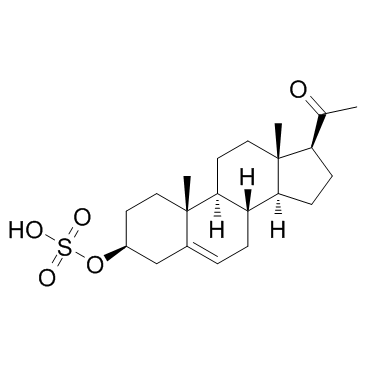
Cas No.: 1247-64-9
Sample solution is provided at 25 µL, 10mM.
_1-3.$$$39978408@51.jpg');)
_1-9.$$$38538795@65.jpg');)
_1-9.$$$39112701@51.jpg');)
_1-7.$$$37316672@70.jpg');)
_366-372.$$$36198801@70.jpg');)
.$$$38565142@65.jpg');)
_1867-1883.$$$33248023@67.jpg');)
_eads6055.$$$39977546@45.jpg');)
_eadm9805.$$$40080571@45.jpg');)
_eadj3020.$$$39666821@45.jpg');)
_1-20.$$$39757301@28.jpg');)
_1-24.$$$38898113@28.jpg');)
_273-287.$$$36806353@46.jpg');)
_1-16.$$$37156877@44.jpg');)
_1-19.$$$37460805@44.jpg');)
_1291-1307.$$$34518654@46.jpg');)
Pregnenolone monosulfate is a key precursor to various steroid hormones, including steroid hormones, and possesses multiple biological functions[1-2]. Pregnenolone monosulfate can be utilized in neuroscience research and related nervous system disorders[3-4].
In vitro, Pregnenolone monosulfate (5-300μM) was applied to GH3 pituitary cells for 1 minute, Pregnenolone monosulfate induced a rapid and transient increase in intracellular calcium ion ([Ca²⁺]i) levels. Pregnenolone monosulfate activated L-type voltage-gated calcium channels, mediating extracellular calcium influx[5]. In neonatal rat cerebellar Purkinje cells (P4–10), Pregnenolone monosulfate (25μM) enhanced glutamate release by promoting presynaptic calcium influx through transient receptor potential (TRP) channels, Pregnenolone monosulfate significantly increased AMPA receptor-mediated miniature excitatory postsynaptic currents (AMPA-mEPSCs)[6].
In vivo, in dopamine transporter knockout (DAT-KO) mice (8-10 weeks old), Pregnenolone monosulfate (40 or 80mg/kg; administered either as a single injection or daily for 10 consecutive days via intraperitoneal injection). Pregnenolone monosulfate significantly suppressed hyperlocomotion and stereotypic behaviors, rescued prepulse inhibition deficits, and improved cognitive impairments in novel object recognition and social food preference tests. The therapeutic effects of Pregnenolone monosulfate were mediated through the AKT/GSK3β pathway and increased expression of the hippocampal NMDA receptor NR1 subunit[7]. In wild-type mice (9-10 weeks old), a single subcutaneous injection of Pregnenolone monosulfate (6mg/kg), Pregnenolone monosulfate antagonized Δ9-tetrahydrocannabinol (THC)-induced psychotic-like behaviors, significantly blocked THC-induced cognitive impairments, sensory gating deficits, and reduced social interaction[8].
References:
[1] Vallée M, Vitiello S, Bellocchio L, et al. Pregnenolone can protect the brain from cannabis intoxication. Science. 2014 Jan 3;343(6166):94-8.
[2] Ducharme N, Banks WA, Morley JE, et al. Brain distribution and behavioral effects of progesterone and pregnenolone after intranasal or intravenous administration. Eur J Pharmacol. 2010 Sep 1;641(2-3):128-34.
[3] Shiels A. TRPM3_miR-204: a complex locus for eye development and disease. Hum Genomics. 2020 Feb 18;14(1):7.
[4] Weaver CE Jr, Wu FS, Gibbs TT, et al. Pregnenolone sulfate exacerbates NMDA-induced death of hippocampal neurons. Brain Res. 1998 Aug 24;803(1-2):129-36.
[5] Büküşoğlu C, Sarlak F. Pregnenolone sulfate increases intracellular Ca2+ levels in a pituitary cell line. Eur J Pharmacol. 1996 Feb 29;298(1):79-85.
[6] Zamudio-Bulcock PA, Valenzuela CF. Pregnenolone sulfate increases glutamate release at neonatal climbing fiber-to-Purkinje cell synapses. Neuroscience. 2011 Feb 23;175:24-36.
[7] Wong P, Sze Y, Chang CC, et al. Pregnenolone sulfate normalizes schizophrenia-like behaviors in dopamine transporter knockout mice through the AKT/GSK3β pathway. Transl Psychiatry. 2015 Mar 17;5(3):e528.
[8] Busquets-Garcia A, Soria-Gómez E, Redon B, et al. Pregnenolone blocks cannabinoid-induced acute psychotic-like states in mice. Mol Psychiatry. 2017 Nov;22(11):1594-1603.
| Cell experiment [1]: | |
Cell lines | GH3 cells (rat pituitary clonal cell line) |
Preparation Method | GH3 cells were cultured as monolayers on glass coverslips in Dulbecco’s modified Eagle medium supplemented with 10% fetal bovine serum at 37°C, 5% CO₂. Cells were loaded with Fura-2/AM (5μM) for 30 min and perfused with physiological buffer. Pregnenolone monosulfate (5–300μM) was applied via perfusion for 1min. |
Reaction Conditions | 5–300μM; 1min |
Applications | Pregnenolone monosulfate induced a rapid, dose-dependent increase in intracellular Ca²⁺ ([Ca²⁺]ᵢ) in GH3 cells, with an EC₅₀ of ~32μM. The [Ca²⁺]ᵢ surge was abolished in Ca²⁺-free medium or in the presence of inorganic Ca²⁺ channel blockers (La³⁺, Co²⁺). Organic L-type voltage-gated Ca²⁺ channel (VGCC) blockers (nicardipine, D600) inhibited the response, indicating that the Ca²⁺ influx is primarily mediated through L-type VGCCs. Co-application with the VGCC agonist Bay K 8644 potentiated the effect, suggesting synergistic modulation of Ca²⁺ channels. |
| Animal experiment [2]: | |
Animal models | C57BL/6-N mice (9–10 weeks old) |
Preparation Method | Mice were subcutaneously (s.c.) administered Pregnenolone monosulfate (6mg/kg) either 10 minutes before or 30 minutes after intraperitoneal (i.p.) injection of Δ9-tetrahydrocannabinol (THC; 0.3–10mg/kg). Behavioral tests (e.g., spontaneous alternation, social interaction, prepulse inhibition, locomotion, and "reality testing") were conducted at specified time points post-THC administration (45–120 minutes). |
Dosage form | 6mg/kg; s.c.; Acute single injection. |
Applications | Pregnenolone monosulfate blocked a wide spectrum of THC-induced psychotic-like behaviors, including cognitive deficits, reduced prepulse inhibition, decreased social interaction, hyperlocomotion, and impaired "reality testing" (a measure of mental sensory representations). |
References: | |
| Cas No. | 1247-64-9 | SDF | |
| Synonyms | 3β-Hydroxy-5-pregnen-20-one monosulfate | ||
| Canonical SMILES | CC([C@H]1CC[C@@]2([H])[C@]3([H])CC=C4C[C@@H](OS(=O)(O)=O)CC[C@]4(C)[C@@]3([H])CC[C@]12C)=O | ||
| Formula | C21H32O5S | M.Wt | 396.54 |
| Solubility | DMSO: 62.5 mg/mL (157.61 mM) | Storage | Store at -20°C,stored under nitrogen |
| General tips | Please select the appropriate solvent to prepare the stock solution according to the
solubility of the product in different solvents; once the solution is prepared, please store it in
separate packages to avoid product failure caused by repeated freezing and thawing.Storage method
and period of the stock solution: When stored at -80°C, please use it within 6 months; when stored
at -20°C, please use it within 1 month. To increase solubility, heat the tube to 37°C and then oscillate in an ultrasonic bath for some time. |
||
| Shipping Condition | Evaluation sample solution: shipped with blue ice. All other sizes available: with RT, or with Blue Ice upon request. | ||
| Prepare stock solution | |||

|
1 mg | 5 mg | 10 mg |
| 1 mM | 2.5218 mL | 12.6091 mL | 25.2181 mL |
| 5 mM | 504.4 μL | 2.5218 mL | 5.0436 mL |
| 10 mM | 252.2 μL | 1.2609 mL | 2.5218 mL |
Step 1: Enter information below (Recommended: An additional animal making an allowance for loss during the experiment)
 g
μL
g
μL
Step 2: Enter the in vivo formulation (This is only the calculator, not formulation. Please contact us first if there is no in vivo formulation at the solubility Section.)
Calculation results:
Working concentration: mg/ml;
Method for preparing DMSO master liquid: mg drug pre-dissolved in μL DMSO ( Master liquid concentration mg/mL, Please contact us first if the concentration exceeds the DMSO solubility of the batch of drug. )
Method for preparing in vivo formulation: Take μL DMSO master liquid, next addμL PEG300, mix and clarify, next addμL Tween 80, mix and clarify, next add μL saline, mix and clarify.
Method for preparing in vivo formulation: Take μL DMSO master liquid, next add μL Corn oil, mix and clarify.
Note: 1. Please make sure the liquid is clear before adding the next solvent.
2. Be sure to add the solvent(s) in order. You must ensure that the solution obtained, in the previous addition, is a clear solution before proceeding to add the next solvent. Physical methods such as vortex, ultrasound or hot water bath can be used to aid dissolving.
3. All of the above co-solvents are available for purchase on the GlpBio website.
Quality Control & SDS
- View current batch:
- Purity: >98.00% Appearance: A solid
- COA (Certificate of Analysis)
- SDS (Safety Data Sheet)
- Datasheet
Average Rating: 5 (Based on Reviews and 4 reference(s) in Google Scholar.)