

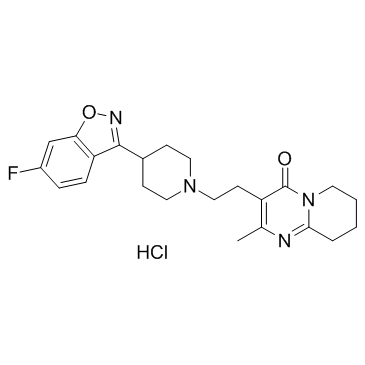
Risperidone hydrochloride (Synonyms: R 64 766 hydrochloride) |
Catalog No.GC37539
 One-Click Copy Product Info
|

Risperidone hydrochloride (R 64 766 hydrochloride) 5-HT2 receptor blocker, P-Glycoprotein inhibitor and potent dopamine D2 receptor antagonist, with Kis of 4.8, 5.9 nM for 5-HT2A and dopamine D2 receptor, respectively.
Products are for research use only. Not for human use. We do not sell to patients.
Cas No.: 666179-74-4
Sample solution is provided at 25 µL, 10mM.
_1-3.$$$39978408@51.jpg');)
_1-9.$$$38538795@65.jpg');)
_1-9.$$$39112701@51.jpg');)
_1-7.$$$37316672@70.jpg');)
_366-372.$$$36198801@70.jpg');)
.$$$38565142@65.jpg');)
_1867-1883.$$$33248023@67.jpg');)
_eads6055.$$$39977546@45.jpg');)
_eadm9805.$$$40080571@45.jpg');)
_eadj3020.$$$39666821@45.jpg');)
_1-20.$$$39757301@28.jpg');)
_1-24.$$$38898113@28.jpg');)
_273-287.$$$36806353@46.jpg');)
_1-16.$$$37156877@44.jpg');)
_1-19.$$$37460805@44.jpg');)
_1291-1307.$$$34518654@46.jpg');)
Risperidone hydrochloride is a serotonin 5-HT2 receptor blocker and a potent dopamine D2 receptor antagonist, with Kis of 0.16, 1.4 nM for 5-HT2 and D2 receptor, respectively. 5-HT2 Receptor|0.16 nM (Ki)|D2 receptor|1.4 nM (Ki)
Risperidone is serotonin 5-HT2 receptor blocker as shown by displacement of radioligand binding (Ki=0.16 nM), activity on isolated tissues (EC50=0.5 nM). Risperidone is also a potent dopamine D2 receptor antagonist as indicated by displacement of radioligand binding (Ki=1.4 nM), activity in isolated striatal slices (IC50=0.89 nM)[1]. Risperidone increases the production of IL-10 and MDC as well as the proinflammatory cytokines, such as IL-6, IL-8, and TNF-α, but decreases the production of IP-10 and IL-12[2].
Long-Evans rats receive daily subcutaneous injections of vehicle or 1 of 2 doses of risperidone (1.0 and 3.0 mg/kg per day) from postnatal Days 14 to 42. Weight gain during development is slightly yet significantly reduced in risperidone-treated rats. In the first 2 experiments, early-life Risperidone administration is associated with increased locomotor activity at 1 week post administration through approximately 9 months of age, independent of changes in weight gain[2].
[1]. Chen ML, et al. Risperidone modulates the cytokine and chemokine release of dendritic cells and induces TNF-α-directed cellapoptosis in neutrophils. Int Immunopharmacol. 2012 Jan;12(1):197-204. [2]. Bardgett ME, et al. Adult rats treated with risperidone during development are hyperactive. Exp Clin Psychopharmacol. 2013 Jun;21(3):259-67.
Animal experiment: | Rats[2]A 1.0 mg/kg dose and a higher dose (3.0 mg/kg) of Risperidone are chosen for study. Beginning on postnatal day 14, subcutaneous injections of Risperidone are performed daily until postnatal day 42. Within each study, three groups of roughly equal numbers of rats receive injections of 1.0 mg/kg of Risperidone, 3.0 mg/kg of Risperidone, or the vehicle used for the Risperidone solution as a control. Within each litter, there are 1-2 pups of the same sex that receive the same treatment. Injections of Risperidone are performed in a room just outside of the housing room. Prior to weaning, the pups are removed from the home cage and placed in a separate cage during injections[2]. |
References: [1]. Chen ML, et al. Risperidone modulates the cytokine and chemokine release of dendritic cells and induces TNF-α-directed cellapoptosis in neutrophils. Int Immunopharmacol. 2012 Jan;12(1):197-204. | |
| Cas No. | 666179-74-4 | SDF | |
| Synonyms | R 64 766 hydrochloride | ||
| Canonical SMILES | O=C1C(CCN2CCC(C3=NOC4=C3C=CC(F)=C4)CC2)=C(C)N=C5N1CCCC5.Cl | ||
| Formula | C23H28ClFN4O2 | M.Wt | 446.95 |
| Solubility | Soluble in DMSO | Storage | Store at -20°C |
| General tips | Please select the appropriate solvent to prepare the stock solution according to the
solubility of the product in different solvents; once the solution is prepared, please store it in
separate packages to avoid product failure caused by repeated freezing and thawing.Storage method
and period of the stock solution: When stored at -80°C, please use it within 6 months; when stored
at -20°C, please use it within 1 month. To increase solubility, heat the tube to 37°C and then oscillate in an ultrasonic bath for some time. |
||
| Shipping Condition | Evaluation sample solution: shipped with blue ice. All other sizes available: with RT, or with Blue Ice upon request. | ||
| Prepare stock solution | |||

|
1 mg | 5 mg | 10 mg |
| 1 mM | 2.2374 mL | 11.1869 mL | 22.3739 mL |
| 5 mM | 447.5 μL | 2.2374 mL | 4.4748 mL |
| 10 mM | 223.7 μL | 1.1187 mL | 2.2374 mL |
Step 1: Enter information below (Recommended: An additional animal making an allowance for loss during the experiment)
 g
μL
g
μL
Step 2: Enter the in vivo formulation (This is only the calculator, not formulation. Please contact us first if there is no in vivo formulation at the solubility Section.)
Calculation results:
Working concentration: mg/ml;
Method for preparing DMSO master liquid: mg drug pre-dissolved in μL DMSO ( Master liquid concentration mg/mL, Please contact us first if the concentration exceeds the DMSO solubility of the batch of drug. )
Method for preparing in vivo formulation: Take μL DMSO master liquid, next addμL PEG300, mix and clarify, next addμL Tween 80, mix and clarify, next add μL saline, mix and clarify.
Method for preparing in vivo formulation: Take μL DMSO master liquid, next add μL Corn oil, mix and clarify.
Note: 1. Please make sure the liquid is clear before adding the next solvent.
2. Be sure to add the solvent(s) in order. You must ensure that the solution obtained, in the previous addition, is a clear solution before proceeding to add the next solvent. Physical methods such as vortex, ultrasound or hot water bath can be used to aid dissolving.
3. All of the above co-solvents are available for purchase on the GlpBio website.
Quality Control & SDS
- View current batch:
- Purity: >98.00% Appearance: A solid
- COA (Certificate of Analysis)
- SDS (Safety Data Sheet)
- Datasheet
Average Rating: 5 (Based on Reviews and 25 reference(s) in Google Scholar.)