

Icariin |
Catalog No.GN10278
 One-Click Copy Product Info
|

Icariin is a flavonol glycoside.
Products are for research use only. Not for human use. We do not sell to patients.
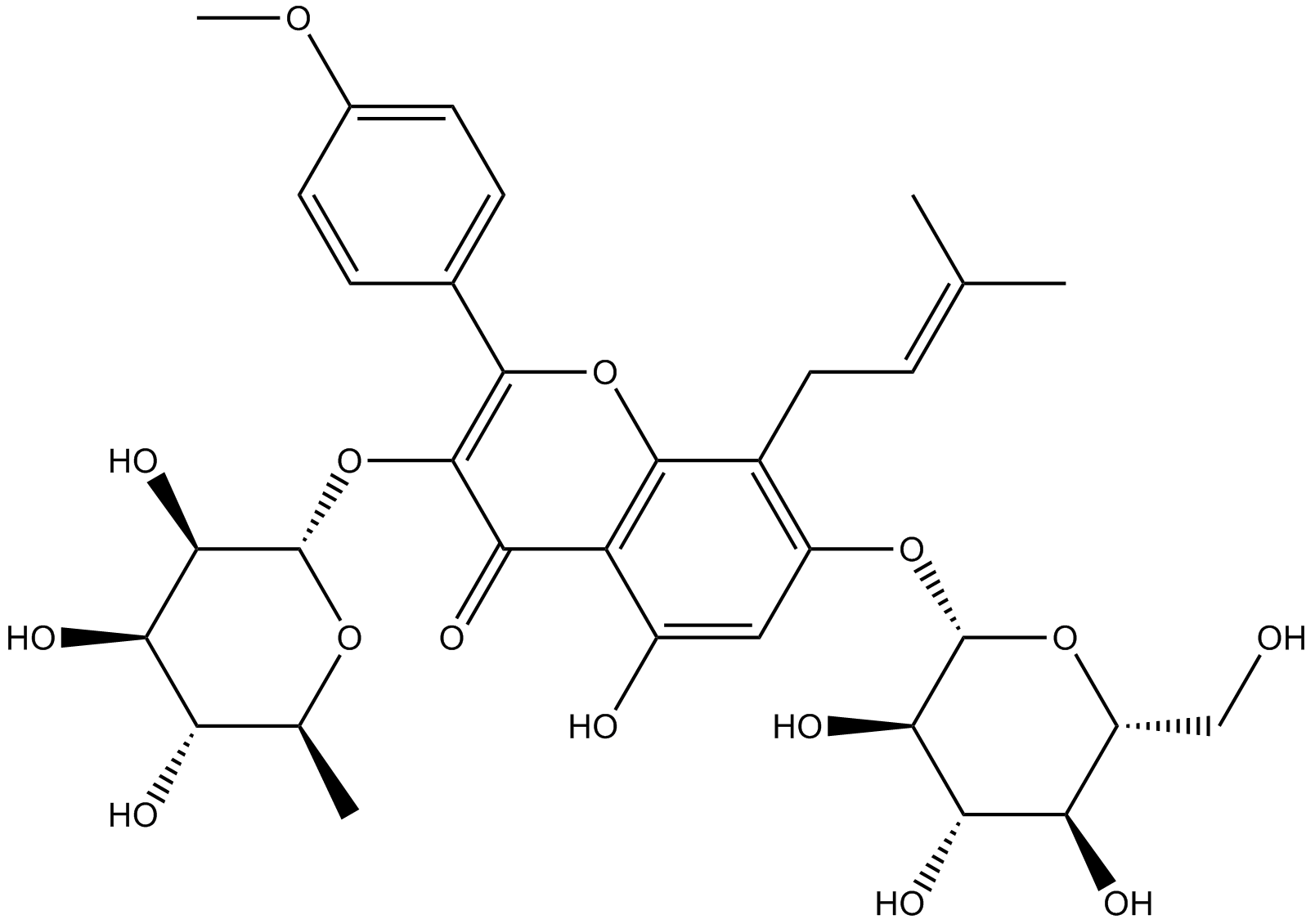
Cas No.: 489-32-7
Sample solution is provided at 25 µL, 10mM.
Icariin is a flavonol glycoside. Icariin inhibits PDE5 and PDE4 activities with IC50 of 432 nM and 73.50 μM, respectively. Icariin also is a PPARα activator[1]. It has exert anti-oxidative, anti-neuroinflammatory, and anti-apoptotic effects[2].
In vitro experiment it shown that treatment of 10 or 20 μM induced 13.1 ± 2.1% and 18.2 ± 1.6% apoptosis in MDA‐MB‐453 cells respectively in comparison with control group. 4T1 cells were treated with 20 μM icariin triggered cell apoptosis[3].
In vivo, rats were injected in 50 mg/kg Icariin significantly reduced paw swelling in carrageenan-injected animals and ameliorated carrageenan-induced paw histopathological alterations. Icariin obviously increased paw enzymatic and non-enzymatic antioxidants and decreased paw lipid peroxidation. Icariin decreased paw levels of inflammatory cytokines and NF-kB[4].
In vivo, rats were administrated with 25 mg/kg and 50 mg/kg icariin improved depression symptoms via regulation of the PI3K-AKT pathway, boosted the expression of the regulatory methylene p85 and catalytic methylene p110 of PI3K, increased the relative expression of p-AKT, and encouraged the expression of the anti-apoptosis factor Bcl-2, thus elevating the ratio of Bcl-2/Bax[5]. In vivo, C57BL/6 J mice were administrated with 50 mg/kg/d icariin effectively attenuated alcohol consumption-induced atrial structural and electrical remodeling[6].
References:
[1] Xin ZC, et al. Effects of icariin on cGMP-specific PDE5 and cAMP-specific PDE4 activities. Asian J Androl. 2003 Mar;5(1):15-8.
[2] Jin J, et al. An outline for the pharmacological effect of icariin in the nervous system. Eur J Pharmacol. 2019 Jan 5;842:20-32.
[3] Song L, et al. Icariin-induced inhibition of SIRT6/NF-κB triggers redox mediated apoptosis and enhances anti-tumor immunity in triple-negative breast cancer. Cancer Sci. 2020 Nov;111(11):4242-4256.
[4] El-Shitany NA, Eid BG. Icariin modulates carrageenan-induced acute inflammation through HO-1/Nrf2 and NF-kB signaling pathways. Biomed Pharmacother. 2019 Dec;120:109567.
[5] Cao LH, et al. PI3K-AKT Signaling Activation and Icariin: The Potential Effects on the Perimenopausal Depression-Like Rat Model. Molecules. 2019 Oct 15;24(20):3700.
[6] Yu LM, et al. Icariin attenuates excessive alcohol consumption-induced susceptibility to atrial fibrillation through SIRT3 signaling. Biochim Biophys Acta Mol Basis Dis. 2022 Oct 1;1868(10):166483.
| Cell experiment [1]: | |
|
Cell lines |
OA chondrocytes |
|
Preparation Method |
For the in vitro experiments, we sorted OA chondrocytes into six groups, with the cells in these groups being incubated with blank medium (control), 100 nM rapamycin (rapamycin), 12 mM 3-methyladenine (3-methyladenine), or 20, 40, or 80 µM icariin. AO-PI staining and flow cytometry were performed on the treated chondrocytes to evaluate apoptosis. |
|
Reaction Conditions |
20, 40, or 80 µM |
|
Applications |
Relative to the control, the apoptotic rate of OA chondrocytes showed an increase from 20.25% to 37.56% after 3-methyladenine treatment and a decrease to 11.76% and 16.12%, 12.75%, and 11.04% after treatment with rapamycin and 20, 40, and 80 µM icariin, respectively. |
| Animal experiment [2]: | |
|
Animal models |
BALB/c mice |
|
Preparation Method |
MDA‐MB‐231 tumor‐bearing mice and 4T1 tumor‐bearing mice were treated with icariin at 20 and 40 mg/kg. |
|
Dosage form |
20 and 40 mg/kg; i.p. |
|
Applications |
Treatment with icariin at 20 mg/kg or 40 mg/kg significantly inhibited MDA‐MB‐231 tumor growth and weight in a dose‐dependent manner compared with the control group. |
|
References: Tang Y, et al. Icariin alleviates osteoarthritis by regulating autophagy of chondrocytes by mediating PI3K/AKT/mTOR signaling. Bioengineered. 2021 Dec;12(1):2984-2999. |
|
| Cas No. | 489-32-7 | SDF | |
| Chemical Name | 5-hydroxy-2-(4-methoxyphenyl)-8-(3-methylbut-2-enyl)-7-[(2S,3R,4S,5S,6R)-3,4,5-trihydroxy-6-(hydroxymethyl)oxan-2-yl]oxy-3-[(2S,3R,4R,5R,6S)-3,4,5-trihydroxy-6-methyloxan-2-yl]oxychromen-4-one | ||
| Canonical SMILES | CC1C(C(C(C(O1)OC2=C(OC3=C(C2=O)C(=CC(=C3CC=C(C)C)OC4C(C(C(C(O4)CO)O)O)O)O)C5=CC=C(C=C5)OC)O)O)O | ||
| Formula | C33H40O15 | M.Wt | 676.65 |
| Solubility | ≥ 30.5mg/mL in DMSO | Storage | Store at 2-8°C |
| General tips | Please select the appropriate solvent to prepare the stock solution according to the
solubility of the product in different solvents; once the solution is prepared, please store it in
separate packages to avoid product failure caused by repeated freezing and thawing.Storage method
and period of the stock solution: When stored at -80°C, please use it within 6 months; when stored
at -20°C, please use it within 1 month. To increase solubility, heat the tube to 37°C and then oscillate in an ultrasonic bath for some time. |
||
| Shipping Condition | Evaluation sample solution: shipped with blue ice. All other sizes available: with RT, or with Blue Ice upon request. | ||
| Prepare stock solution | |||

|
1 mg | 5 mg | 10 mg |
| 1 mM | 1.4779 mL | 7.3893 mL | 14.7787 mL |
| 5 mM | 295.6 μL | 1.4779 mL | 2.9557 mL |
| 10 mM | 147.8 μL | 738.9 μL | 1.4779 mL |
Step 1: Enter information below (Recommended: An additional animal making an allowance for loss during the experiment)
 g
μL
g
μL
Step 2: Enter the in vivo formulation (This is only the calculator, not formulation. Please contact us first if there is no in vivo formulation at the solubility Section.)
Calculation results:
Working concentration: mg/ml;
Method for preparing DMSO master liquid: mg drug pre-dissolved in μL DMSO ( Master liquid concentration mg/mL, Please contact us first if the concentration exceeds the DMSO solubility of the batch of drug. )
Method for preparing in vivo formulation: Take μL DMSO master liquid, next addμL PEG300, mix and clarify, next addμL Tween 80, mix and clarify, next add μL saline, mix and clarify.
Method for preparing in vivo formulation: Take μL DMSO master liquid, next add μL Corn oil, mix and clarify.
Note: 1. Please make sure the liquid is clear before adding the next solvent.
2. Be sure to add the solvent(s) in order. You must ensure that the solution obtained, in the previous addition, is a clear solution before proceeding to add the next solvent. Physical methods such as vortex, ultrasound or hot water bath can be used to aid dissolving.
3. All of the above co-solvents are available for purchase on the GlpBio website.
Quality Control & SDS
- View current batch:
- Purity: >98.00% Appearance: A solid
- COA (Certificate of Analysis)
- SDS (Safety Data Sheet)
- Datasheet

Average Rating: 5 (Based on Reviews and 30 reference(s) in Google Scholar.)