

ISRIB |
Catalog No.GC10581
 One-Click Copy Product Info
|

ISRIB is an inhibitor of the protein kinase R-like endoplasmic reticulum kinase (PERK) signaling pathway. ISRIB effectively reverses the phosphorylation of eukaryotic translation initiation factor 2 alpha (eIF2α), with an IC50 value of 5nM.
Products are for research use only. Not for human use. We do not sell to patients.
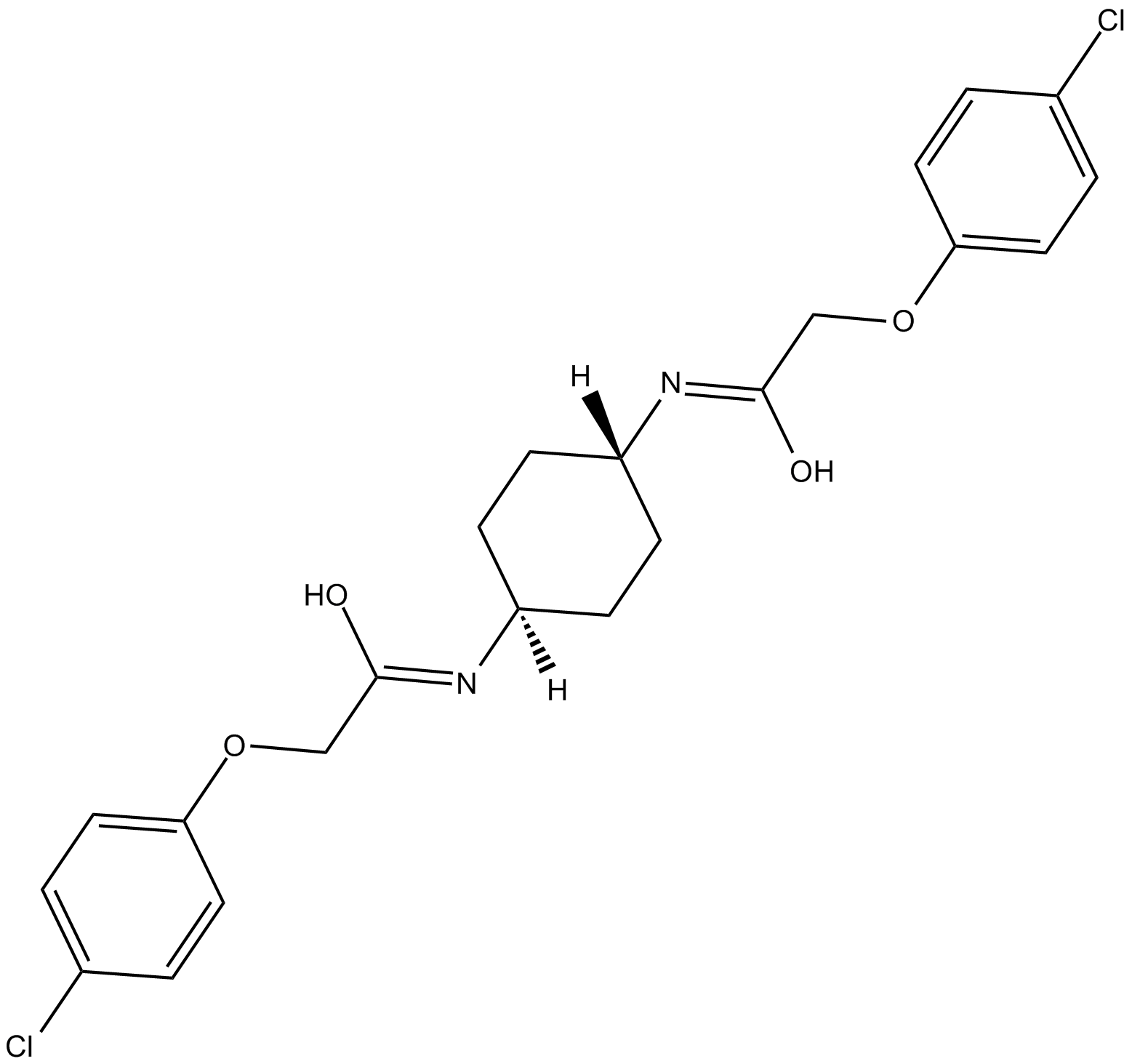
Cas No.: 548470-11-7
Sample solution is provided at 25 µL, 10mM.
ISRIB is an inhibitor of the protein kinase R-like endoplasmic reticulum kinase (PERK) signaling pathway. ISRIB effectively reverses the phosphorylation of eukaryotic translation initiation factor 2 alpha (eIF2α), with an IC50 value of 5nM[1]. ISRIB is an inhibitor of the integrated stress response (ISR), which restores protein synthesis suppressed under stress conditions by modulating eIF2α activity, thus exerting neuroprotective effects and improving cognitive function[2, 3].
In vitro, treatment of U2OS cells with ISRIB (200nM) specifically blocked the formation of stress granules (SGs) induced by eIF2α phosphorylation[4]. Pretreatment of the myeloid leukemia cell line K562 with ISRIB (0-1000nM) for 2h significantly reduced the mRNA levels of ISR markers (CHOP and GADD34)[5].
In vivo, ISRIB (2.5mg/kg) administered intraperitoneally to a mouse model of traumatic brain injury (TBI) significantly improved spatial learning and memory performance in the Morris water maze test[6]. ISRIB (0.25mg/kg) administered intraperitoneally to prion-infected mice reduced the levels of transcription factor ATF4 in the brain and partially restored protein synthesis rates, preventing hippocampal neuronal loss and reducing typical prion-related spongiform encephalopathy[7].
References:
[1] Sidrauski C, Acosta-Alvear D, Khoutorsky A, et al. Pharmacological brake-release of mRNA translation enhances cognitive memory[J]. elife, 2013, 2: e00498.
[2] Ilyin N P, Nikitin V S, Kalueff A V. The Role of the Integrated Stress Response (ISR) in Neuropsychiatric Disorders[J]. Journal of Evolutionary Biochemistry and Physiology, 2024, 60(6): 2215-2240.
[3] Costa-Mattioli M, Walter P. The integrated stress response: From mechanism to disease[J]. Science, 2020, 368(6489): eaat5314.
[4] Sidrauski C, McGeachy A M, Ingolia N T, et al. The small molecule ISRIB reverses the effects of eIF2α phosphorylation on translation and stress granule assembly[J]. elife, 2015, 4: e05033.
[5] Dudka W, Hoser G, Mondal S S, et al. Targeting integrated stress response with ISRIB combined with imatinib treatment attenuates RAS/RAF/MAPK and STAT5 signaling and eradicates chronic myeloid leukemia cells[J]. BMC cancer, 2022, 22(1): 1254.
[6] Chou A, Krukowski K, Jopson T, et al. Inhibition of the integrated stress response reverses cognitive deficits after traumatic brain injury[J]. Proceedings of the National Academy of Sciences, 2017, 114(31): E6420-E6426.
[7] Halliday M, Radford H, Sekine Y, et al. Partial restoration of protein synthesis rates by the small molecule ISRIB prevents neurodegeneration without pancreatic toxicity[J]. Cell death & disease, 2015, 6(3): e1672-e1672.
| Cell experiment [1]: | |
|
Cell lines |
U2OS cells |
|
Preparation Method |
U2OS cells were treated with 200nM thapsigargin (Tg) for 1h, 250μM arsenite (Ars) for 30min, or 100nM Pateamine A (Pat A) for 30min, either in the presence or absence of 200nM ISRIB. Immunofluorescence analysis was then performed, with eIF2α visualized using a secondary Alexa Fluor 488 anti-rabbit antibody and cell nuclei visualized using DAPI. |
|
Reaction Conditions |
200nM; 30min, 1h |
|
Applications |
ISRIB prevents formation of stress granules exclusively triggered by eIF2α phosphorylation. |
| Animal experiment [2]: | |
|
Animal models |
Male C57B6/J wild-type (WT) mice |
|
Preparation Method |
All animals were randomly assigned to undergo either sham surgery or traumatic brain injury (TBI) surgery. After surgery, the animals were returned to their cages after recovering to normal behavior in a 37°C environment. Subsequently, one day prior to the start of behavioral testing (day 27 post-injury), the sham surgery group and the TBI group were further randomly divided into a vehicle control group and an ISRIB treatment group, and administered the drug via intraperitoneal injection (ISRIB dose: 2.5mg/kg). |
|
Dosage form |
2.5mg/kg; i.p. |
|
Applications |
ISRIB treatment can effectively improve spatial learning and memory deficits occurring 28 days after focal brain injury, as well as behavioral impairments observed in the radial maze and water maze tests. |
|
References: |
|
| Cas No. | 548470-11-7 | SDF | |
| Chemical Name | (1Z,1'Z)-N',N''-((1r,4r)-cyclohexane-1,4-diyl)bis(2-(4-chlorophenoxy)acetimidic acid) | ||
| Canonical SMILES | ClC1=CC=C(OC/C(O)=N/[C@@]2([H])CC[C@@](/N=C(O)/COC3=CC=C(Cl)C=C3)([H])CC2)C=C1 | ||
| Formula | C22H24Cl2N2O4 | M.Wt | 451.34 |
| Solubility | 6 mg/mL in DMSO with gentle warming | Storage | Store at -20°C |
| General tips | Please select the appropriate solvent to prepare the stock solution according to the
solubility of the product in different solvents; once the solution is prepared, please store it in
separate packages to avoid product failure caused by repeated freezing and thawing.Storage method
and period of the stock solution: When stored at -80°C, please use it within 6 months; when stored
at -20°C, please use it within 1 month. To increase solubility, heat the tube to 37°C and then oscillate in an ultrasonic bath for some time. |
||
| Shipping Condition | Evaluation sample solution: shipped with blue ice. All other sizes available: with RT, or with Blue Ice upon request. | ||
| Prepare stock solution | |||

|
1 mg | 5 mg | 10 mg |
| 1 mM | 2.2156 mL | 11.0781 mL | 22.1562 mL |
| 5 mM | 443.1 μL | 2.2156 mL | 4.4312 mL |
| 10 mM | 221.6 μL | 1.1078 mL | 2.2156 mL |
Step 1: Enter information below (Recommended: An additional animal making an allowance for loss during the experiment)
 g
μL
g
μL
Step 2: Enter the in vivo formulation (This is only the calculator, not formulation. Please contact us first if there is no in vivo formulation at the solubility Section.)
Calculation results:
Working concentration: mg/ml;
Method for preparing DMSO master liquid: mg drug pre-dissolved in μL DMSO ( Master liquid concentration mg/mL, Please contact us first if the concentration exceeds the DMSO solubility of the batch of drug. )
Method for preparing in vivo formulation: Take μL DMSO master liquid, next addμL PEG300, mix and clarify, next addμL Tween 80, mix and clarify, next add μL saline, mix and clarify.
Method for preparing in vivo formulation: Take μL DMSO master liquid, next add μL Corn oil, mix and clarify.
Note: 1. Please make sure the liquid is clear before adding the next solvent.
2. Be sure to add the solvent(s) in order. You must ensure that the solution obtained, in the previous addition, is a clear solution before proceeding to add the next solvent. Physical methods such as vortex, ultrasound or hot water bath can be used to aid dissolving.
3. All of the above co-solvents are available for purchase on the GlpBio website.
Quality Control & SDS
- View current batch:
- Purity: >98.00% Appearance: A solid
- COA (Certificate of Analysis)
- SDS (Safety Data Sheet)
- Datasheet
Average Rating: 5 (Based on Reviews and 27 reference(s) in Google Scholar.)