

Limonin (Synonyms: di-δ-lactone Limonoic Acid) |
Catalog No.GC16589
 One-Click Copy Product Info
|

Limonin is a natural tetracyclic triterpenoid compound, which widely exists in Euodia rutaecarpa (Juss.) Benth.
Products are for research use only. Not for human use. We do not sell to patients.
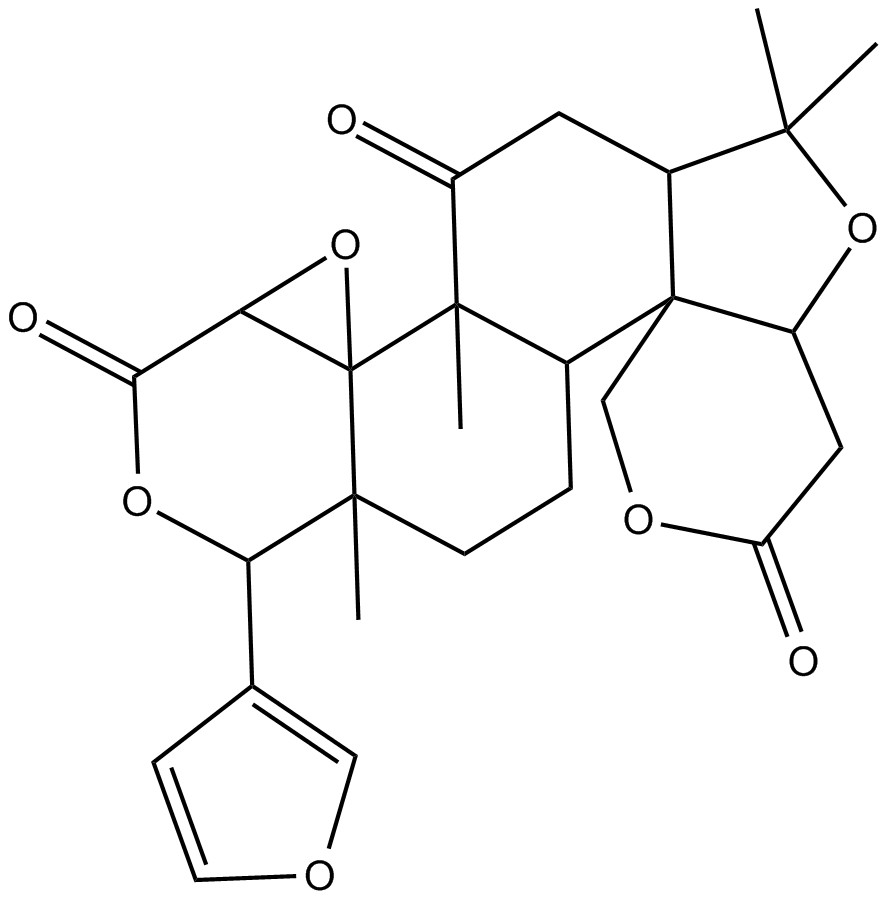
Cas No.: 1180-71-8
Sample solution is provided at 25 µL, 10mM.
_1-3.$$$39978408@51.jpg');)
_1-9.$$$38538795@65.jpg');)
_1-9.$$$39112701@51.jpg');)
_1-7.$$$37316672@70.jpg');)
_366-372.$$$36198801@70.jpg');)
.$$$38565142@65.jpg');)
_1867-1883.$$$33248023@67.jpg');)
_eads6055.$$$39977546@45.jpg');)
_eadm9805.$$$40080571@45.jpg');)
_eadj3020.$$$39666821@45.jpg');)
_1-20.$$$39757301@28.jpg');)
_1-24.$$$38898113@28.jpg');)
_273-287.$$$36806353@46.jpg');)
_1-16.$$$37156877@44.jpg');)
_1-19.$$$37460805@44.jpg');)
_1291-1307.$$$34518654@46.jpg');)
Limonin is a natural tetracyclic triterpenoid compound, which widely exists in Euodia rutaecarpa (Juss.) Benth., Phellodendron chinense Schneid., and Coptis chinensis Franch [1]. Limonin has pharmacological effects in anti-tumor, anti-inflammatory and analgesic, anti-bacterial and anti-virus, anti-oxidation, nerve protection, liver protection, and blood lipid regulation. Modern pharmacological effects indicate that limonin has value in the prevention and treatment of certain diseases, including cancer, enteritis, hepatitis, hemorrhoids, osteoporosis, obesity, anaphylactic reaction, and brain aging [2].
Limonin has an anti-hepatocarcinoma effect. In vitro, limonin inhibited the growth of hepatocellular carcinoma cell line (SMMC-7721) cells (IC50 = 24.42 μg/mL) in a concentration and time-dependent manner [3]. Limonin has certain cytotoxicity to human colon cancer (Caco-2) cells [4]. Limonin has a good antiproliferative effect on lung cancer cells A549 (IC50 = 82.5 uM) [5].
In vivo, limonin (200 mg/kg) diets inhibited cell proliferation and promoted apoptosis through suppressing the levels of both inducible nitric oxide synthase (iNOS) and cyclooxygenase-2 (COX-2) in azoxymethane (AOM)-injected rats, therefore, it was considered that limonin has the effect of inhibiting colon cancer [6]. Limonin (50 mg/kg) has excellent antioxidant and therapeutic effects on N-nitroethylenediamine (DEN)-induced hepatocarcinoma rats by suppressing lipid peroxidation (LPO) and oxidative stress-mediated free radicals generation, and through modulating antioxidants` defense mechanism [7]. Limonin significantly decreased the levels of tumor necrosis factor-α (TNF-α), interleukin (IL-1β and IL-6), and inhibited the expression of inflammatory factors in lipopolysaccharide (LPS)-induced acute lung injury mice [8].
References:
[1].Fan S, Zhang C, Luo T, et al. Limonin: A review of its pharmacology, toxicity, and pharmacokinetics[J]. Molecules, 2019, 24(20): 3679.
[2].Gualdani R, Cavalluzzi M M, Lentini G, et al. The chemistry and pharmacology of citrus limonoids[J]. Molecules, 2016, 21(11): 1530.
[3].Zhang J J, Luo G, He R L, et al. Inhibiting effects of limonin on human hepatocarcinoma cells SMMC-7721 in vitro[J]. Sichuan J. Physiolog. Sci, 2007, 29: 157-160.
[4].Qian P, Jin H W, Yang X W. New limonoids from Coptidis Rhizoma–Euodiae Fructus couple[J]. Journal of Asian natural products research, 2014, 16(4): 333-344.
[5].Bai Y, Jin X, Jia X, et al. Two new apotirucallane-type isomeric triterpenoids from the root bark of Dictamnus dasycarpus with their anti-proliferative activity[J]. Phytochemistry Letters, 2014, 10: 118-122.
[6].Vanamala J, Leonardi T, Patil B S, et al. Suppression of colon carcinogenesis by bioactive compounds in grapefruit[J]. Carcinogenesis, 2006, 27(6): 1257-1265.
[7].Langeswaran K, Kumar S G, Perumal S, et al. Limonin–A citrus limonoid, establish anticancer potential by stabilizing lipid peroxidation and antioxidant status against N-nitrosodiethylamine induced experimental hepatocellular carcinoma[J]. Biomedicine & Preventive Nutrition, 2013, 3(2): 165-171.
[8].WANG D, ZHANG H, FANG J, et al. Effects of limoninon on LPS-induced acute lung injury in mice[J]. Chinese Journal of Clinical Pharmacology and Therapeutics, 2018, 23(1): 8.
| Cell experiment [1]: | |
|
Cell lines |
Colon cancer (SW480) and fibroblast (112CoN) cells |
|
Preparation Method |
Cells were treated with different concentrations (6.25, 12.5,25,50 and 100 µM) of limonin, LG, and camptothecin after incubation for 24, 48, and 72 h; 50 µL of supernatant medium was removed without disturbing the cells, mixed with an equal volume of LDH reagent, and incubated for 30 min in the dark at ambient temperature. |
|
Reaction Conditions |
6.25, 12.5,25,50 and 100 µM for 24, 48, and 72 h |
|
Applications |
Maximum release of LDH into the medium was observed after 48 h of incubation with limonoids. |
| Animal experiment [2]: | |
|
Animal models |
Male Wistar rats |
|
Preparation Method |
Animals were randomly divided into three experimental groups (each containing eight animals): sham, ischemia/reperfusion (I/R) injury, limonin (100 mg/kg). Sham group received vehicle then anesthetized, the portal vein and bile duct exposed but not occluded. Rats of I/R group were anesthetized by i.p injection of ketamine (75 mg/kg) and subjected to partial liver ischemia (70%) followed by reperfusion. Ischemia was induced by occluding hepatic portal vein and bile duct with a traumatic vascular clamp. After 45 min of ischemia, the clamp was removed to start reperfusion for 1 h. Limonin dissolved in dimethyl sulfoxide (DMSO) then given i.p as single dose 30 min before ischemia. Blood was collected from the retro-orbital plexus and centrifuged (3000×g, 4 °C, 20 min) for separation of serum. |
|
Dosage form |
15 or 30 mg/kg, Miniature osmotic infusion pump |
|
Applications |
Rats subjected to I/R showed a marked increase in inflammatory cytokines (TNF-α) by 347.4%, and marked decrease in anti-inflammatory mediators (IL-10) in liver tissue by 54.5% as compared to sham group. Limonin treatment significantly reduced liver TNF-α by 43.8%, and increased liver IL-10 by 154.9% as compared to I/R group. |
|
References: [1]: Chidambara Murthy K N, Jayaprakasha G K, Kumar V, et al. Citrus limonin and its glucoside inhibit colon adenocarcinoma cell proliferation through apoptosis[J]. Journal of agricultural and food chemistry, 2011, 59(6): 2314-2323. |
|
| Cas No. | 1180-71-8 | SDF | |
| Synonyms | di-δ-lactone Limonoic Acid | ||
| Chemical Name | 12-(furan-3-yl)-6,6,8a,12a-tetramethyldecahydrooxireno[2,3-d]pyrano[4',3':3,3a]isobenzofuro[5,4-f]isochromene-3,8,10(1H,6H,8aH)-trione | ||
| Canonical SMILES | CC1(C2CC(=O)C3(C(C24COC(=O)CC4O1)CCC5(C36C(O6)C(=O)OC5C7=COC=C7)C)C)C | ||
| Formula | C26H30O8 | M.Wt | 470.51 |
| Solubility | ≥ 23.9 mg/mL in DMSO | Storage | Store at -20°C |
| General tips | Please select the appropriate solvent to prepare the stock solution according to the
solubility of the product in different solvents; once the solution is prepared, please store it in
separate packages to avoid product failure caused by repeated freezing and thawing.Storage method
and period of the stock solution: When stored at -80°C, please use it within 6 months; when stored
at -20°C, please use it within 1 month. To increase solubility, heat the tube to 37°C and then oscillate in an ultrasonic bath for some time. |
||
| Shipping Condition | Evaluation sample solution: shipped with blue ice. All other sizes available: with RT, or with Blue Ice upon request. | ||
| Prepare stock solution | |||

|
1 mg | 5 mg | 10 mg |
| 1 mM | 2.1254 mL | 10.6268 mL | 21.2535 mL |
| 5 mM | 425.1 μL | 2.1254 mL | 4.2507 mL |
| 10 mM | 212.5 μL | 1.0627 mL | 2.1254 mL |
Step 1: Enter information below (Recommended: An additional animal making an allowance for loss during the experiment)
 g
μL
g
μL
Step 2: Enter the in vivo formulation (This is only the calculator, not formulation. Please contact us first if there is no in vivo formulation at the solubility Section.)
Calculation results:
Working concentration: mg/ml;
Method for preparing DMSO master liquid: mg drug pre-dissolved in μL DMSO ( Master liquid concentration mg/mL, Please contact us first if the concentration exceeds the DMSO solubility of the batch of drug. )
Method for preparing in vivo formulation: Take μL DMSO master liquid, next addμL PEG300, mix and clarify, next addμL Tween 80, mix and clarify, next add μL saline, mix and clarify.
Method for preparing in vivo formulation: Take μL DMSO master liquid, next add μL Corn oil, mix and clarify.
Note: 1. Please make sure the liquid is clear before adding the next solvent.
2. Be sure to add the solvent(s) in order. You must ensure that the solution obtained, in the previous addition, is a clear solution before proceeding to add the next solvent. Physical methods such as vortex, ultrasound or hot water bath can be used to aid dissolving.
3. All of the above co-solvents are available for purchase on the GlpBio website.
Quality Control & SDS
- View current batch:
- Purity: >99.50% Appearance: A solid
- COA (Certificate of Analysis)
- SDS (Safety Data Sheet)
- Datasheet
Average Rating: 5 (Based on Reviews and 30 reference(s) in Google Scholar.)