

Marimastat (Synonyms: BB-2516, KB-R8898) |
Catalog No.GC14099
 One-Click Copy Product Info
|

Marimastat is a broad-spectrum, orally active matrix metalloproteinase (MMP) inhibitor with IC50 values ranging from 3 to 13nM.
Products are for research use only. Not for human use. We do not sell to patients.
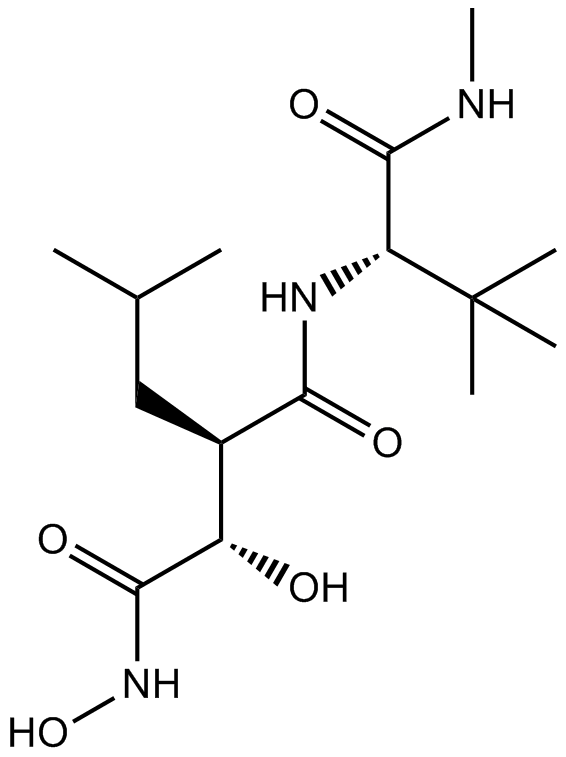
Cas No.: 154039-60-8
Sample solution is provided at 25 µL, 10mM.
_1-3.$$$39978408@51.jpg');)
_1-9.$$$38538795@65.jpg');)
_1-9.$$$39112701@51.jpg');)
_1-7.$$$37316672@70.jpg');)
_366-372.$$$36198801@70.jpg');)
.$$$38565142@65.jpg');)
_1867-1883.$$$33248023@67.jpg');)
_eads6055.$$$39977546@45.jpg');)
_eadm9805.$$$40080571@45.jpg');)
_eadj3020.$$$39666821@45.jpg');)
_1-20.$$$39757301@28.jpg');)
_1-24.$$$38898113@28.jpg');)
_273-287.$$$36806353@46.jpg');)
_1-16.$$$37156877@44.jpg');)
_1-19.$$$37460805@44.jpg');)
_1291-1307.$$$34518654@46.jpg');)
Marimastat is a broad-spectrum, orally active matrix metalloproteinase (MMP) inhibitor with IC50 values ranging from 3 to 13nM[1]. MMPs are a family of zinc-dependent proteolytic enzymes that are essential for tissue repair and remodeling, and are involved in various physiological processes including wound healing, angiogenesis, and cell migration[2]. Marimastat exerts its effects by inhibiting tumor metastasis and angiogenesis, and is commonly used in the research and treatment of pancreatic and gastric cancers[3,4].
In vitro, rat hippocampal neurons cultured in vitro on 7 days were pretreated with Marimastat (5nM, 0.5, 5, 40, and 100μM) for 30min, followed by stimulation with glutamate (50μM) for an additional 30min. Marimastat at 0.5μM inhibited MMP-9-dependent nectin-3 cleavage, while complete inhibition of nectin-3 cleavage was achieved at 5μM[5].
In vivo, C57BL/6J mice were administered Marimastat (100mg/kg; twice daily) by oral gavage for 1 week, followed by continued drug administration concomitant with CCl4 treatment for 6 weeks. Compared with the control group, the relative collagen content (hydroxyproline) in the liver increased by 25%, and the relative fibrotic area increased from 3.1% to 4.2%[6]. C57BL/6 mice fed a 60% high-fat diet for 9 weeks to induce hepatic steatosis were then treated with Marimastat (100mg/kg; twice daily) by oral gavage for 2 weeks, which significantly reduced fasting blood glucose levels[7].
References:
[1] RASMUSSEN H S, MCCANN P P. Matrix metalloproteinase inhibition as a novel anticancer strategy: a review with special focus on batimastat and marimastat[J]. Pharmacology & Therapeutics, 1997, 75(1): 69-75.
[2] NAGASE H, VISSE R, MURPHY G. Structure and function of matrix metalloproteinases and TIMPs[J]. Cardiovascular Research, 2006, 69(3): 562-573.
[3] KIMATA M, OTANI Y, KUBOTA T, et al. Matrix metalloproteinase inhibitor, marimastat, decreases peritoneal spread of gastric carcinoma in nude mice[J]. Japanese Journal of Cancer Research, 2002, 93(7): 834-841.
[4] STEWARD W P. Marimastat (BB2516): current status of development[J]. Cancer Chemotherapy and Pharmacology, 1999, 43(Suppl 1): S56-S60.
[5] PIJET B, KONOPKA A, REJMAK E, et al. The matrix metalloproteinase inhibitor marimastat inhibits seizures in a model of kainic acid-induced status epilepticus[J]. Scientific Reports, 2020, 10(1): 21314.
[6] DE MEIJER V E, SVERDLOV D Y, POPOV Y, et al. Broad-spectrum matrix metalloproteinase inhibition curbs inflammation and liver injury but aggravates experimental liver fibrosis in mice[J]. PLoS One, 2010, 5(6): e11256.
[7] DE MEIJER V E, LE H D, MEISEL J A, et al. Tumor necrosis factor α-converting enzyme inhibition reverses hepatic steatosis and improves insulin sensitivity markers and surgical outcome in mice[J]. PLoS One, 2011, 6(9): e25587.
| Cell experiment [1]: | |
Cell lines | Hippocampal neurons (cultured in vitro on 7 days (DIV7)) |
Preparation Method | Rat hippocampal neurons were pretreated with Marimastat (5nM, 0.5, 5, 40, or 100μM) for 30min and then stimulated with glutamate (50μM) for an additional 30min, after which MMP-9-dependent cleavage of nectin-3 was assessed by immunoblotting, as indicated by the accumulation of the 17kDa proteolytic fragment. |
Reaction Conditions | 5nM, 0.5, 5, 40, or 100μM; 30min and additional 30min |
Applications | 0.5μM of Marimastat can inhibit MMP-9-dependent nectin-3 cleavage, while 5μM concentration can completely inhibit nectin-3 cleavage. |
| Animal experiment [2]: | |
Animal models | C57BL/6 mice with high-fat diet-induced hepatic steatosis |
Preparation Method | C57BL/6 mice were fed a 60% high-fat diet for 9 weeks to induce hepatic steatosis, then treated with Marimastat (100mg/kg; twice daily) via orogastric gavage for 2 weeks. At the end of the feeding experiments, mice were fasted for 6h. Glucose concentration was determined from tail vein blood. |
Dosage form | 100mg/kg; twice daily; 2 weeks; i.g. |
Applications | Treatment with Marimastat significantly reduced fasting blood glucose levels in mice with high-fat diet-induced hepatic steatosis. |
References: | |
| Cas No. | 154039-60-8 | SDF | |
| Synonyms | BB-2516, KB-R8898 | ||
| Chemical Name | (2R,3S)-N-[(2S)-3,3-dimethyl-1-(methylamino)-1-oxobutan-2-yl]-N',3-dihydroxy-2-(2-methylpropyl)butanediamide | ||
| Canonical SMILES | CC(C)CC(C(C(=O)NO)O)C(=O)NC(C(=O)NC)C(C)(C)C | ||
| Formula | C15H29N3O5 | M.Wt | 331.41 |
| Solubility | ≥ 80.1 mg/mL in DMSO, ≥ 20.43 mg/mL in EtOH, ≥ 2.8 mg/mL in Water with ultrasonic and warming | Storage | Store at -20°C |
| General tips | Please select the appropriate solvent to prepare the stock solution according to the
solubility of the product in different solvents; once the solution is prepared, please store it in
separate packages to avoid product failure caused by repeated freezing and thawing.Storage method
and period of the stock solution: When stored at -80°C, please use it within 6 months; when stored
at -20°C, please use it within 1 month. To increase solubility, heat the tube to 37°C and then oscillate in an ultrasonic bath for some time. |
||
| Shipping Condition | Evaluation sample solution: shipped with blue ice. All other sizes available: with RT, or with Blue Ice upon request. | ||
| Prepare stock solution | |||

|
1 mg | 5 mg | 10 mg |
| 1 mM | 3.0174 mL | 15.0871 mL | 30.1741 mL |
| 5 mM | 603.5 μL | 3.0174 mL | 6.0348 mL |
| 10 mM | 301.7 μL | 1.5087 mL | 3.0174 mL |
Step 1: Enter information below (Recommended: An additional animal making an allowance for loss during the experiment)
 g
μL
g
μL
Step 2: Enter the in vivo formulation (This is only the calculator, not formulation. Please contact us first if there is no in vivo formulation at the solubility Section.)
Calculation results:
Working concentration: mg/ml;
Method for preparing DMSO master liquid: mg drug pre-dissolved in μL DMSO ( Master liquid concentration mg/mL, Please contact us first if the concentration exceeds the DMSO solubility of the batch of drug. )
Method for preparing in vivo formulation: Take μL DMSO master liquid, next addμL PEG300, mix and clarify, next addμL Tween 80, mix and clarify, next add μL saline, mix and clarify.
Method for preparing in vivo formulation: Take μL DMSO master liquid, next add μL Corn oil, mix and clarify.
Note: 1. Please make sure the liquid is clear before adding the next solvent.
2. Be sure to add the solvent(s) in order. You must ensure that the solution obtained, in the previous addition, is a clear solution before proceeding to add the next solvent. Physical methods such as vortex, ultrasound or hot water bath can be used to aid dissolving.
3. All of the above co-solvents are available for purchase on the GlpBio website.
Quality Control & SDS
- View current batch:
- Purity: >98.00% Appearance: A solid
- COA (Certificate of Analysis)
- SDS (Safety Data Sheet)
- Datasheet
Average Rating: 5 (Based on Reviews and 30 reference(s) in Google Scholar.)