

MONNA |
Catalog No.GC18358
 One-Click Copy Product Info
|

MONNA is a specific blocker of ANO1 (anoctamin-1/TMEM16A) calcium-activated chloride channels, with an IC50 of 0.08μM for xANO1 in Xenopus laevis oocytes.
Products are for research use only. Not for human use. We do not sell to patients.
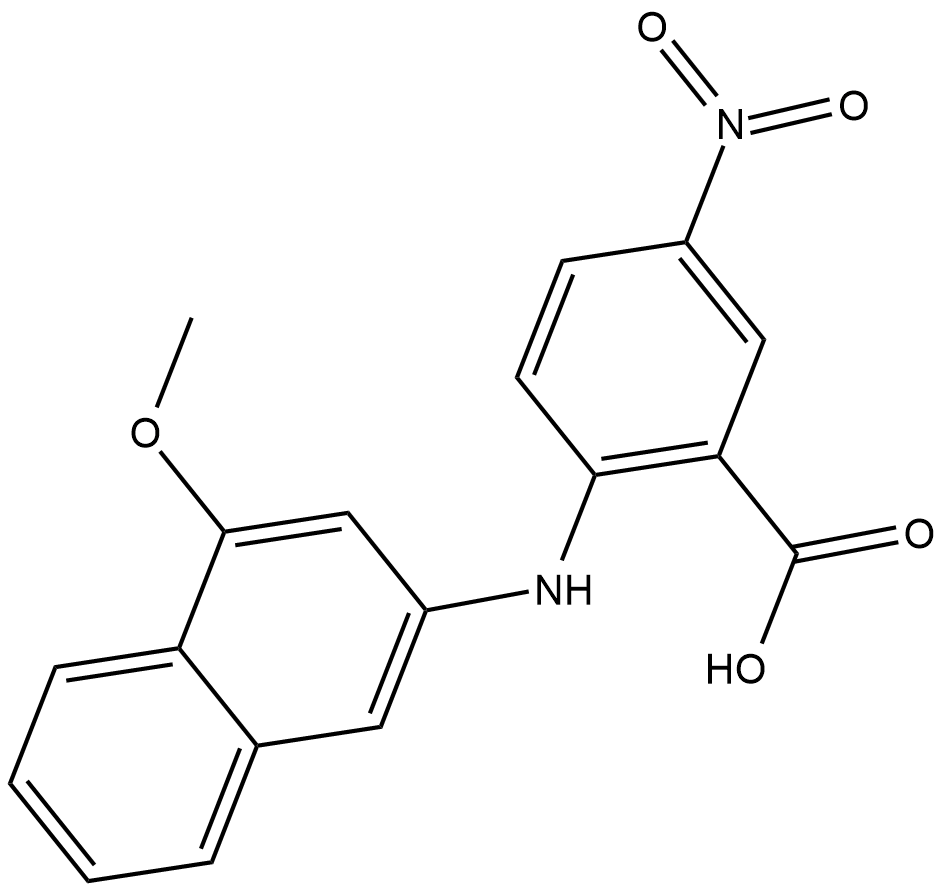
Cas No.: 1572936-83-4
Sample solution is provided at 25 µL, 10mM.
_1-3.$$$39978408@51.jpg');)
_1-9.$$$38538795@65.jpg');)
_1-9.$$$39112701@51.jpg');)
_1-7.$$$37316672@70.jpg');)
_366-372.$$$36198801@70.jpg');)
.$$$38565142@65.jpg');)
_1867-1883.$$$33248023@67.jpg');)
_eads6055.$$$39977546@45.jpg');)
_eadm9805.$$$40080571@45.jpg');)
_eadj3020.$$$39666821@45.jpg');)
_1-20.$$$39757301@28.jpg');)
_1-24.$$$38898113@28.jpg');)
_273-287.$$$36806353@46.jpg');)
_1-16.$$$37156877@44.jpg');)
_1-19.$$$37460805@44.jpg');)
_1291-1307.$$$34518654@46.jpg');)
MONNA is a specific blocker of ANO1 (anoctamin-1/TMEM16A) calcium-activated chloride channels, with an IC50 of 0.08μM for xANO1 in Xenopus laevis oocytes[1]. MONNA modulates epithelial chloride transport and smooth muscle contraction by selectively blocking ANO1-mediated chloride currents[2]. MONNA is commonly used in research on diseases such as hypertension, cystic fibrosis, bronchitis, asthma, and hyperalgesia[3][4].
In vitro, MONNA (1μM; 30s) caused reproducible elevations in intracellular Ca2+ concentration in isolated mouse bronchial smooth muscle cells[5].
In vivo, MONNA (1μM; 30min perfusion) reversed the U46619-induced decrease in coronary flow in Langendorff-perfused rat hearts[6]. MONNA (10μg/day; 3 days; starting on day 4 after SNL; intrathecal injection) reduced SNL-induced up-regulation of anoctamin-1, ATF-3, and caspase-3 protein expression in injured L5 dorsal root ganglia of rats[7].
References:
[1] Oh SJ, Hwang SJ, Jung J, et al. MONNA, a potent and selective blocker for transmembrane protein with unknown function 16/anoctamin-1. Mol Pharmacol. 2013;84(5):726-735.
[2] Liu Y, Liu Z, Wang K. The Ca2+-activated chloride channel ANO1/TMEM16A: An emerging therapeutic target for epithelium-originated diseases?. Acta Pharm Sin B. 2021;11(6):1412-1433.
[3] Galietta LJV. TMEM16A (ANO1) as a therapeutic target in cystic fibrosis. Curr Opin Pharmacol. 2022;64:102206.
[4] Boedtkjer DM, Kim S, Jensen AB, Matchkov VM, Andersson KE. New selective inhibitors of calcium-activated chloride channels - T16A(inh) -A01, CaCC(inh) -A01 and MONNA - what do they inhibit?. Br J Pharmacol. 2015;172(16):4158-4172.
[5] Dwivedi R, Drumm BT, Alkawadri T, et al. The TMEM16A blockers benzbromarone and MONNA cause intracellular Ca2+-release in mouse bronchial smooth muscle cells. Eur J Pharmacol. 2023;947:175677.
[6] Askew Page HR, Dalsgaard T, Baldwin SN, et al. TMEM16A is implicated in the regulation of coronary flow and is altered in hypertension. Br J Pharmacol. 2019;176(11):1635-1648.
[7] García G, Martínez-Rojas VA, Oviedo N, Murbartián J. Blockade of anoctamin-1 in injured and uninjured nerves reduces neuropathic pain. Brain Res. 2018;1696:38-48.
| Cell experiment [1]: | |
Cell lines | Single airway smooth muscle cells |
Preparation Method | Single airway smooth muscle cells were isolated using a collagenase/proteinase mixture consisting of (per 5mL of Hanks Ca2+-free solution): 15mg/ml of collagenase (type II), 10mg/ml bovine serum albumin, 10mg/ml trypsin inhibitor and 1mg/ml proteinase. In order to examine the effects of MONNA on cytosolic [Ca2+] in isolated cells, MONNA (1μM) was applied three times for 30s. Cells were plated and incubated in 0.4μM fluo-4AM (Molecular Probes) for 6–8min at room temperature in Hank’s Ca2+-free solution to which 100μM Ca2+ was added. During experiments, dishes containing cells were continuously perfused with Hanks solution (Solution C) at 35±2℃. Additionally, the cell under study was continuously superfused with Hanks solution by means of a custom built close delivery system with a pipette tip diameter of 200μm placed approximately 300μm from the cell. The Hanks solution in the close delivery system could be switched to a drug-containing solution with a dead-space time of less than 5s. Cells were imaged using an iXon 887 EMCCD camera coupled to a Nipkow spinning disk confocal head. |
Reaction Conditions | 1μM; 30s |
Applications | MONNA caused reproducible elevations in intracellular Ca2+ concentration in isolated mouse bronchial smooth muscle cells. |
| Animal experiment [2]: | |
Animal models | Female Wistar rats |
Preparation Method | Female Wistar rats of 130-150g of weight (6-7 weeks) were housed in cages on a standard 12/12h light/dark cycle and had free access to food and water before experiments. Rats were sacrificed in a CO2 chamber at the end of experiments. Neuropathic pain was induced by L5/L6 spinal nerve ligation [SNL]. In order to determine the effect of MONNA in nerve injuryinduced neuropathic pain, rats were treated with MONNA (1-10μg; i.t.) or vehicle (1% or 15% DMSO; i.t.) daily for 3 days, starting on day 4 after nerve injury (SNL). Then, tactile allodynia was assessed from 7 to 21 days after injury. |
Dosage form | 1-10μg/day; 3 days; starting on day 4 after SNL; intrathecal injection |
Applications | MONNA reverted SNL-induced tactile allodynia in a dose-dependent manner in injured L5 dorsal root ganglia of rats. |
References: | |
| Cas No. | 1572936-83-4 | SDF | |
| Chemical Name | 2-[(4-methoxy-2-naphthalenyl)amino]-5-nitro-benzoic acid | ||
| Canonical SMILES | COC1=CC(NC2=C(C(O)=O)C=C([N+]([O-])=O)C=C2)=CC3=CC=CC=C31 | ||
| Formula | C18H14N2O5 | M.Wt | 338.3 |
| Solubility | DMF: 30 mg/ml,DMSO: 30 mg/ml,DMSO:PBS(pH 7.2) (1:3): 0.25 mg/ml,Ethanol: slightly soluble | Storage | Store at -20°C |
| General tips | Please select the appropriate solvent to prepare the stock solution according to the
solubility of the product in different solvents; once the solution is prepared, please store it in
separate packages to avoid product failure caused by repeated freezing and thawing.Storage method
and period of the stock solution: When stored at -80°C, please use it within 6 months; when stored
at -20°C, please use it within 1 month. To increase solubility, heat the tube to 37°C and then oscillate in an ultrasonic bath for some time. |
||
| Shipping Condition | Evaluation sample solution: shipped with blue ice. All other sizes available: with RT, or with Blue Ice upon request. | ||
| Prepare stock solution | |||

|
1 mg | 5 mg | 10 mg |
| 1 mM | 2.956 mL | 14.7798 mL | 29.5596 mL |
| 5 mM | 591.2 μL | 2.956 mL | 5.9119 mL |
| 10 mM | 295.6 μL | 1.478 mL | 2.956 mL |
Step 1: Enter information below (Recommended: An additional animal making an allowance for loss during the experiment)
 g
μL
g
μL
Step 2: Enter the in vivo formulation (This is only the calculator, not formulation. Please contact us first if there is no in vivo formulation at the solubility Section.)
Calculation results:
Working concentration: mg/ml;
Method for preparing DMSO master liquid: mg drug pre-dissolved in μL DMSO ( Master liquid concentration mg/mL, Please contact us first if the concentration exceeds the DMSO solubility of the batch of drug. )
Method for preparing in vivo formulation: Take μL DMSO master liquid, next addμL PEG300, mix and clarify, next addμL Tween 80, mix and clarify, next add μL saline, mix and clarify.
Method for preparing in vivo formulation: Take μL DMSO master liquid, next add μL Corn oil, mix and clarify.
Note: 1. Please make sure the liquid is clear before adding the next solvent.
2. Be sure to add the solvent(s) in order. You must ensure that the solution obtained, in the previous addition, is a clear solution before proceeding to add the next solvent. Physical methods such as vortex, ultrasound or hot water bath can be used to aid dissolving.
3. All of the above co-solvents are available for purchase on the GlpBio website.
Quality Control & SDS
- View current batch:
- Purity: >98.00% Appearance: A solid
- COA (Certificate of Analysis)
- SDS (Safety Data Sheet)
- Datasheet
Average Rating: 5 (Based on Reviews and 13 reference(s) in Google Scholar.)