

Perifosine (Synonyms: NSC639966;KRX-0401;KRX0401;D-21266;D21266) |
Catalog No.GC15680
 One-Click Copy Product Info
|

Perifosine is an inhibitor of Akt .
Products are for research use only. Not for human use. We do not sell to patients.
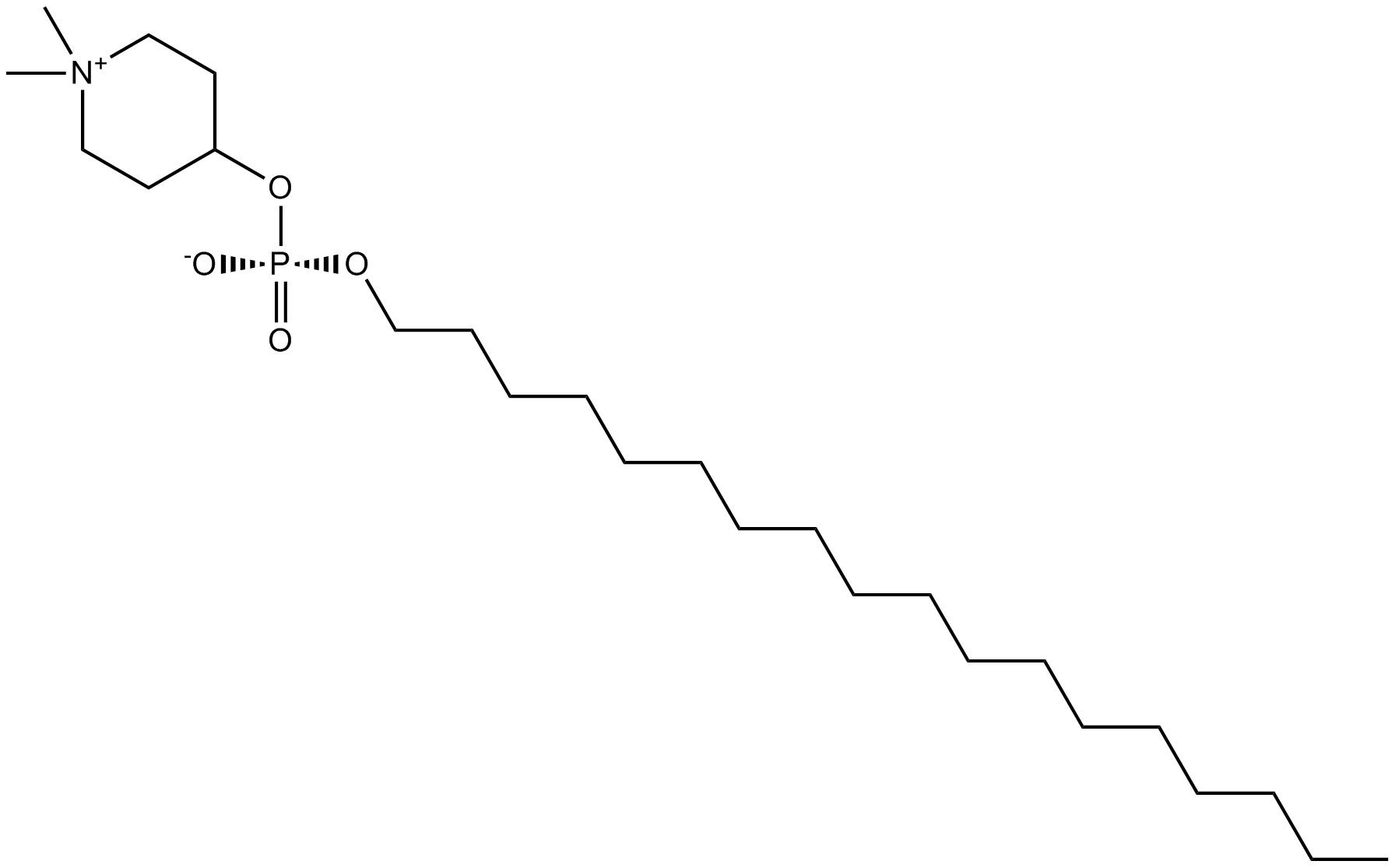
Cas No.: 157716-52-4
Sample solution is provided at 25 µL, 10mM.
Perifosine is an inhibitor of Akt [1].
Perifosine is a synthetic antitumor alkylphospholipid. It induces cell apoptosis through inhibiting the activity of Akt. Perifosine shows antitumor activity in various cell lines including NSCLC, MM, epithelial carcinoma, prostate carcinoma and leukemia cells. In H460 cells, perifosine decreased cell survival and induced apoptosis with IC50 values of 1μM and 10 μM, respectively. The treatment of perifosine was also found to induce cleavage of caspase-8, caspase-9, caspase-3 and PARP in this cell line. In MM.1S cells, perifosine induced sub-G1 phase population increase from 15% to 57% at 10 μM and induced cleavage of caspase-8, caspase-9 and PARP in a dose-dependent manner. In mice inoculated with MM.1S cells, oral administration of perifosine significantly reduced MM tumor growth and increased survival [1, 2].
References:
[1] Elrod H A, Lin Y D, Yue P, et al. The alkylphospholipid perifosine induces apoptosis of human lung cancer cells requiring inhibition of Akt and activation of the extrinsic apoptotic pathway. Molecular cancer therapeutics, 2007, 6(7): 2029-2038.
[2] Hideshima T, Catley L, Yasui H, et al. Perifosine, an oral bioactive novel alkylphospholipid, inhibits Akt and induces in vitro and in vivo cytotoxicity in human multiple myeloma cells. Blood, 2006, 107(10): 4053-4062.
| Cell experiment: [1] | |
|
Cell lines |
CRW22RV1 cells |
|
Preparation method |
Cells (1.2×10⁵) were seeded in 6-cm diameter dishes and incubated overnight to allow the cells to attach. Cells were then treated with perifosine and immediately thereafter with 6 Gy of radiation. To assess the effect of perifosine on radiation-induced apoptosis, the Annexin-FITC based flow cytometry analysis was used. Both nuclear fragmentations with PI staining and translocated membrane phosphatidylserine (PS) with Annexin V staining were measured. |
|
Reaction Conditions |
10 μM, 24 hours |
|
Applications |
Both perifosine and radiation induced significant apoptotic responses as shown by the increase of apoptotic cells. When radiation (6Gy) and perifosine (10 μM) were combined, the number of apoptotic cells was significantly increased. Perifosine alone did not induce cell cycle arrest at the G2/M phases and perifosine did not affect the IR-induced G2/M checkpoint. |
| Animal experiment: [1] | |
|
Animal models |
Male Athymic Nude-Foxn1nu mice injected with CRW22RV1 cells |
|
Dosage form |
Oral administration, in a loading dose of 300 mg/kg (2 × 150 mg/kg separated by 12 hours) followed by daily maintenance doses of 35 mg/kg for 5 days |
|
Applications |
Mice were separated into 4 groups: control, perifosine, radiotherapy and combined therapy. Perifosine alone did not have a significant effect on tumor growth. However, perifosine can significantly increase radiation induced tumor growth delay. To reach the 10-fold size of tumor volume to the initial volume in the control, it took 15, 19, 41 and 59 days in control, perifosine only, radiation only and combined treatment groups, respectively. It is noted that the combined treatment led to a complete remission of the CWR22RV1 tumor. |
|
Other notes |
Please test the solubility of all compounds indoor, and the actual solubility may slightly differ with the theoretical value. This is caused by an experimental system error and it is normal. |
|
References: [1] Gao Y, Ishiyama H, Sun M, et al. The alkylphospholipid, perifosine, radiosensitizes prostate cancer cells both in vitro and in vivo. Radiation oncology (London, England), 2011, 6: 39. |
|
| Cas No. | 157716-52-4 | SDF | |
| Synonyms | NSC639966;KRX-0401;KRX0401;D-21266;D21266 | ||
| Chemical Name | (1,1-dimethylpiperidin-1-ium-4-yl) octadecyl phosphate | ||
| Canonical SMILES | CCCCCCCCCCCCCCCCCCOP(=O)([O-])OC1CC[N+](CC1)(C)C | ||
| Formula | C25H52NO4P | M.Wt | 461.67 |
| Solubility | Water : ≥ 153.33 mg/mL (332.13 mM); Ethanol : 92 mg/mL (199.28 mM) | Storage | Store at -20°C |
| General tips | Please select the appropriate solvent to prepare the stock solution according to the
solubility of the product in different solvents; once the solution is prepared, please store it in
separate packages to avoid product failure caused by repeated freezing and thawing.Storage method
and period of the stock solution: When stored at -80°C, please use it within 6 months; when stored
at -20°C, please use it within 1 month. To increase solubility, heat the tube to 37°C and then oscillate in an ultrasonic bath for some time. |
||
| Shipping Condition | Evaluation sample solution: shipped with blue ice. All other sizes available: with RT, or with Blue Ice upon request. | ||
| Prepare stock solution | |||

|
1 mg | 5 mg | 10 mg |
| 1 mM | 2.166 mL | 10.8302 mL | 21.6605 mL |
| 5 mM | 433.2 μL | 2.166 mL | 4.3321 mL |
| 10 mM | 216.6 μL | 1.083 mL | 2.166 mL |
Step 1: Enter information below (Recommended: An additional animal making an allowance for loss during the experiment)
 g
μL
g
μL
Step 2: Enter the in vivo formulation (This is only the calculator, not formulation. Please contact us first if there is no in vivo formulation at the solubility Section.)
Calculation results:
Working concentration: mg/ml;
Method for preparing DMSO master liquid: mg drug pre-dissolved in μL DMSO ( Master liquid concentration mg/mL, Please contact us first if the concentration exceeds the DMSO solubility of the batch of drug. )
Method for preparing in vivo formulation: Take μL DMSO master liquid, next addμL PEG300, mix and clarify, next addμL Tween 80, mix and clarify, next add μL saline, mix and clarify.
Method for preparing in vivo formulation: Take μL DMSO master liquid, next add μL Corn oil, mix and clarify.
Note: 1. Please make sure the liquid is clear before adding the next solvent.
2. Be sure to add the solvent(s) in order. You must ensure that the solution obtained, in the previous addition, is a clear solution before proceeding to add the next solvent. Physical methods such as vortex, ultrasound or hot water bath can be used to aid dissolving.
3. All of the above co-solvents are available for purchase on the GlpBio website.
Quality Control & SDS
- View current batch:
- Purity: >98.00% Appearance: A solid
- COA (Certificate of Analysis)
- SDS (Safety Data Sheet)
- Datasheet
Average Rating: 5 (Based on Reviews and 24 reference(s) in Google Scholar.)