

RG7388 (Synonyms: RG 7388; RG-7388; ldasanutlin; Ro 5503781) |
Catalog No.GC11594
 One-Click Copy Product Info
|

RG7388 is an orally active MDM2 antagonist (IC50=6nM) that activates the p53 pathway by inhibiting the MDM2-p53 interaction.
Products are for research use only. Not for human use. We do not sell to patients.
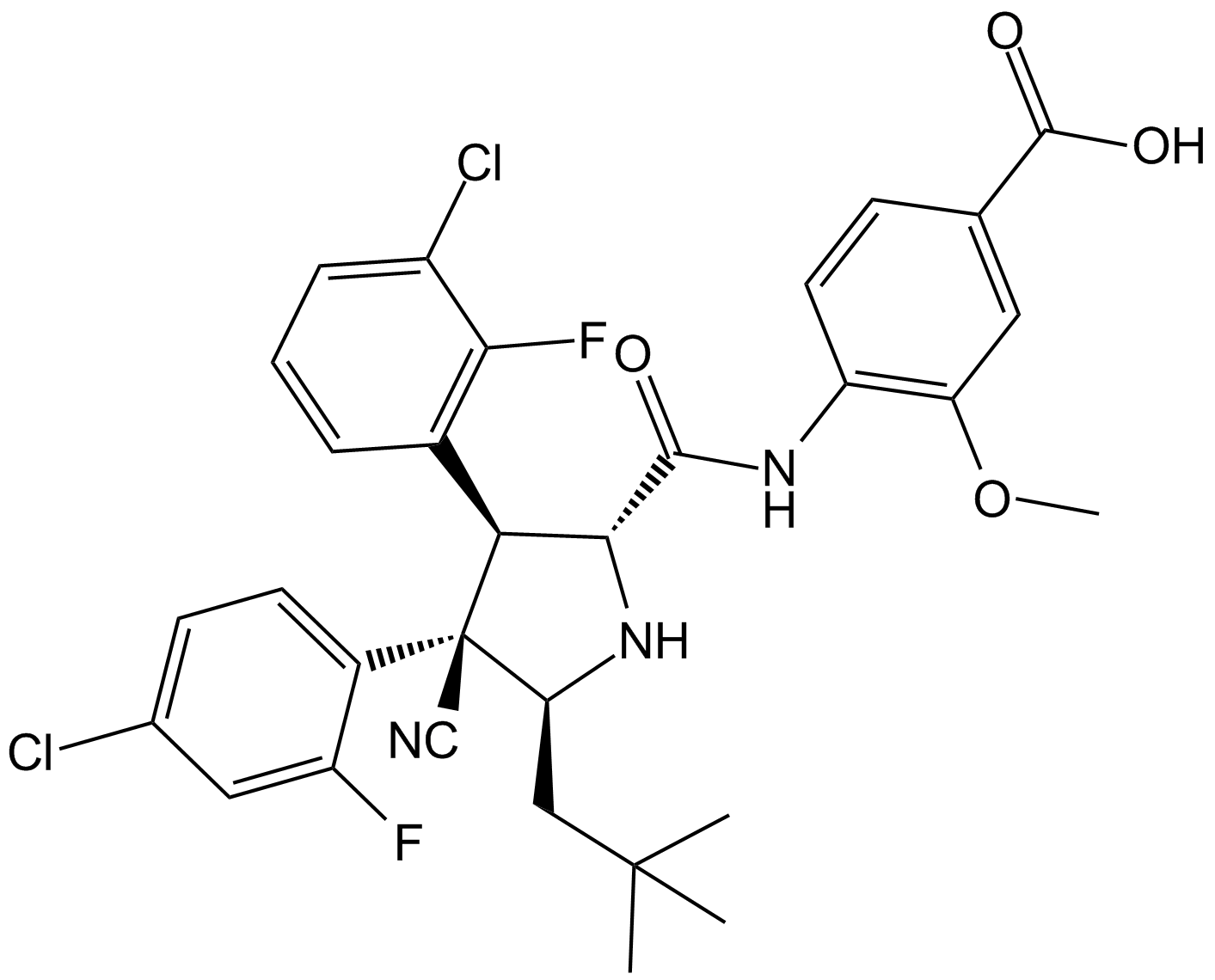
Cas No.: 1229705-06-9
Sample solution is provided at 25 µL, 10mM.
_1-3.$$$39978408@51.jpg');)
_1-9.$$$38538795@65.jpg');)
_1-9.$$$39112701@51.jpg');)
_1-7.$$$37316672@70.jpg');)
_366-372.$$$36198801@70.jpg');)
.$$$38565142@65.jpg');)
_1867-1883.$$$33248023@67.jpg');)
_eads6055.$$$39977546@45.jpg');)
_eadm9805.$$$40080571@45.jpg');)
_eadj3020.$$$39666821@45.jpg');)
_1-20.$$$39757301@28.jpg');)
_1-24.$$$38898113@28.jpg');)
_273-287.$$$36806353@46.jpg');)
_1-16.$$$37156877@44.jpg');)
_1-19.$$$37460805@44.jpg');)
_1291-1307.$$$34518654@46.jpg');)
RG7388 is an orally active MDM2 antagonist (IC50=6nM) that activates the p53 pathway by inhibiting the MDM2-p53 interaction[1-2]. RG7388 can induce cell cycle arrest to reduce tumor cell proliferation and is applicable for research related to acute myeloid leukemia and solid tumors[3-4].
In vitro, treatment of TP53 wild-type T-cell acute lymphoblastic leukemia (T-ALL) cell line MOLT-3 with RG7388 (0-90nM) for 24-72 hours, RG7388 induced p53-dependent stabilization and accumulation of p53 protein, upregulated the expression of the pro-apoptotic BH3 domain genes BAX and BBC3 (PUMA), and increased caspase-3/7 activity and apoptosis[5]. Treatment of colorectal cancer (CRC) cell lines HCT116 and RKO with RG7388 (1µM) for 24 hours, RG7388 induced p53 protein accumulation. In combination with the HSP90 inhibitor Ganetespib (50nM), RG7388 synergistically reduced cell viability and confluence, and increased cell death and PARP-1 cleavage[6].
In vivo, oral co-administration of RG7388 (40-75mg/kg) with the ALK inhibitor Lorlatinib (10mg/kg) in ALK-amplified neuroblastoma PDX model (GR-NB4) mice (5 times per week for 2-3 weeks) leads to complete tumor regression. The combination therapy enhances apoptotic effects in vivo by activating the p53-BAX pathway[7]. Oral administration of RG7388 (25mg/kg/day) to tumor-bearing (KCNR or KP-N-YN cells) mice (once daily for 3 weeks), RG7388 significantly inhibits tumor growth as a monotherapy. In combination with the BCL-2 inhibitor Venetoclax (100mg/kg), RG7388 induces complete remission or partial tumor regression and significantly delays tumor recurrence[8].
References:
[1] Higgins B, Glenn K, Walz A, et al. Preclinical optimization of MDM2 antagonist scheduling for cancer treatment by using a model-based approach. Clin Cancer Res. 2014 Jul 15;20(14):3742-52.
[2] Ding Q, Zhang Z, Liu JJ, et al. Discovery of RG7388, a potent and selective p53-MDM2 inhibitor in clinical development. J Med Chem. 2013 Jul 25;56(14):5979-83.
[3] Corbali MO, Eskazan AE. Idasanutlin as a new treatment option in improving the therapeutic odyssey of relapsed/refractory AML. Future Oncol. 2020 May;16(14):887-889.
[4] Mascarenhas J, Lu M, Kosiorek H, et al. Oral idasanutlin in patients with polycythemia vera. Blood. 2019 Aug 8;134(6):525-533.
[5] Johansson KB, Zimmerman MS, Dmytrenko IV, et al. Idasanutlin and navitoclax induce synergistic apoptotic cell death in T-cell acute lymphoblastic leukemia. Leukemia. 2023 Dec;37(12):2356-2366.
[6] Isermann T, Schneider KL, Wegwitz F, et al. Enhancement of colorectal cancer therapy through interruption of the HSF1-HSP90 axis by p53 activation or cell cycle inhibition. Cell Death Differ. 2025 Sep;32(9):1734-1749.
[7] Tucker ER, Jiménez I, Chen L, et al. Combination Therapies Targeting ALK-aberrant Neuroblastoma in Preclinical Models. Clin Cancer Res. 2023 Apr 3;29(7):1317-1331.
[8] Vernooij L, Bate-Eya LT, Alles LK, et al. High-Throughput Screening Identifies Idasanutlin as a Resensitizing Drug for Venetoclax-Resistant Neuroblastoma Cells. Mol Cancer Ther. 2021 Jun;20(6):1161-1172.
| Cell experiment [1]: | |
Cell lines | MOLT-3 cells (human T-cell acute lymphoblastic leukemia cell line) and patient-derived xenograft (PDX) T-ALL cells |
Preparation Method | MOLT-3 cells were maintained in RPMI-1640 medium supplemented with 10% heat-inactivated fetal bovine serum (FBS) at 37°C, 5% CO₂. Isogenic control and TP53 knockout MOLT-3 cells were treated with RG7388 at concentrations of 30–90nM for 24–72hours. |
Reaction Conditions | 30–90nM; 24-72 hours. |
Applications | RG7388 significantly induced p53 protein stabilization and accumulation in TP53-wildtype MOLT-3 cells, leading to upregulation of pro-apoptotic genes BAX and BBC3 (PUMA) at RNA and protein levels. RG7388 treatment resulted in increased caspase-3/7 activity and apoptosis in a p53-dependent manner. |
| Animal experiment [2]: | |
Animal models | Th-ALKF1174L/MYCN genetically engineered mouse model (GEMM) and patient-derived xenograft (PDX) models (GR-NB4, IC-pPDX-112, HSJD-NB-012) |
Preparation Method | Tumor-bearing mice were treated with RG7388 orally at 40-75mg/kg daily on a 5-days-on/2-days-off schedule for 14-21 days, either alone or in combination with Lorlatinib (10mg/kg). Tumor volume was monitored by MRI or caliper measurements. |
Dosage form | 40-75mg/kg; oral gavage; Daily administration (5 days/week for 2-3 weeks). |
Applications | RG7388 monotherapy showed modest tumor growth inhibition in 3 of 4 PDX models, with complete resistance observed in an ETP-ALL model. However, RG7388 combined with Lorlatinib resulted in complete tumor regression in ALK-amplified GR-NB4 PDX models and significantly delayed tumor regrowth across multiple neuroblastoma models. |
References: | |
| Cas No. | 1229705-06-9 | SDF | |
| Synonyms | RG 7388; RG-7388; ldasanutlin; Ro 5503781 | ||
| Chemical Name | 4-[[(2R,3S,4R,5S)-3-(3-chloro-2-fluorophenyl)-4-(4-chloro-2-fluorophenyl)-4-cyano-5-(2,2-dimethylpropyl)pyrrolidine-2-carbonyl]amino]-3-methoxybenzoic acid | ||
| Canonical SMILES | CC(C)(C)CC1C(C(C(N1)C(=O)NC2=C(C=C(C=C2)C(=O)O)OC)C3=C(C(=CC=C3)Cl)F)(C#N)C4=C(C=C(C=C4)Cl)F | ||
| Formula | C31H29Cl2F2N3O4 | M.Wt | 616.48 |
| Solubility | ≥ 30.824 mg/mL in DMSO, ≥ 6.96 mg/mL in EtOH with gentle warming | Storage | Store at -20°C |
| General tips | Please select the appropriate solvent to prepare the stock solution according to the
solubility of the product in different solvents; once the solution is prepared, please store it in
separate packages to avoid product failure caused by repeated freezing and thawing.Storage method
and period of the stock solution: When stored at -80°C, please use it within 6 months; when stored
at -20°C, please use it within 1 month. To increase solubility, heat the tube to 37°C and then oscillate in an ultrasonic bath for some time. |
||
| Shipping Condition | Evaluation sample solution: shipped with blue ice. All other sizes available: with RT, or with Blue Ice upon request. | ||
| Prepare stock solution | |||

|
1 mg | 5 mg | 10 mg |
| 1 mM | 1.6221 mL | 8.1106 mL | 16.2211 mL |
| 5 mM | 324.4 μL | 1.6221 mL | 3.2442 mL |
| 10 mM | 162.2 μL | 811.1 μL | 1.6221 mL |
Step 1: Enter information below (Recommended: An additional animal making an allowance for loss during the experiment)
 g
μL
g
μL
Step 2: Enter the in vivo formulation (This is only the calculator, not formulation. Please contact us first if there is no in vivo formulation at the solubility Section.)
Calculation results:
Working concentration: mg/ml;
Method for preparing DMSO master liquid: mg drug pre-dissolved in μL DMSO ( Master liquid concentration mg/mL, Please contact us first if the concentration exceeds the DMSO solubility of the batch of drug. )
Method for preparing in vivo formulation: Take μL DMSO master liquid, next addμL PEG300, mix and clarify, next addμL Tween 80, mix and clarify, next add μL saline, mix and clarify.
Method for preparing in vivo formulation: Take μL DMSO master liquid, next add μL Corn oil, mix and clarify.
Note: 1. Please make sure the liquid is clear before adding the next solvent.
2. Be sure to add the solvent(s) in order. You must ensure that the solution obtained, in the previous addition, is a clear solution before proceeding to add the next solvent. Physical methods such as vortex, ultrasound or hot water bath can be used to aid dissolving.
3. All of the above co-solvents are available for purchase on the GlpBio website.
Quality Control & SDS
- View current batch:
- Purity: >99.50% Appearance: A solid
- COA (Certificate of Analysis)
- SDS (Safety Data Sheet)
- Datasheet
Average Rating: 5 (Based on Reviews and 30 reference(s) in Google Scholar.)