

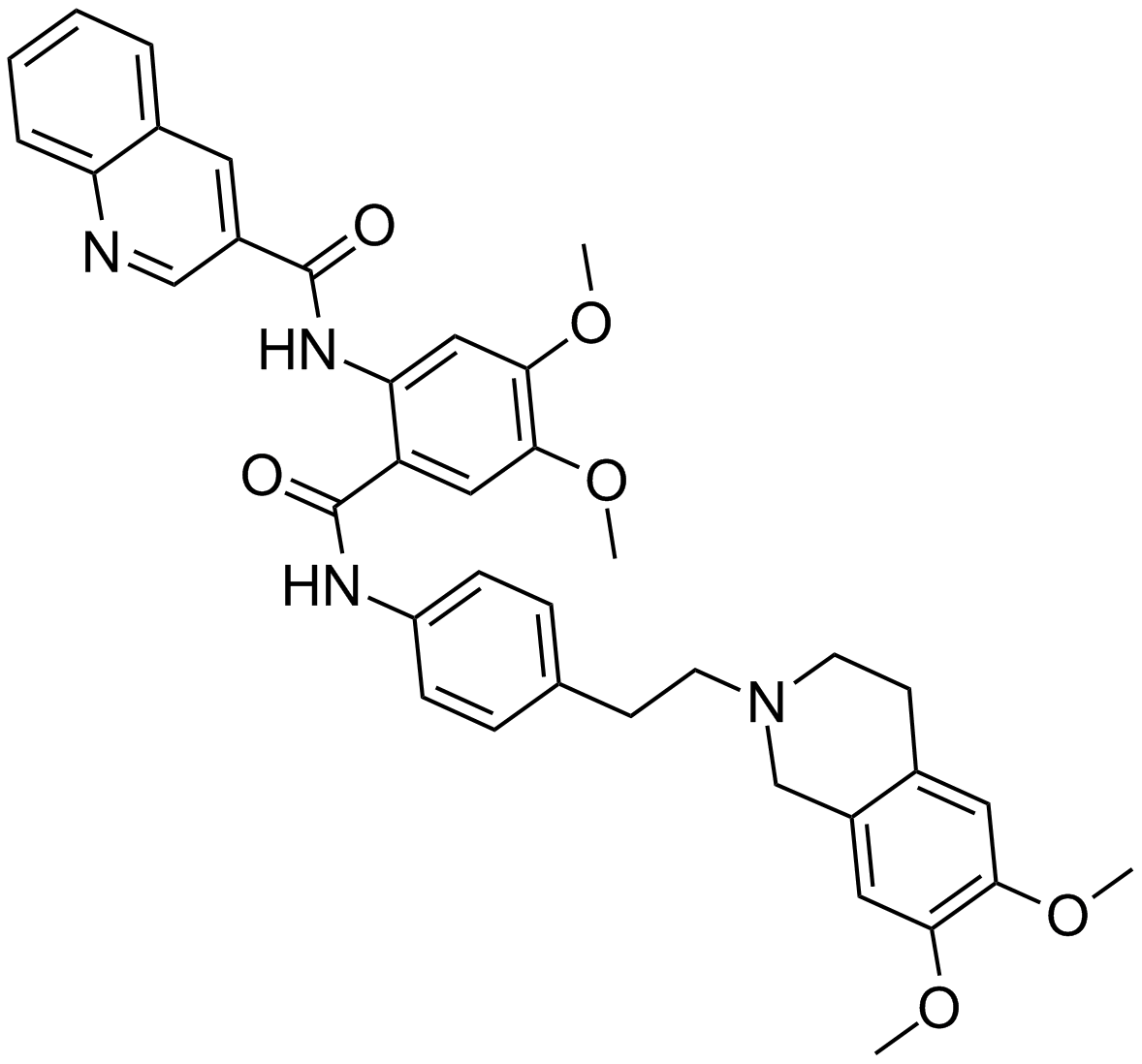
Tariquidar (Synonyms: XR9576) |
Catalog No.GC15570
 One-Click Copy Product Info
|

Tariquidar is a potent and selective inhibitor of P-glycoprotein (P-gp) with a KD value of 5.1nM.
Products are for research use only. Not for human use. We do not sell to patients.
Cas No.: 206873-63-4
Sample solution is provided at 25 µL, 10mM.
_1-3.$$$39978408@51.jpg');)
_1-9.$$$38538795@65.jpg');)
_1-9.$$$39112701@51.jpg');)
_1-7.$$$37316672@70.jpg');)
_366-372.$$$36198801@70.jpg');)
.$$$38565142@65.jpg');)
_1867-1883.$$$33248023@67.jpg');)
_eads6055.$$$39977546@45.jpg');)
_eadm9805.$$$40080571@45.jpg');)
_eadj3020.$$$39666821@45.jpg');)
_1-20.$$$39757301@28.jpg');)
_1-24.$$$38898113@28.jpg');)
_273-287.$$$36806353@46.jpg');)
_1-16.$$$37156877@44.jpg');)
_1-19.$$$37460805@44.jpg');)
_1291-1307.$$$34518654@46.jpg');)
Tariquidar is a potent and selective inhibitor of P-glycoprotein (P-gp) with a KD value of 5.1nM [1]. Tariquidar inhibits the ABC transporter ABCB1 by blocking ATPase activity, with an IC50 value of 223 ± 8nM[2]. Tariquidar has been widely used in multi-drug resistant cell models to inhibit cell proliferation[3].
In vitro, Tariquidar treatment (33.34µM) for 2 days significantly inhibited the cell viability of MRC5 cells[4]. The 0.3µM dose of Tariquidar treatment for 72 hours significantly inhibited the expression of MRP7 protein in HEK/MRP7 cells, without affecting the MRP7 mRNA level, and enhanced the sensitivity of the cells to paclitaxel[5]. The 2-hour pretreatment with 1.5μM Tariquidar significantly enhanced the killing effect of 1μM doxorubicin on MDA-MB-231 cells[6].
In vivo, Tariquidar via injecting intraperitoneally at a dose of 13mg/kg every two days for 18 days can enhance the efficacy of Astragaloside IV (ASIV) (20mg/kg/day; i, p.) on experimental autoimmune encephalomyelitis (EAE) mice, manifested as reduced clinical symptoms, decreased incidence rate, less inflammatory infiltration in the central nervous system (CNS), and less demyelination[7]. Male Sprague Dawley rats received a single intravenous dose of Tariquidar (7.5mg/kg) for 2h inhibited the P-gp efflux of ondansetron in the brain and spinal cord[8].
References:
[1] Weidner L D, Fung K L, Kannan P, et al. Tariquidar is an inhibitor and not a substrate of human and mouse P-glycoprotein[J]. Drug Metabolism and Disposition, 2016, 44(2): 275-282.
[2] Kühnle M, Egger M, Müller C, et al. Potent and selective inhibitors of breast cancer resistance protein (ABCG2) derived from the p-glycoprotein (ABCB1) modulator tariquidar[J]. J Med Chem, 2009, 52(4): 1190-7.
[3] Mistry P, Stewart A J, Dangerfield W, et al. In vitro and in vivo reversal of P-glycoprotein-mediated multidrug resistance by a novel potent modulator, XR9576[J]. Cancer research, 2001, 61(2): 749-758.
[4] Parsons A J, Cohen T, Schwarz T M, et al. Valspodar limits human cytomegalovirus infection and dissemination[J]. Antiviral research, 2021, 193: 105124.
[5] Sun Y L, Chen J J, Kumar P, et al. Reversal of MRP7 (ABCC10)-mediated multidrug resistance by tariquidar[J]. PloS one, 2013, 8(2): e55576.
[6] Jadhao M, Tsai E M, Yang H C, et al. The long-term DEHP exposure confers multidrug resistance of triple-negative breast cancer cells through ABC transporters and intracellular ROS[J]. Antioxidants, 2021, 10(6): 949.
[7] Zhang W, Liu M, Yang L, et al. P-glycoprotein inhibitor tariquidar potentiates efficacy of astragaloside IV in experimental autoimmune encephalomyelitis mice[J]. Molecules, 2019, 24(3): 561.
[8] Chiang M, Back H, Lee J B, et al. Pharmacokinetic Modeling of the Effect of Tariquidar on Ondansetron Disposition into the Central Nervous System[J]. Pharmaceutical research, 2024, 41(7): 1401-1411.
| Cell experiment [1]: | |
Cell lines | MRC5 cells |
Preparation Method | MRC5 cells were cultured in DMEM medium, which was supplemented with 10% fetal bovine serum, 1mM HEPES, 100U/ml penicillin and 100μg/ml streptomycin. Then cells were placed in an environment at 37°C and 5% CO2. 1×10⁴ MRC5 cells were seeded in 96-well plates and incubated overnight. After adhering to the plate, cells were treated with Tariquidar (0.26, 0.52, 1.04, 2.08, 4.16, 8.32, 16.67, and 33.34μM) for 2 days, and then the absorbance was measured at 570nm. |
Reaction Conditions | 0.26, 0.52, 1.04, 2.08, 4.16, 8.32, 16.67, and 33.34μM; 48h |
Applications | Tariquidar significantly inhibited the viability of MRC5 cells at 33.34μM. |
| Animal experiment [2]: | |
Animal models | Female C57BL/6 mice |
Preparation Method | Female C57BL/6 mice (18-22g, 6 weeks old) were housed at room temperature (22±1℃) under a 12-hour light/dark cycle, with free access to food and water. EAE was induced in mice by subcutaneous immunization with myelin oligodendrocyte glycoprotein 35-55 (MOG35–55). From one day before the MOG35-55 immunization, intraperitoneal injections of ASIV (20mg/kg) were given daily for 18 consecutive days. 30 minutes before the ASIV administration, intraperitoneal injections of Tariquidar (13mg/kg) were given every other day for 18 days. |
Dosage form | 13mg/kg; every other day for 18 days; i.p. |
Applications | Tariquidar treatment potentiated efficacy of ASIV in EAE mice, as shown by attenuated clinical symptoms and reduced incidence rate as well as mitigated inflammatory infiltration in CNS. |
References: | |
| Cas No. | 206873-63-4 | SDF | |
| Synonyms | XR9576 | ||
| Chemical Name | N-[2-[[4-[2-(6,7-dimethoxy-3,4-dihydro-1H-isoquinolin-2-yl)ethyl]phenyl]carbamoyl]-4,5-dimethoxyphenyl]quinoline-3-carboxamide | ||
| Canonical SMILES | COC1=C(C=C2CN(CCC2=C1)CCC3=CC=C(C=C3)NC(=O)C4=CC(=C(C=C4NC(=O)C5=CC6=CC=CC=C6N=C5)OC)OC)OC | ||
| Formula | C38H38N4O6 | M.Wt | 646.73 |
| Solubility | ≥ 16.168mg/mL in DMSO | Storage | Store at -20°C |
| General tips | Please select the appropriate solvent to prepare the stock solution according to the
solubility of the product in different solvents; once the solution is prepared, please store it in
separate packages to avoid product failure caused by repeated freezing and thawing.Storage method
and period of the stock solution: When stored at -80°C, please use it within 6 months; when stored
at -20°C, please use it within 1 month. To increase solubility, heat the tube to 37°C and then oscillate in an ultrasonic bath for some time. |
||
| Shipping Condition | Evaluation sample solution: shipped with blue ice. All other sizes available: with RT, or with Blue Ice upon request. | ||
| Prepare stock solution | |||

|
1 mg | 5 mg | 10 mg |
| 1 mM | 1.5462 mL | 7.7312 mL | 15.4624 mL |
| 5 mM | 309.2 μL | 1.5462 mL | 3.0925 mL |
| 10 mM | 154.6 μL | 773.1 μL | 1.5462 mL |
Step 1: Enter information below (Recommended: An additional animal making an allowance for loss during the experiment)
 g
μL
g
μL
Step 2: Enter the in vivo formulation (This is only the calculator, not formulation. Please contact us first if there is no in vivo formulation at the solubility Section.)
Calculation results:
Working concentration: mg/ml;
Method for preparing DMSO master liquid: mg drug pre-dissolved in μL DMSO ( Master liquid concentration mg/mL, Please contact us first if the concentration exceeds the DMSO solubility of the batch of drug. )
Method for preparing in vivo formulation: Take μL DMSO master liquid, next addμL PEG300, mix and clarify, next addμL Tween 80, mix and clarify, next add μL saline, mix and clarify.
Method for preparing in vivo formulation: Take μL DMSO master liquid, next add μL Corn oil, mix and clarify.
Note: 1. Please make sure the liquid is clear before adding the next solvent.
2. Be sure to add the solvent(s) in order. You must ensure that the solution obtained, in the previous addition, is a clear solution before proceeding to add the next solvent. Physical methods such as vortex, ultrasound or hot water bath can be used to aid dissolving.
3. All of the above co-solvents are available for purchase on the GlpBio website.
Quality Control & SDS
- View current batch:
- Purity: >98.50% Appearance: A solid
- COA (Certificate of Analysis)
- SDS (Safety Data Sheet)
- Datasheet
Average Rating: 5 (Based on Reviews and 30 reference(s) in Google Scholar.)