

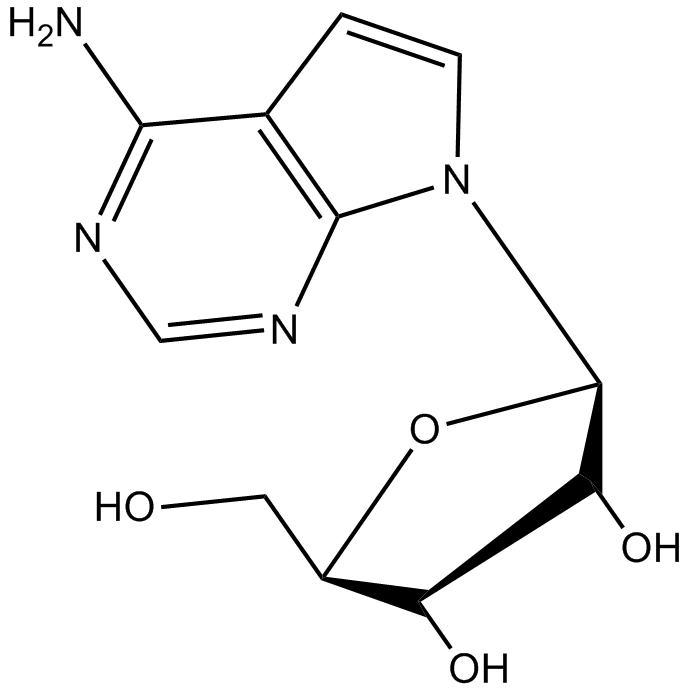
Tubercidin (Synonyms: 7-Deazaadenosine, 7-DZA, NSC 56408) |
Catalog No.GC16879
 One-Click Copy Product Info
|

Tubercidin is an adenosine analog with potent antimycobacterial and antitumor bioactivities.
Products are for research use only. Not for human use. We do not sell to patients.
Cas No.: 69-33-0
Sample solution is provided at 25 µL, 10mM.
_1-3.$$$39978408@51.jpg');)
_1-9.$$$38538795@65.jpg');)
_1-9.$$$39112701@51.jpg');)
_1-7.$$$37316672@70.jpg');)
_366-372.$$$36198801@70.jpg');)
.$$$38565142@65.jpg');)
_1867-1883.$$$33248023@67.jpg');)
_eads6055.$$$39977546@45.jpg');)
_eadm9805.$$$40080571@45.jpg');)
_eadj3020.$$$39666821@45.jpg');)
_1-20.$$$39757301@28.jpg');)
_1-24.$$$38898113@28.jpg');)
_273-287.$$$36806353@46.jpg');)
_1-16.$$$37156877@44.jpg');)
_1-19.$$$37460805@44.jpg');)
_1291-1307.$$$34518654@46.jpg');)
Tubercidin is an adenosine analog with potent antimycobacterial and antitumor bioactivities[1]. Tubercidin inhibits the replication of porcine reproductive and respiratory syndrome virus (PRRSV) through the RIG-I/NF-κB pathway and interferes with the expression of the viral non-structural protein 2 and viral dsRNA synthesis[2]. Tubercidin has been widely used to suppress Phytophthora capsica and control phytophthora blight in pepper plants[3].
In vitro, Tubercidin treatment for 48 hours significantly inhibited the viability of A549, HST116, and A375 cells, with IC50 values of 0.044µM, 0.082µM, and 0.043µM, respectively[4]. Treatment with 0.014µM Tubercidin for 48h dramatically inhibited the proliferation of Jurkat cells[5]. Under serum starvation or hypoxia stress, treatment with 5μg/ml Tubercidin for 6 hours significantly promoted apoptosis of HL-1 cells and exacerbated the destruction of nuclear speckles[6].
In vivo, Tubercidin treatment via subcutaneous injection at a dose of 5mg/kg, three times per week for 3 weeks, significantly inhibited the growth of DMS 114 xenograft tumors in mice[7].
References:
[1] Liu Y, Gong R, Liu X, et al. Discovery and characterization of the tubercidin biosynthetic pathway from Streptomyces tubercidicus NBRC 13090[J]. Microbial cell factories, 2018, 17(1): 131.
[2] Xu Y, Zhu Z, Zhang M, et al. Tubercidin inhibits PRRSV replication via RIG-I/NF-κB pathways and interrupting viral nsp2 synthesis[J]. Microbiology Spectrum, 2024, 12(3): e03479-23.
[3] Hwang B K, Kim B S. In‐vivo efficacy and in‐vitro activity of tubercidin, an antibiotic nucleoside, for control of Phytophthora capsici blight in Capsicum annuum[J]. Pesticide science, 1995, 44(3): 255-260.
[4] Brel V K, Artyushin O I, Chuprov-Netochin R N, et al. Synthesis and biological evaluation of indolylglyoxylamide bisphosphonates, antimitotic microtubule-targeting derivatives of indibulin with improved aqueous solubility[J]. Bioorganic & Medicinal Chemistry Letters, 2020, 30(23): 127635.
[5] Olsen D B, Eldrup A B, Bartholomew L, et al. A 7-deaza-adenosine analog is a potent and selective inhibitor of hepatitis C virus replication with excellent pharmacokinetic properties[J]. Antimicrobial agents and chemotherapy, 2004, 48(10): 3944-3953.
[6] Shen G, Cheng Q, Liang L, et al. Tubercidin enhances apoptosis in serum-starved and hypoxic mouse cardiomyocytes by inducing nuclear speckle condensation[J]. BMC Cardiovascular Disorders, 2025, 25(1): 211.
[7] Chen J, Barrett L, Lin Z, et al. Identification of natural compounds tubercidin and lycorine HCl against small‐cell lung cancer and BCAT1 as a therapeutic target[J]. Journal of cellular and molecular medicine, 2022, 26(9): 2557-2565.
| Cell experiment [1]: | |
|
Cell lines |
A549 cells |
|
Preparation Method |
A549 cells were cultured in DMEM medium supplemented with 10% fetal bovine serum (FBS), 2mM glutamine, and 1% penicillin-streptomycin at 37°C in 5% CO2/atmosphere. A549 cells were seeded onto 96-well microplates (5×10⁴ cells/well) and cultured overnight. The cells were treated with different concentrations of Tubercidin (0, 0.0003, 0.001, 0.01, 0.1, 1, and 10µM). After 48h of incubation, cell viability was assessed. |
|
Reaction Conditions |
0, 0.0003, 0.001, 0.01, 0.1, 1, and 10µM; 48h |
|
Applications |
Tubercidin treatment reduced the cell viability of A549 cells in a dose-dependent manner. |
| Animal experiment [2]: | |
|
Animal models |
Nude mice |
|
Preparation Method |
Nude mice (6-weeks old) were housed under controlled temperature (21-23°C), humidity (30-35%) and light cycle (7:00 AM to 7:00 PM) and maintained on a standard rodent diet. 6×10⁵ DMS 114 cells in 50µl PBS plus 50µl growth factor-depleted matrigel were injected subcutaneously into the flank of nude mice. When tumors reached 8-10mm in diameter (about 1.5 weeks), the mice were randomly separated into different groups (4 mice per group) and received in situ subcutaneous injection with either vehicle, Tubercidin (5mg/kg), 3 times a week. The mice were observed and weighed every 2-3 days for the size of palpable tumors for an additional 3 weeks. At the end of the experiment, the tumors were excised and compared. |
|
Dosage form |
5mg/kg; 3 times a week; 3 weeks; s.c. |
|
Applications |
Tubercidin treatment significantly inhibited tumor growth in mice with DMS 114 xenografts. |
References: [1] Brel V K, Artyushin O I, Chuprov-Netochin R N, et al. Synthesis and biological evaluation of indolylglyoxylamide bisphosphonates, antimitotic microtubule-targeting derivatives of indibulin with improved aqueous solubility[J]. Bioorganic & Medicinal Chemistry Letters, 2020, 30(23): 127635. [2] Chen J, Barrett L, Lin Z, et al. Identification of natural compounds tubercidin and lycorine HCl against small‐cell lung cancer and BCAT1 as a therapeutic target[J]. Journal of cellular and molecular medicine, 2022, 26(9): 2557-2565. | |
| Cas No. | 69-33-0 | SDF | |
| Synonyms | 7-Deazaadenosine, 7-DZA, NSC 56408 | ||
| Chemical Name | (2R,3R,4S,5R)-2-(4-amino-7H-pyrrolo[2,3-d]pyrimidin-7-yl)-5-(hydroxymethyl)tetrahydrofuran-3,4-diol | ||
| Canonical SMILES | NC1=NC=NC2=C1C=CN2[C@H]3[C@H](O)[C@H](O)[C@@H](CO)O3 | ||
| Formula | C11H14N4O4 | M.Wt | 266.25 |
| Solubility | DMSO : ≥ 30 mg/mL (112.68 mM) | Storage | Store at -20°C |
| Shipping Condition | Evaluation sample solution: shipped with blue ice. All other sizes available: with RT, or with Blue Ice upon request. | ||
| Prepare stock solution | |||

|
1 mg | 5 mg | 10 mg |
| 1 mM | 3.7559 mL | 18.7793 mL | 37.5587 mL |
| 5 mM | 751.2 μL | 3.7559 mL | 7.5117 mL |
| 10 mM | 375.6 μL | 1.8779 mL | 3.7559 mL |
Step 1: Enter information below (Recommended: An additional animal making an allowance for loss during the experiment)
 g
μL
g
μL
Step 2: Enter the in vivo formulation (This is only the calculator, not formulation. Please contact us first if there is no in vivo formulation at the solubility Section.)
Calculation results:
Working concentration: mg/ml;
Method for preparing DMSO master liquid: mg drug pre-dissolved in μL DMSO ( Master liquid concentration mg/mL, Please contact us first if the concentration exceeds the DMSO solubility of the batch of drug. )
Method for preparing in vivo formulation: Take μL DMSO master liquid, next addμL PEG300, mix and clarify, next addμL Tween 80, mix and clarify, next add μL saline, mix and clarify.
Method for preparing in vivo formulation: Take μL DMSO master liquid, next add μL Corn oil, mix and clarify.
Note: 1. Please make sure the liquid is clear before adding the next solvent.
2. Be sure to add the solvent(s) in order. You must ensure that the solution obtained, in the previous addition, is a clear solution before proceeding to add the next solvent. Physical methods such as vortex, ultrasound or hot water bath can be used to aid dissolving.
3. All of the above co-solvents are available for purchase on the GlpBio website.
Quality Control & SDS
- View current batch:
- Purity: >98.00% Appearance: A solid
- COA (Certificate of Analysis)
- SDS (Safety Data Sheet)
- Datasheet
Average Rating: 5 (Based on Reviews and 12 reference(s) in Google Scholar.)