

URMC-099 |
Catalog No.GC15004
 One-Click Copy Product Info
|

URMC-099, as a 7‐azaindole‐based MLK3 inhibitor with IC50 of 14 nM, could specifically affect specific Aβ species engaged in disease pathobiology.
Products are for research use only. Not for human use. We do not sell to patients.
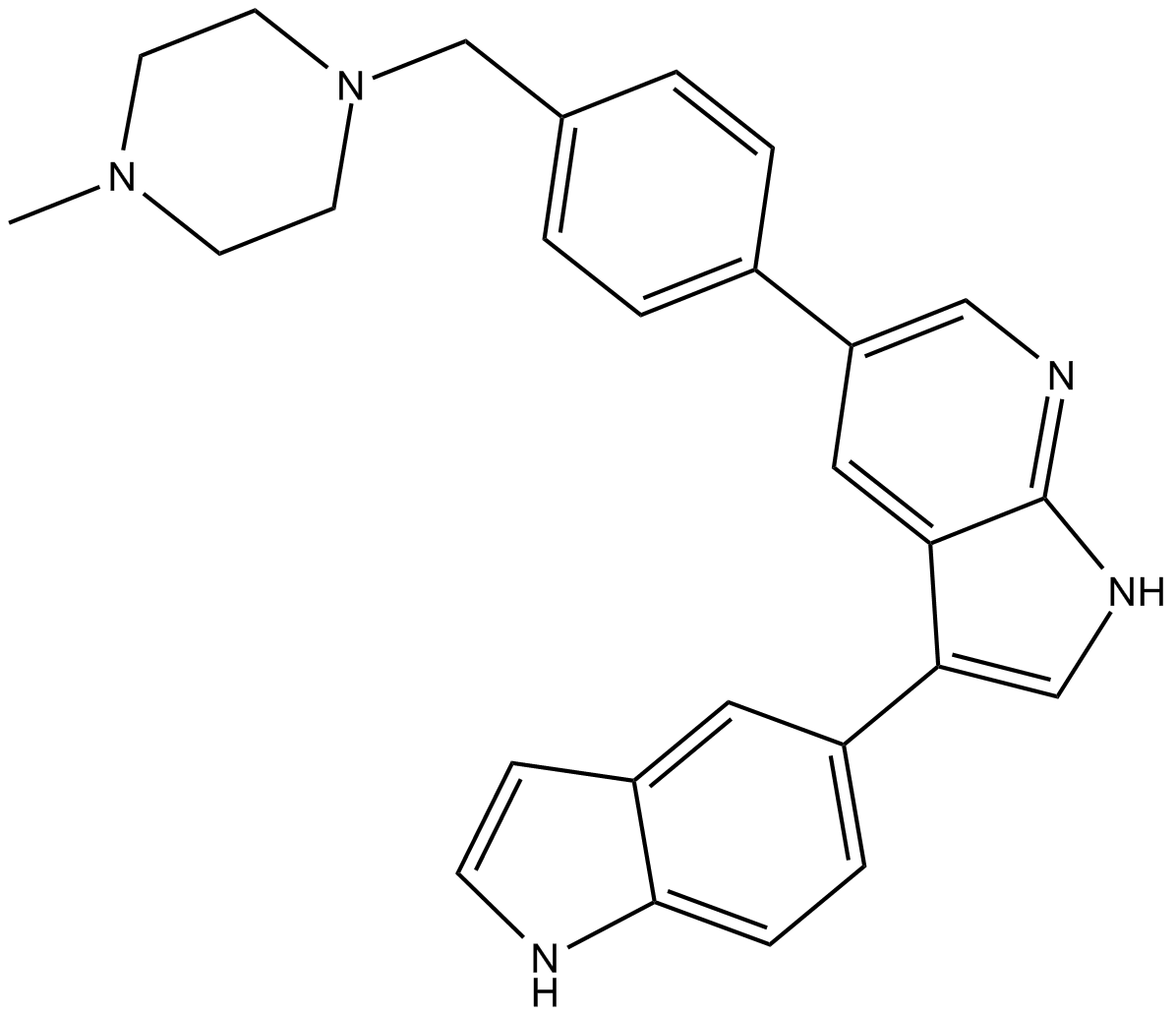
Cas No.: 1229582-33-5
Sample solution is provided at 25 µL, 10mM.
_1-3.$$$39978408@51.jpg');)
_1-9.$$$38538795@65.jpg');)
_1-9.$$$39112701@51.jpg');)
_1-7.$$$37316672@70.jpg');)
_366-372.$$$36198801@70.jpg');)
.$$$38565142@65.jpg');)
_1867-1883.$$$33248023@67.jpg');)
_eads6055.$$$39977546@45.jpg');)
_eadm9805.$$$40080571@45.jpg');)
_eadj3020.$$$39666821@45.jpg');)
_1-20.$$$39757301@28.jpg');)
_1-24.$$$38898113@28.jpg');)
_273-287.$$$36806353@46.jpg');)
_1-16.$$$37156877@44.jpg');)
_1-19.$$$37460805@44.jpg');)
_1291-1307.$$$34518654@46.jpg');)
URMC-099, as a 7‐azaindole‐based MLK3 inhibitor with IC50 of 14 nM, could specifically affect specific Aβ species engaged in disease pathobiology[1].
In vitro, the average half maximal inhibitory concentrations (IC50) of URMC-099 in seven GBM cell lines was 4.57 μM. In vitro, treatment with ≥ 5 μM URMC-099 for 48 h in 7 GBM cell lines reduced cell viability[2]. In vitro experiment it shown that treatment with 100 or 300 nM URMC-099 in neuronal cell prevented neuronal death and maintained healthy neurites up to 48 h after NGF withdrawal in a dose-dependent manner[3]. In vitro, URMC-099 treatment (100 nm) reduced inflammatory cytokine production by HIV-1 Tat-exposed microglia and prevented destruction and phagocytosis of cultured neuronal axons by these cells[4].
In vivo, URMC-099 treatment in C57BL/6 mice (10 mg/kg, i.v.) reduced inflammatory cytokine production, protected neuronal architecture, and altered the morphologic and ultrastructural response of microglia to HIV-1 Tat exposure[4]. In vivo efficacy test it shown that 10 mg/kg URMC‐099 (i.p.) prophylaxis prevents the induction of VCAM‐1 in the SLM of 6‐month‐old CVN‐AD (APPSwDI/mNos2−/− AD) mice following surgery[5]. In vivo, prophylactic URMC-099 (10 mg/kg, i.p.) treatment in mice is sufficient to prevent surgery-induced microgliosis and cognitive impairment without affecting fracture healing[6].
References:
[1] Goodfellow VS, Loweth CJ, Ravula SB, Wiemann T, Nguyen T, Xu Y, Todd DE, Sheppard D, Pollack S, Polesskaya O, Marker DF, Dewhurst S, Gelbard HA. Discovery, synthesis, and characterization of an orally bioavailable, brain penetrant inhibitor of mixed lineage kinase 3. J Med Chem. 2013 Oct 24;56(20):8032-48.
[2] Zhao HF, et al. Synergism between the phosphatidylinositol 3-kinase p110β isoform inhibitor AZD6482 and the mixed lineage kinase 3 inhibitor URMC-099 on the blockade of glioblastoma cell motility and focal adhesion formation. Cancer Cell Int. 2021 Jan 6;21(1):24.
[3] Bellizzi MJ, et al. The Mixed-Lineage Kinase Inhibitor URMC-099 Protects Hippocampal Synapses in Experimental Autoimmune Encephalomyelitis. eNeuro. 2018 Dec 3;5(6):ENEURO.0245-18.2018.
[4] Marker DF, et al. The new small-molecule mixed-lineage kinase 3 inhibitor URMC-099 is neuroprotective and anti-inflammatory in models of human immunodeficiency virus-associated neurocognitive disorders. J Neurosci. 2013 Jun 12;33(24):9998-10010.
[5] Miller-Rhodes P, et al. URMC-099 prophylaxis prevents hippocampal vascular vulnerability and synaptic damage in an orthopedic model of delirium superimposed on dementia. FASEB J. 2022 Jun;36(6):e22343.
[6] Miller-Rhodes P, et al. The broad spectrum mixed-lineage kinase 3 inhibitor URMC-099 prevents acute microgliosis and cognitive decline in a mouse model of perioperative neurocognitive disorders. J Neuroinflammation. 2019 Oct 28;16(1):193.
| Cell experiment [1]: | |
|
Cell lines |
Microglia |
|
Preparation Method |
Microglia were plated at a density of 2 × 10⁵ onto 24-well plates for RNA/protein extraction or onto 24-well plates with glass coverslips for confocal microscopy. 2 × 10⁴ cells were placed in each 96-well plate for immunofluorescence studies. One day before Aβ exposure and URMC-099 treatment, media was replaced without MCSF. Microglia were pre-incubated for 30 min with URMC-099 (100 nM). After pre-incubation with URMC-099, microglia were incubated with media containing the monomeric Aβ42. |
|
Reaction Conditions |
100 nM; 30 min |
|
Applications |
URMC-099 administered at 100 nM did not affect microglial viability as measured by the MTT assay. Phagocytosis of Aβ42 was facilitated by URMC-099 with up-regulation of scavenger receptors. |
| Animal experiment [2]: | |
|
Animal models |
Four-month-old APP/PS1 mice |
|
Preparation Method |
Four-month-old APP/PS1 mice were administered intraperitoneal URMC-099 injections at 10 mg/kg daily for 3 weeks. Brain tissues were examined by biochemical, molecular and immunohistochemical tests. |
|
Dosage form |
10 mg/kg; i.p. |
|
Applications |
URMC-099 inhibited mitogen-activated protein kinase 3/4-mediated activation and attenuated β-amyloidosis. Microglial nitric oxide synthase-2 and arginase-1 were co-localized with lysosomal-associated membrane protein 1 (Lamp1) and Aβ. Importatly, URMC-099 restored synaptic integrity and hippocampal neurogenesis in APP/PS1 mice. |
|
References: Dong W, et al. The mixed-lineage kinase 3 inhibitor URMC-099 facilitates microglial amyloid-β degradation. J Neuroinflammation. 2016 Jul 11;13(1):184. | |
| Cas No. | 1229582-33-5 | SDF | |
| Chemical Name | 3-(1H-indol-5-yl)-5-[4-[(4-methylpiperazin-1-yl)methyl]phenyl]-1H-pyrrolo[2,3-b]pyridine | ||
| Canonical SMILES | CN1CCN(CC1)CC2=CC=C(C=C2)C3=CN=C4C(=C3)C(=CN4)C5=CC6=C(C=C5)NC=C6 | ||
| Formula | C27H27N5 | M.Wt | 421.54 |
| Solubility | ≥ 21.1mg/mL in DMSO | Storage | Store at -20°C |
| General tips | Please select the appropriate solvent to prepare the stock solution according to the
solubility of the product in different solvents; once the solution is prepared, please store it in
separate packages to avoid product failure caused by repeated freezing and thawing.Storage method
and period of the stock solution: When stored at -80°C, please use it within 6 months; when stored
at -20°C, please use it within 1 month. To increase solubility, heat the tube to 37°C and then oscillate in an ultrasonic bath for some time. |
||
| Shipping Condition | Evaluation sample solution: shipped with blue ice. All other sizes available: with RT, or with Blue Ice upon request. | ||
| Prepare stock solution | |||

|
1 mg | 5 mg | 10 mg |
| 1 mM | 2.3723 mL | 11.8613 mL | 23.7225 mL |
| 5 mM | 474.5 μL | 2.3723 mL | 4.7445 mL |
| 10 mM | 237.2 μL | 1.1861 mL | 2.3723 mL |
Step 1: Enter information below (Recommended: An additional animal making an allowance for loss during the experiment)
 g
μL
g
μL
Step 2: Enter the in vivo formulation (This is only the calculator, not formulation. Please contact us first if there is no in vivo formulation at the solubility Section.)
Calculation results:
Working concentration: mg/ml;
Method for preparing DMSO master liquid: mg drug pre-dissolved in μL DMSO ( Master liquid concentration mg/mL, Please contact us first if the concentration exceeds the DMSO solubility of the batch of drug. )
Method for preparing in vivo formulation: Take μL DMSO master liquid, next addμL PEG300, mix and clarify, next addμL Tween 80, mix and clarify, next add μL saline, mix and clarify.
Method for preparing in vivo formulation: Take μL DMSO master liquid, next add μL Corn oil, mix and clarify.
Note: 1. Please make sure the liquid is clear before adding the next solvent.
2. Be sure to add the solvent(s) in order. You must ensure that the solution obtained, in the previous addition, is a clear solution before proceeding to add the next solvent. Physical methods such as vortex, ultrasound or hot water bath can be used to aid dissolving.
3. All of the above co-solvents are available for purchase on the GlpBio website.
Quality Control & SDS
- View current batch:
- Purity: >99.50% Appearance: A solid
- COA (Certificate of Analysis)
- SDS (Safety Data Sheet)
- Datasheet
Average Rating: 5 (Based on Reviews and 9 reference(s) in Google Scholar.)