

WIN 18446 (Synonyms: NSC 59354) |
Catalog No.GC10438
 One-Click Copy Product Info
|

WIN 18446 (Fertilysin) is a potent inhibitor of aldehyde dehydrogenase 1A2 (ALDH1A2) enzyme with an IC50 value of 0.3μM.
Products are for research use only. Not for human use. We do not sell to patients.
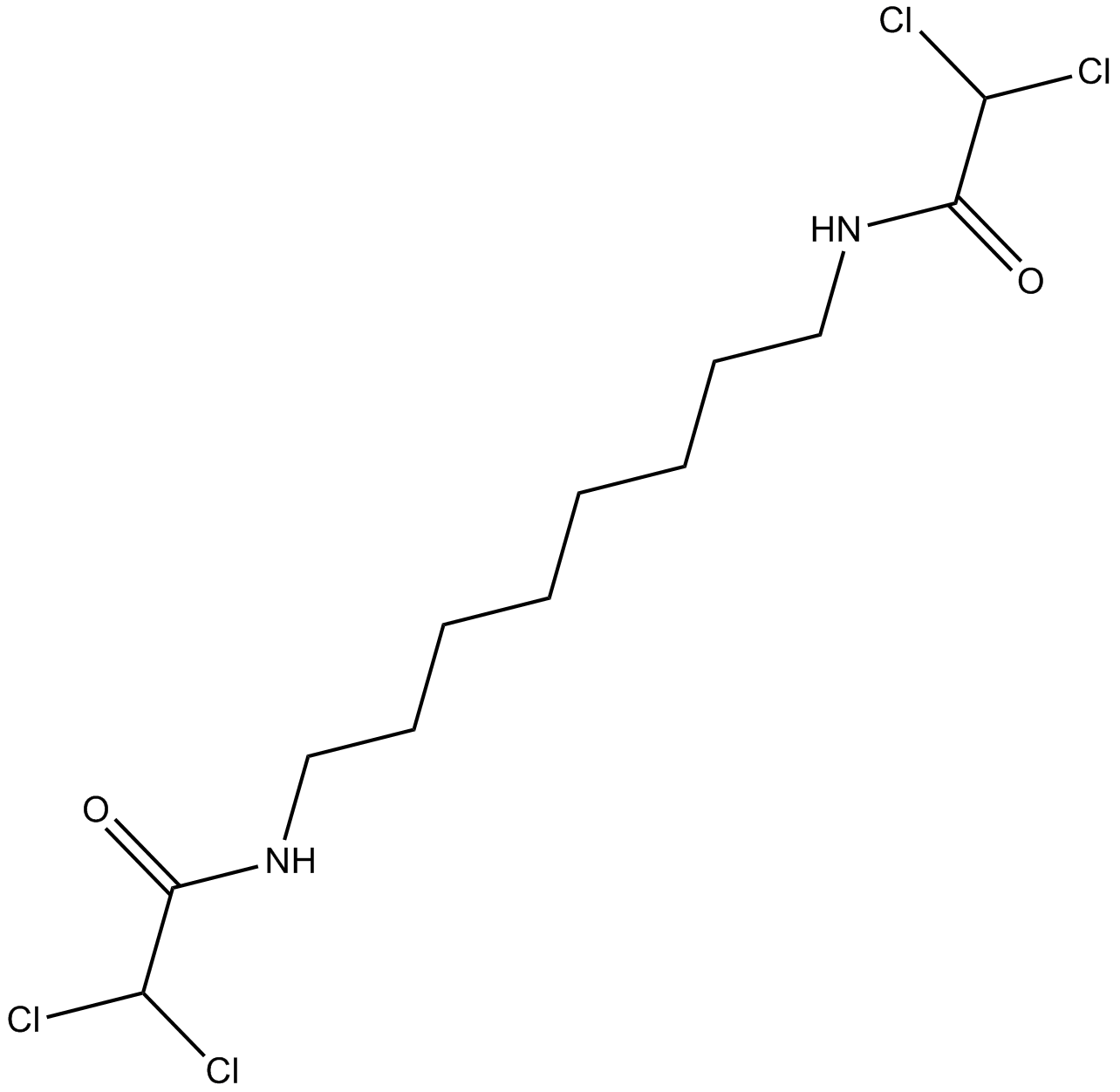
Cas No.: 1477-57-2
Sample solution is provided at 25 µL, 10mM.
_1-3.$$$39978408@51.jpg');)
_1-9.$$$38538795@65.jpg');)
_1-9.$$$39112701@51.jpg');)
_1-7.$$$37316672@70.jpg');)
_366-372.$$$36198801@70.jpg');)
.$$$38565142@65.jpg');)
_1867-1883.$$$33248023@67.jpg');)
_eads6055.$$$39977546@45.jpg');)
_eadm9805.$$$40080571@45.jpg');)
_eadj3020.$$$39666821@45.jpg');)
_1-20.$$$39757301@28.jpg');)
_1-24.$$$38898113@28.jpg');)
_273-287.$$$36806353@46.jpg');)
_1-16.$$$37156877@44.jpg');)
_1-19.$$$37460805@44.jpg');)
_1291-1307.$$$34518654@46.jpg');)
WIN 18446 (Fertilysin) is a potent inhibitor of aldehyde dehydrogenase 1A2 (ALDH1A2) enzyme with an IC50 value of 0.3μM[1]. WIN 18446 has been made as a candidate for male contraception studies[2]. ALDH1a2 is an enzyme involved in retinoic acid biosynthesis[3]. Therefore, inhibiting ALDH1A2 disrupts retinoic acid synthesis, leading suppression of spermatogenesis[3].
In vitro, purified ALDH1A2 enzyme was obtained from cloned human ALDH1A2 testis cDNA[4]. 0.1μM, 1μM or 3μM of WIN 18446 was added to ALDH1A2 enzyme alone with 2.5, 20.5, 50, 100, 500, 1000 and 2000ng/ml of retinol for 20, 40, 60, 80mins. After 80mins treatment with WIN 18446 (0.1μM, 1μM or 3μM) ALDH1A2 enzyme retained only 2-3% of its activity[4,5]. As the incubation time increased until 80mins, the rate of retinoic acid production reached saturation with increased concentration of retinal. When WIN 18446 inhibits ALDH1A2 enzyme, retinaldehyde accumulates, which might compensate for the loss of ALDH1A2 enzyme activity and promote retinoic acid synthesis to saturation[4]. By adding dithiothreitol (DTT) to retain ALDH1A2 enzyme activity, ALDH1A2 enzyme inhibition assay still could not be reversed, indicating that WIN 18446 might inhibited ALDH1A2 enzyme directly[4].
In vivo, C57BL/6 male mice were fed WIN 18446 (2mg/g diet) or AIN9M (control diet) for 3, 7, 14, 21, and 28 days[6]. Testes weights with WIN 18446 treatment (2mg/g diet) were significantly reduced[6]. When further treated WIN 18446 groups with AIN9M control diet only for recovery assay after 14 days, testes weights remained smaller compared to control groups[3,6]. After 28 days treatment of WIN 18446 (2mg/g diet), most testicular tubules exhibited severe epithelial disruption, characterized by the loss of germ cells and the presence of frequent multinucleated cells[3,6].
References:
[1] Amory JK, Muller CH, Shimshoni JA, Isoherranen N, Paik J, Moreb JS, Amory Sr DW, Evanoff R, Goldstein AS, Griswold MD. Suppression of spermatogenesis by bisdichloroacetyldiamines is mediated by inhibition of testicular retinoic acid biosynthesis. Journal of andrology. 2011 Jan 2;32(1):111-9.
[2] Gray A. Overcoming the challenges in developing male contraceptives. The Pharmaceutical Journal. 2016;296:7890.
[3] Das BC, Thapa P, Karki R, Das S, Mahapatra S, Liu TC, Torregroza I, Wallace DP, Kambhampati S, Van Veldhuizen P, Verma A. Retinoic acid signaling pathways in development and diseases. Bioorganic & medicinal chemistry. 2014 Jan 15;22(2):673-83.
[4] Paik J, Haenisch M, Muller CH, Goldstein AS, Arnold S, Isoherranen N, Brabb T, Treuting PM, Amory JK. Inhibition of retinoic acid biosynthesis by the bisdichloroacetyldiamine WIN 18,446 markedly suppresses spermatogenesis and alters retinoid metabolism in mice. Journal of Biological Chemistry. 2014 May 23;289(21):15104-17.
[5] Hartmann S, Froescheis O, Ringenbach F, Wyss R, Bucheli F, Bischof S, Bausch J, Wiegand UW. Determination of retinol and retinyl esters in human plasma by high-performance liquid chromatography with automated column switching and ultraviolet detection. Journal of Chromatography B: Biomedical Sciences and Applications. 2001 Feb 25;751(2):265-75.
[6] Paik J, Snyder JM, Kim A, Haenisch M, Fogassy K, Amory JK. Kinetics of the inhibition and recovery of spermatogenesis induced by treatment with WIN 18,446, a male contraceptive, in mice. Andrology. 2024.
| Kinase experiment [1,2]: | |
Preparation Method | Human ALDH1A2 cDNA was cloned from human testis RNA to generate human ALDH1A2 enzyme. ALDH1A2 enzyme was incubated in assay buffer containing 20mM Hepes, 150mM KCI and 1mM EDTA[1]. 0.1μM, 1μM or 3μM of WIN 18446 was dissolved in DMSO (concentration of DMSO was less than 1%)[1]. Dissolved WIN 18446 was added to assay buffer with 2.5, 20.5, 50, 100, 500, 1000 and 2000ng/ml of retinol dissolved in ethanol for 20, 40, 60, 80mins as treatment group[2]. Concentration of retinoic acid were determined by HPLC. This protocol only provides a guideline, and should be modified according to your specific needs. |
Reaction Conditions | WIN 18446: 0.1μM, 1μM or 3μM; Retinol: 2.5, 20.5, 50, 100, 500, 1000 and 2000ng/ml; 20, 40, 60, 80mins |
Applications | After 80mins treatment with WIN 18446 (0.1μM, 1μM or 3μM) ALDH1A2 enzyme retained only 2-3% of its activity. As the incubation time increased until 80mins, the rate of retinoic acid production reached saturation with increased concentration of retinal. |
| Animal experiment [3]: | |
Animal models | C57BL/6 male mice |
Preparation Method | C57BL/6 male mice (breeding age, n=60) were fed WIN 18446 (2mg/g diet) with AIN9M (control diet) for 3, 7, 14, 21, and 28 days[3]. Five of the sixty mice per time point were euthanized and testes were collected. After 28 days, the rest of mice were fed with AIN9M (control diet) only for recovery assay for 42 and 56 days (up to 8 weeks) [3]. Five recovery group mice were euthanized per time point and testes were collected. Control group mice (n=15) were fed with AIN9M (control diet) only[3]. Testes specimens were fixed in Davidson's fixative for 24–48h, then transferred to 70% ethanol for testicular histology analysis[3]. This protocol only provides a guideline, and should be modified according to your specific needs. |
Dosage form | WIN 18446: 2mg/g diet for 3, 7, 14, 21, 28, 42 and 56 days; AIN9M: control diet for 3, 7, 14, 21, 28, 42 and 56 days |
Applications | Testes weights from WIN 18446 (2mg/g diet) treated mice group were significantly reduced. Testes weights from recovery group (AIN9M control diet only) still remained smaller compared to control groups. After 28 days treatment of WIN 18446 (2mg/g diet), most testicular tubules exhibited severe epithelial disruption, characterized by the loss of germ cells and the presence of frequent multinucleated cells. |
[1] Paik J, Haenisch M, Muller CH, Goldstein AS, Arnold S, Isoherranen N, Brabb T, Treuting PM, Amory JK. Inhibition of retinoic acid biosynthesis by the bisdichloroacetyldiamine WIN 18,446 markedly suppresses spermatogenesis and alters retinoid metabolism in mice. Journal of Biological Chemistry. 2014 May 23;289(21):15104-17. | |
| Cas No. | 1477-57-2 | SDF | |
| Synonyms | NSC 59354 | ||
| Chemical Name | N,N'-(octane-1,8-diyl)bis(2,2-dichloroacetamide) | ||
| Canonical SMILES | ClC(C(NCCCCCCCCNC(C(Cl)Cl)=O)=O)Cl | ||
| Formula | C12H20Cl4N2O2 | M.Wt | 366.11 |
| Solubility | ≥ 11.4mg/mL in DMSO | Storage | Store at -20°C |
| General tips | Please select the appropriate solvent to prepare the stock solution according to the
solubility of the product in different solvents; once the solution is prepared, please store it in
separate packages to avoid product failure caused by repeated freezing and thawing.Storage method
and period of the stock solution: When stored at -80°C, please use it within 6 months; when stored
at -20°C, please use it within 1 month. To increase solubility, heat the tube to 37°C and then oscillate in an ultrasonic bath for some time. |
||
| Shipping Condition | Evaluation sample solution: shipped with blue ice. All other sizes available: with RT, or with Blue Ice upon request. | ||
| Prepare stock solution | |||

|
1 mg | 5 mg | 10 mg |
| 1 mM | 2.7314 mL | 13.6571 mL | 27.3142 mL |
| 5 mM | 546.3 μL | 2.7314 mL | 5.4628 mL |
| 10 mM | 273.1 μL | 1.3657 mL | 2.7314 mL |
Step 1: Enter information below (Recommended: An additional animal making an allowance for loss during the experiment)
 g
μL
g
μL
Step 2: Enter the in vivo formulation (This is only the calculator, not formulation. Please contact us first if there is no in vivo formulation at the solubility Section.)
Calculation results:
Working concentration: mg/ml;
Method for preparing DMSO master liquid: mg drug pre-dissolved in μL DMSO ( Master liquid concentration mg/mL, Please contact us first if the concentration exceeds the DMSO solubility of the batch of drug. )
Method for preparing in vivo formulation: Take μL DMSO master liquid, next addμL PEG300, mix and clarify, next addμL Tween 80, mix and clarify, next add μL saline, mix and clarify.
Method for preparing in vivo formulation: Take μL DMSO master liquid, next add μL Corn oil, mix and clarify.
Note: 1. Please make sure the liquid is clear before adding the next solvent.
2. Be sure to add the solvent(s) in order. You must ensure that the solution obtained, in the previous addition, is a clear solution before proceeding to add the next solvent. Physical methods such as vortex, ultrasound or hot water bath can be used to aid dissolving.
3. All of the above co-solvents are available for purchase on the GlpBio website.
Quality Control & SDS
- View current batch:
- Purity: >97.00% Appearance: A solid
- COA (Certificate of Analysis)
- SDS (Safety Data Sheet)
- Datasheet
Average Rating: 5 (Based on Reviews and 17 reference(s) in Google Scholar.)