

Caspofungin |
Catalog No.GC17230
 One-Click Copy Product Info
|

Caspofungin is a β(1,3)-D-glucan synthase inhibitor with antifungal activity.
Products are for research use only. Not for human use. We do not sell to patients.
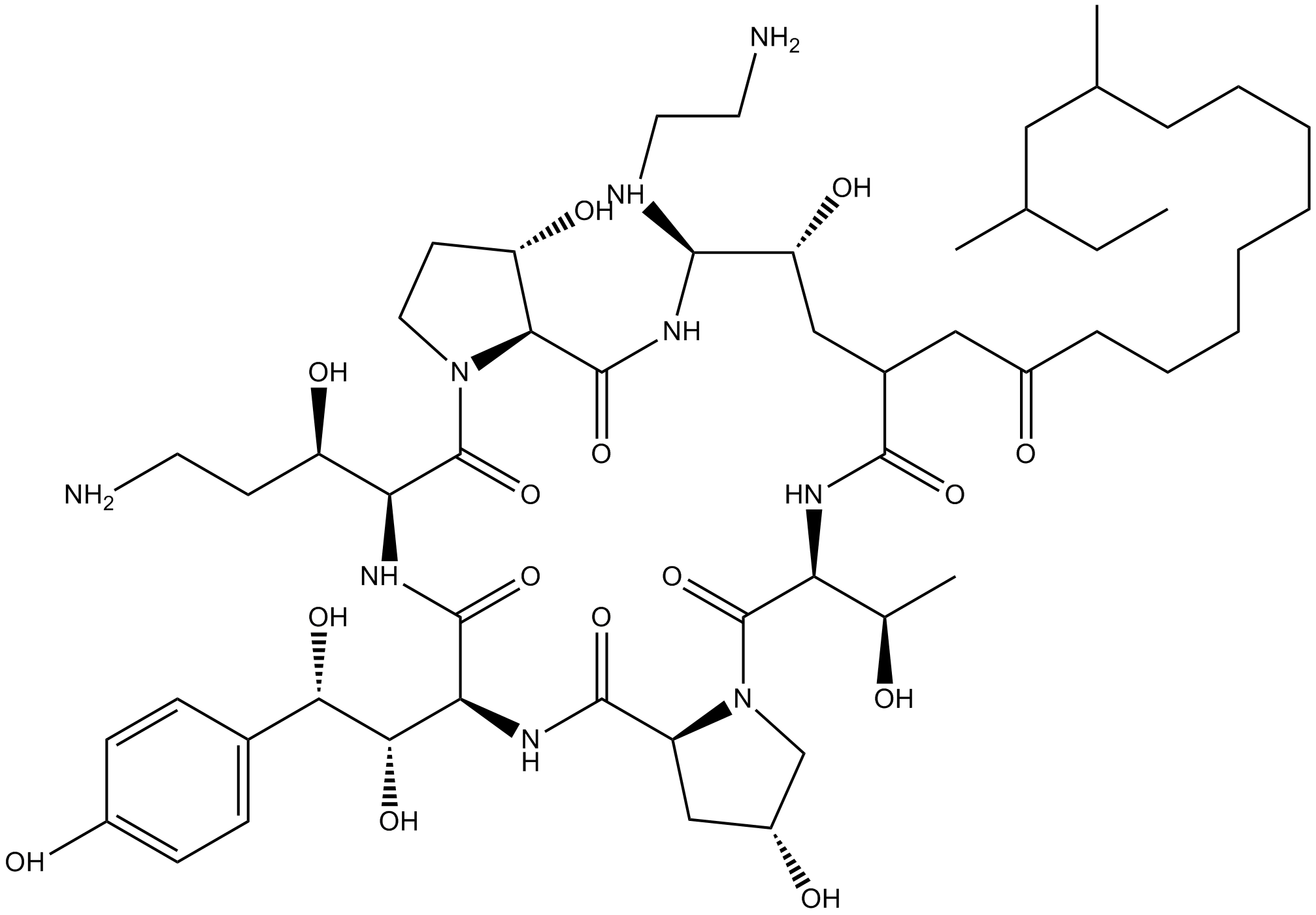
Cas No.: 162808-62-0
Sample solution is provided at 25 µL, 10mM.
_1-3.$$$39978408@51.jpg');)
_1-9.$$$38538795@65.jpg');)
_1-9.$$$39112701@51.jpg');)
_1-7.$$$37316672@70.jpg');)
_366-372.$$$36198801@70.jpg');)
.$$$38565142@65.jpg');)
_1867-1883.$$$33248023@67.jpg');)
_eads6055.$$$39977546@45.jpg');)
_eadm9805.$$$40080571@45.jpg');)
_eadj3020.$$$39666821@45.jpg');)
_1-20.$$$39757301@28.jpg');)
_1-24.$$$38898113@28.jpg');)
_273-287.$$$36806353@46.jpg');)
_1-16.$$$37156877@44.jpg');)
_1-19.$$$37460805@44.jpg');)
_1291-1307.$$$34518654@46.jpg');)
Caspofungin is a β(1,3)-D-glucan synthase inhibitor with antifungal activity. Caspofungin causes fungal cell wall permeability changes and cell lysis. Caspofungin has fungicidal activity against Candida species and fungistatic activity against Aspergillus species. Caspofungin can be used in studies related to candidemia, invasive candidiasis including intra-abdominal abscesses/peritonitis/pleural space infections, and esophageal candidiasis[1-4].
In vitro, treatment of SARS-CoV-2-infected Vero E6 cells with 100μg/mL Caspofungin for 72 hours reduced viral RNA concentration[5]. Treatment of J774.16 cells and 6F12/7C7/9C7/3B9/5B8 hybridoma cells with 64-1024μg/mL Caspofungin for 24 hours inhibited J774.16 and hybridoma cell growth at Caspofungin concentrations above 512μg/mL[6]. Treatment of Candida albicans SN250 wild-type, efg1 mutant, cas5 mutant, and efg1 cas5 double mutant strains with 500ng/mL Caspofungin for 2 days inhibited colony formation of efg1 and cas5 single mutants and the double mutant[7].
In vivo, CD-1 mice inoculated intracranially with Aspergillus fumigatus 10AF conidia received intraperitoneal injections of 1-10mg/kg Caspofungin once daily for 4 consecutive days. Caspofungin did not reduce Aspergillus fumigatus burden in brain and kidney tissues[8]. DBA/2N mice inoculated intravenously with Candida albicans MY1055 received intraperitoneal injections of 1-8mg/kg Caspofungin once daily for 7 consecutive days. Caspofungin significantly prolonged mouse survival and reduced fungal burden in kidney and brain tissues[9]. Cyclophosphamide-induced transiently leukopenic ICR mice inoculated intravenously with Aspergillus fumigatus MF5668 conidia received intraperitoneal injections of 0.125-1.0mg/kg Caspofungin once daily for 14 consecutive days starting 24 hours after inoculation. Caspofungin significantly prolonged survival time[10].
References:
[1] Parakh A, Dubey AP, Samanta D. Caspofungin. Indian Pediatr. 2008 Nov;45(11):905-10.
[2] Keating GM, Jarvis B. Caspofungin. Drugs. 2001;61(8):1121-9; discussion 1130-1.
[3] Perrine-Walker F. Caspofungin resistance in Candida albicans: genetic factors and synergistic compounds for combination therapies. Braz J Microbiol. 2022 Sep;53(3):1101-1113.
[4] McCormack PL, Perry CM. Caspofungin: a review of its use in the treatment of fungal infections. Drugs. 2005;65(14):2049-68.
[5] Hoste ACR, Smeralda W, Cugnet A, et al. The structure of lipopeptides impacts their antiviral activity and mode of action against SARS-CoV-2 in vitro. Appl Environ Microbiol. 2024 Nov;90(11):e01036-24.
[6] Martinez LR, Ntiamoah P, Casadevall A, et al. Caspofungin reduces the incidence of fungal contamination in cell culture. Mycopathologia. 2007;164(5):279-286.
[7] Xiong K, Su C, Sun Q, et al. Efg1 and Cas5 orchestrate cell wall damage response to caspofungin in Candida albicans. Antimicrob Agents Chemother. 2021 Jan 20;65(2):e01584-20.
[8] Singh G, Imai J, Clemons KV, et al. Efficacy of caspofungin against central nervous system Aspergillus fumigatus infection in mice determined by TaqMan PCR and CFU methods. Antimicrob Agents Chemother. 2005 Apr;49(4):1369-76.
[9] Flattery AM, Hickey E, Gill CJ, et al. Efficacy of caspofungin in a juvenile mouse model of central nervous system candidiasis. Antimicrob Agents Chemother. 2011 Jul;55(7):3491-3497.
[10] Abruzzo GK, Gill CJ, Flattery AM, et al. Efficacy of the echinocandin caspofungin against disseminated aspergillosis and candidiasis in cyclophosphamide-induced immunosuppressed mice. Antimicrob Agents Chemother. 2000 Sep;44(9):2310-2318.
| Cell experiment [1]: | |
|
Cell lines |
J774.16 cells (mouse macrophage-like cell line) |
|
Preparation Method |
J774.16 cells were cultured in standard medium (10% FBS-DMEM with NCTC-109 and nonessential amino acids) at 37°C, 10% CO2. Cells were treated with Caspofungin at 64-1024μg/mL for 24h; growth/morphology by Trypan blue, XTT reduction, and light microscopy; cytokine profile by RayBio mouse cytokine antibody array I (24h, ±1μg/mL LPS, ±256μg/mL Caspofungin) and TNF-α/IFN-γ ELISA. |
|
Reaction Conditions |
64-1024μg/mL; 24h |
|
Applications |
Caspofungin did not alter J774.16 cell morphology or growth rate at <512μg/mL. Caspofungin induced morphological alteration and growth inhibition in J774.16 cells at ≥512μg/mL. Caspofungin did not change MCP-1, IL-10 or other baseline cytokine/chemokine expression in unstimulated J774.16 cells. Caspofungin modestly increased IL-4 and IFN-γ secretion in LPS-stimulated J774.16 cells. Caspofungin reduced LPS-stimulated TNF-α secretion in J774.16 cells. |
| Animal experiment [2]: | |
|
Animal models |
8-10-week-old male complement component 5-deficient DBA/2N mice (juvenile mouse model of disseminated candidiasis with CNS involvement) |
|
Preparation Method |
Mice were inoculated intravenously via lateral tail vein with 5.64×10⁴ CFU Candida albicans MY1055 in 0.2mL saline. Antifungal therapy was initiated 30h after infection. Caspofungin was administered by intraperitoneal injection at 1-8mg/kg once daily for 7 consecutive days. Vehicle control received sterile distilled water. Survival was monitored to day 28. Kidney and brain tissues were harvested at 30h, day 5, day 8, day 14, day 21 and day 28 for quantitative culture (log10 CFU/g), histopathology, and pharmacokinetic sampling. |
|
Dosage form |
1-8mg/kg; i.p.; once daily for 7 days |
|
Applications |
Caspofungin reduced kidney and brain Candida burden. Caspofungin maintained kidney and brain clearance rates of 20-86% at days 14-28. Caspofungin reduced histopathological fungal burden and inflammation scores in kidney and brain at day 5 and shifted acute granulomatous inflammation to chronic lymphohistiocytic inflammation by day 14. |
References: [1] Martinez LR, Ntiamoah P, Casadevall A, et al. Caspofungin reduces the incidence of fungal contamination in cell culture. Mycopathologia. 2007;164(5):279-286. [2] Flattery AM, Hickey E, Gill CJ, et al. Efficacy of caspofungin in a juvenile mouse model of central nervous system candidiasis. Antimicrob Agents Chemother. 2011 Jul;55(7):3491-3497. | |
| Cas No. | 162808-62-0 | SDF | |
| Chemical Name | (2R,6S,11R,12R,14aS,15S,20S,23S,25aS)-20-((R)-3-amino-1-hydroxypropyl)-12-((2-aminoethyl)amino)-23-((1S,2S)-1,2-dihydroxy-2-(4-hydroxyphenyl)ethyl)-9-(11,13-dimethyl-2-oxopentadecyl)-2,11,15-trihydroxy-6-((R)-1-hydroxyethyl)hexadecahydro-1H-dipyrrolo[2,1- | ||
| Canonical SMILES | O=C([C@@H]1C[C@@H](O)CN1C([C@@H](NC(C2CC(CCCCCCCCC(C)CC(CC)C)=O)=O)[C@@H](C)O)=O)N[C@@H]([C@H](O)[C@@H](O)C3=CC=C(O)C=C3)C(N[C@@H]([C@H](O)CCN)C(N4CC[C@H](O)[C@H]4C(N[C@@H](NCCN)[C@H](O)C2)=O)=O)=O | ||
| Formula | C52H88N10O15 | M.Wt | 1093.31 |
| Solubility | ≥ 48.1mg/mL in DMSO | Storage | -20°C, sealed storage, away from moisture and light |
| General tips | Please select the appropriate solvent to prepare the stock solution according to the
solubility of the product in different solvents; once the solution is prepared, please store it in
separate packages to avoid product failure caused by repeated freezing and thawing.Storage method
and period of the stock solution: When stored at -80°C, please use it within 6 months; when stored
at -20°C, please use it within 1 month. To increase solubility, heat the tube to 37°C and then oscillate in an ultrasonic bath for some time. |
||
| Shipping Condition | Evaluation sample solution: shipped with blue ice. All other sizes available: with RT, or with Blue Ice upon request. | ||
| Prepare stock solution | |||

|
1 mg | 5 mg | 10 mg |
| 1 mM | 914.7 μL | 4.5733 mL | 9.1465 mL |
| 5 mM | 182.9 μL | 914.7 μL | 1.8293 mL |
| 10 mM | 91.5 μL | 457.3 μL | 914.7 μL |
Step 1: Enter information below (Recommended: An additional animal making an allowance for loss during the experiment)
 g
μL
g
μL
Step 2: Enter the in vivo formulation (This is only the calculator, not formulation. Please contact us first if there is no in vivo formulation at the solubility Section.)
Calculation results:
Working concentration: mg/ml;
Method for preparing DMSO master liquid: mg drug pre-dissolved in μL DMSO ( Master liquid concentration mg/mL, Please contact us first if the concentration exceeds the DMSO solubility of the batch of drug. )
Method for preparing in vivo formulation: Take μL DMSO master liquid, next addμL PEG300, mix and clarify, next addμL Tween 80, mix and clarify, next add μL saline, mix and clarify.
Method for preparing in vivo formulation: Take μL DMSO master liquid, next add μL Corn oil, mix and clarify.
Note: 1. Please make sure the liquid is clear before adding the next solvent.
2. Be sure to add the solvent(s) in order. You must ensure that the solution obtained, in the previous addition, is a clear solution before proceeding to add the next solvent. Physical methods such as vortex, ultrasound or hot water bath can be used to aid dissolving.
3. All of the above co-solvents are available for purchase on the GlpBio website.
Quality Control & SDS
- View current batch:
- Purity: >99.50% Appearance: A solid
- COA (Certificate of Analysis)
- SDS (Safety Data Sheet)
- Datasheet
Average Rating: 5 (Based on Reviews and 21 reference(s) in Google Scholar.)