

CL264 |
Catalog No.GC39361
 One-Click Copy Product Info
|

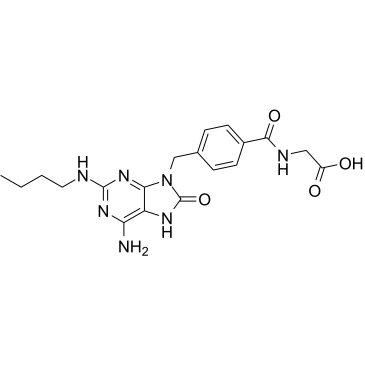
CL264 is an adenine analog and a potent, highly specific TLR7 ligand.
Products are for research use only. Not for human use. We do not sell to patients.
Cas No.: 1510712-69-2
Sample solution is provided at 25 µL, 10mM.
_1-3.$$$39978408@51.jpg');)
_1-9.$$$38538795@65.jpg');)
_1-9.$$$39112701@51.jpg');)
_1-7.$$$37316672@70.jpg');)
_366-372.$$$36198801@70.jpg');)
.$$$38565142@65.jpg');)
_1867-1883.$$$33248023@67.jpg');)
_eads6055.$$$39977546@45.jpg');)
_eadm9805.$$$40080571@45.jpg');)
_eadj3020.$$$39666821@45.jpg');)
_1-20.$$$39757301@28.jpg');)
_1-24.$$$38898113@28.jpg');)
_273-287.$$$36806353@46.jpg');)
_1-16.$$$37156877@44.jpg');)
_1-19.$$$37460805@44.jpg');)
_1291-1307.$$$34518654@46.jpg');)
CL264 is an adenine analog and a potent, highly specific TLR7 ligand. The binding of TLR7 to CL264 in plasmacytoid dendritic cells significantly enhances immune responses, demonstrating great potential in the treatment of cancer, allergic and infectious diseases[1].
In vitro, CL264 (0.5-10µg/ml; 1-12h) promoted the secretion of TNF-α, IL-6, and IFN-β in CAL-1 cells in a dose- and concentration-dependent manner[1]. In a Lewis lung carcinoma (LLC) and bone marrow-derived macrophage (BMDM) co-culture system, CL264 (40ng/ml; 24h) stimulation of BMDMs inhibited LLC cells with IFN‑γ co‑stimulation[2].
In vivo, intratumoral injection of CL264 (40µg/dose) on days 0, 3, and 6 post-tumor grafting induced a pro-tumorigenic effect in C57BL/6J mice[3].
References:
[1] Hilbert T, Steinhagen F, Weisheit C, Baumgarten G, Hoeft A, Klaschik S. Synergistic Stimulation with Different TLR7 Ligands Modulates Gene Expression Patterns in the Human Plasmacytoid Dendritic Cell Line CAL-1. Mediators Inflamm. 2015;2015:948540.
[2] Müller E, Christopoulos PF, et al. Toll-Like Receptor Ligands and Interferon-γ Synergize for Induction of Antitumor M1 Macrophages. Front Immunol. 2017 Oct 26;8:1383.
[3] Dajon M, Iribarren K, Petitprez F, et al. Toll like receptor 7 expressed by malignant cells promotes tumor progression and metastasis through the recruitment of myeloid derived suppressor cells. Oncoimmunology. 2018;8(1):e1505174.
| Cell experiment [1]: | |
|
Cell lines |
CAL-1 cells |
|
Preparation Method |
CAL-1 cells were stimulated with the TLR7 ligand CL264. The reagents were diluted in culture medium and added to the cell suspension in the wells of the 96- or 24-well plates. Vehicle and nonstimulatory Poly-A RNA (2µg/mL) was used as control. |
|
Reaction Conditions |
0.5-10µg/mL; 1-12h |
|
Applications |
CL264 promotes the secretion of TNF-α, IL-6, and IFN-β in CAL-1 cells in a dose- and concentration-dependent manner. |
| Animal experiment [2]: | |
|
Animal models |
C57Bl/6J mice |
|
Preparation Method |
Cancer cells - Murine lung adenocarcinoma LLC-luc cells (1E6 in 100μl PBS/injection) were injected into the flank of recipient mice. Mice then received intra-tumor injections of CL264 at day 0, 3 and 6 after tumor grafting. |
|
Dosage form |
40µg/injection; intra-tumor injections; 3 times |
|
Applications |
Intratumoral injection of the TLR7 agonist CL264 induced a pro-tumorigenic effect. |
References: [1] Hilbert T, Steinhagen F, Weisheit C, Baumgarten G, Hoeft A, Klaschik S. Synergistic Stimulation with Different TLR7 Ligands Modulates Gene Expression Patterns in the Human Plasmacytoid Dendritic Cell Line CAL-1. Mediators Inflamm. 2015;2015:948540. [2] Dajon M, Iribarren K, Petitprez F, et al. Toll like receptor 7 expressed by malignant cells promotes tumor progression and metastasis through the recruitment of myeloid derived suppressor cells. Oncoimmunology. 2018;8(1):e1505174. | |
| Cas No. | 1510712-69-2 | SDF | |
| Canonical SMILES | O=C(O)CNC(C1=CC=C(CN2C(NC3=C(N)N=C(NCCCC)N=C23)=O)C=C1)=O | ||
| Formula | C19H23N7O4 | M.Wt | 413.43 |
| Solubility | DMSO : 25 mg/mL (60.47 mM; Need ultrasonic); H2O : < 0.1 mg/mL (insoluble) | Storage | Store at -20°C |
| Shipping Condition | Evaluation sample solution: shipped with blue ice. All other sizes available: with RT, or with Blue Ice upon request. | ||
| Prepare stock solution | |||

|
1 mg | 5 mg | 10 mg |
| 1 mM | 2.4188 mL | 12.0939 mL | 24.1879 mL |
| 5 mM | 483.8 μL | 2.4188 mL | 4.8376 mL |
| 10 mM | 241.9 μL | 1.2094 mL | 2.4188 mL |
Step 1: Enter information below (Recommended: An additional animal making an allowance for loss during the experiment)
 g
μL
g
μL
Step 2: Enter the in vivo formulation (This is only the calculator, not formulation. Please contact us first if there is no in vivo formulation at the solubility Section.)
Calculation results:
Working concentration: mg/ml;
Method for preparing DMSO master liquid: mg drug pre-dissolved in μL DMSO ( Master liquid concentration mg/mL, Please contact us first if the concentration exceeds the DMSO solubility of the batch of drug. )
Method for preparing in vivo formulation: Take μL DMSO master liquid, next addμL PEG300, mix and clarify, next addμL Tween 80, mix and clarify, next add μL saline, mix and clarify.
Method for preparing in vivo formulation: Take μL DMSO master liquid, next add μL Corn oil, mix and clarify.
Note: 1. Please make sure the liquid is clear before adding the next solvent.
2. Be sure to add the solvent(s) in order. You must ensure that the solution obtained, in the previous addition, is a clear solution before proceeding to add the next solvent. Physical methods such as vortex, ultrasound or hot water bath can be used to aid dissolving.
3. All of the above co-solvents are available for purchase on the GlpBio website.
Quality Control & SDS
- View current batch:
- Purity: >98.00% Appearance: A solid
- COA (Certificate of Analysis)
- SDS (Safety Data Sheet)
- Datasheet
Average Rating: 5 (Based on Reviews and 4 reference(s) in Google Scholar.)