

Edaravone (Synonyms: Edaravone, NSC 2629) |
Catalog No.GC12838
 One-Click Copy Product Info
|

Edaravone, a classical free-radical scavenger, is an organic substance capable of crossing the blood-brain barrier and offering protection to brain cells.
Products are for research use only. Not for human use. We do not sell to patients.
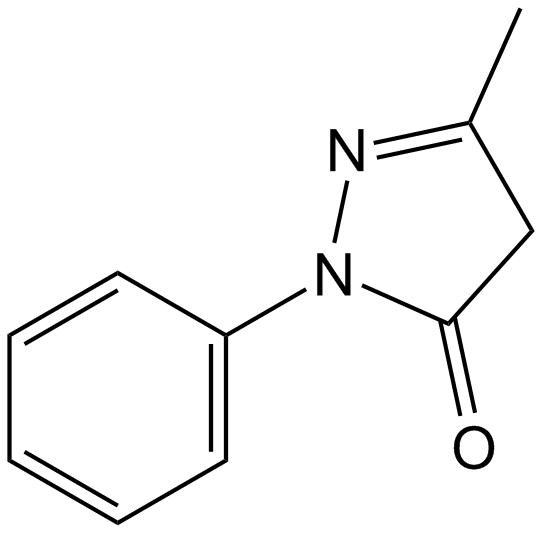
Cas No.: 89-25-8
Sample solution is provided at 25 µL, 10mM.
_1-3.$$$39978408@51.jpg');)
_1-9.$$$38538795@65.jpg');)
_1-9.$$$39112701@51.jpg');)
_1-7.$$$37316672@70.jpg');)
_366-372.$$$36198801@70.jpg');)
.$$$38565142@65.jpg');)
_1867-1883.$$$33248023@67.jpg');)
_eads6055.$$$39977546@45.jpg');)
_eadm9805.$$$40080571@45.jpg');)
_eadj3020.$$$39666821@45.jpg');)
_1-20.$$$39757301@28.jpg');)
_1-24.$$$38898113@28.jpg');)
_273-287.$$$36806353@46.jpg');)
_1-16.$$$37156877@44.jpg');)
_1-19.$$$37460805@44.jpg');)
_1291-1307.$$$34518654@46.jpg');)
Edaravone, a classical free-radical scavenger, is an organic substance capable of crossing the blood-brain barrier and offering protection to brain cells[1]. Edaravone’s keto-enol tautomerism underpins its potent radical-scavenging activity, enabling Edaravone to neutralize both peroxyl radicals and peroxynitrite and thereby confer cell- and neuro-protective antioxidant effects[2]. Edaravone can also be used to treat digestive diseases, including acute liver injury, liver fibrosis[3].
In vitro, pretreatment with 500μM Edaravone to spiral ganglion neurons (SGNs) for 20min reversed glutamate-induced injury: cell numbers were restored, death was prevented, spindle morphology was preserved, and debris was cleared. When 500μM Edaravone was instead added at 2, 6, or 12h after the glutamate insult, protection declined with delay; administration within 2h (or sooner) gave maximal rescue, whereas later time points failed to reduce cell death effectively[4]. Treating Hepa 1-6 hepatoma cells with Edaravone (1-100µM) for 24h under cystine deprivation dose-dependently suppressed cell death and markedly reduced lactate dehydrogenase (LDH) leakage[5].
In vivo, in Sprague-Dawley rats subjected to middle cerebral artery occlusion (MCAO), intraperitoneal administration of Edaravone (3mg/kg) significantly reduced both infarct volume and post-ischemic hemorrhage, yielding a markedly lower hemorrhage-to-infarct ratio than in untreated controls (23.5% vs. 63.2%)[6]. In seven-day-old Wistar rats, daily intraperitoneal Edaravone (20mg/kg) for 14 days starting at hydrocephalus induction attenuated astrocyte activation and conferred partial protection against apoptotic cell death[7].
References:
[1] Huang M, Mo Y, Lei H, et al. Edaravone: A Possible Treatment for Acute Lung Injury. Int J Gen Med. 2024;17:3975-3986.
[2] Duranti E, Cordani N, Villa C. Edaravone: A Novel Possible Drug for Cancer Treatment?. Int J Mol Sci. 2024;25(3):1633.
[3] Lei H, Wang M, Huang M, et al. Edaravone in Digestive Diseases - A Narrative Review. Drug Des Devel Ther. 2025;19:5071-5084.
[4] Bai X, Zhang C, Chen A, et al. Protective Effect of Edaravone on Glutamate-Induced Neurotoxicity in Spiral Ganglion Neurons. Neural Plast. 2016;2016:4034218.
[5] Homma T, Kobayashi S, Sato H, et al. Edaravone, a free radical scavenger, protects against ferroptotic cell death in vitro. Exp Cell Res. 2019;384(1):111592.
[6] Okamura K, Tsubokawa T, Johshita H, et al. Edaravone, a free radical scavenger, attenuates cerebral infarction and hemorrhagic infarction in rats with hyperglycemia. Neurol Res. 2014;36(1):65-69.
[7] Garcia CAB, Catalão CHR, Machado HR, et al. Edaravone reduces astrogliosis and apoptosis in young rats with kaolin-induced hydrocephalus. Childs Nerv Syst. 2017;33(3):419-428.
| Cell experiment [1]: | |
Cell lines | Spiral ganglion neurons (SGNs) |
Preparation Method | SGNs (1.0×10⁵/mL) subcultured in 96-well or 24-well plates were treated with 2mM glutamate for 10 minutes. Then the medium was replaced by normal DMEM. Different concentrations of Edaravone were added to the medium either 20min before or 2h, 6h, and 12h after glutamate treatment. Then the medium was changed to normal medium 10min after that. Cell viability was observed after normal culture for 24h. |
Reaction Conditions | 250, 500, and 750μM; 20min (for preventative effect), 22h, 18h, 12h (therapeutic effect) |
Applications | Edaravone pretreatment reversed the glutamate-induced damage: Edaravone restored cell numbers, prevented widespread death, maintained the neurons’ elongated spindle shape, and eliminated cellular debris. At 500μM and 750μM, SGNs grew normally with virtually no cell loss. 500μM Edaravone was added to the medium 2h, 6h, or 12h after glutamate treatment. Cell death decreased with the treatment of Edaravone. 2h after glutamate treatment or even an earlier time point was the most suitable time point for administering Edaravone to reach the maximal protection effect among these groups. At later time points, the cell death could not be reduced effectively. |
| Animal experiment [2]: | |
Animal models | Sprague-Dawley rats |
Preparation Method | Adult male Sprague-Dawley rats weighing between 275 and 415g were randomly divided into the following two groups, with 10 animals in each group: middle cerebral artery occlusion (MCAO) treated with Edaravone and MCAO treated with physiological saline (controls; n=10). Rats in which MCAO was performed/rats with hyperglycemia, were administered Edaravone. Edaravone was dissolved in 1N NaOH, and the pH of the solution was adjusted to 7.0 using 1N HCl. Edaravone (3mg/kg) was IP injected immediately after occlusion, and the injection was repeated twice, once immediately following reperfusion and 1 hour after reperfusion. |
Dosage form | 3mg/kg; i.p. |
Applications | Edaravone significantly decreased infarct volume, with the average infarct volume in the Edaravone-treated rats (227.6mm3) being significantly lower than that in the control rats (264.0mm3). Edaravone treatment also decreased the postischemic hemorrhage volumes (53.4mm3 in Edaravone-treated rats vs 176.4mm3 in controls). In addition, the ratio of hemorrhage volume to infarct volume was lower in the Edaravone-treated rats (23.5%) than in the untreated rats (63.2%). |
References:
[1] Bai X, Zhang C, Chen A, et al. Protective Effect of Edaravone on Glutamate-Induced Neurotoxicity in Spiral Ganglion Neurons. Neural Plast. 2016;2016:4034218.
[2] Okamura K, Tsubokawa T, Johshita H, et al. Edaravone, a free radical scavenger, attenuates cerebral infarction and hemorrhagic infarction in rats with hyperglycemia. Neurol Res. 2014;36(1):65-69.
| Cas No. | 89-25-8 | SDF | |
| Synonyms | Edaravone, NSC 2629 | ||
| Chemical Name | 5-methyl-2-phenyl-4H-pyrazol-3-one | ||
| Canonical SMILES | CC1=NN(C(=O)C1)C2=CC=CC=C2 | ||
| Formula | C10H10N2O | M.Wt | 174.2 |
| Solubility | ≥ 6.45mg/mL in DMSO, ≥ 47.8 mg/mL in EtOH with ultrasonic | Storage | Store at -20°C |
| General tips | Please select the appropriate solvent to prepare the stock solution according to the
solubility of the product in different solvents; once the solution is prepared, please store it in
separate packages to avoid product failure caused by repeated freezing and thawing.Storage method
and period of the stock solution: When stored at -80°C, please use it within 6 months; when stored
at -20°C, please use it within 1 month. To increase solubility, heat the tube to 37°C and then oscillate in an ultrasonic bath for some time. |
||
| Shipping Condition | Evaluation sample solution: shipped with blue ice. All other sizes available: with RT, or with Blue Ice upon request. | ||
| Prepare stock solution | |||

|
1 mg | 5 mg | 10 mg |
| 1 mM | 5.7405 mL | 28.7026 mL | 57.4053 mL |
| 5 mM | 1.1481 mL | 5.7405 mL | 11.4811 mL |
| 10 mM | 574.1 μL | 2.8703 mL | 5.7405 mL |
Step 1: Enter information below (Recommended: An additional animal making an allowance for loss during the experiment)
 g
μL
g
μL
Step 2: Enter the in vivo formulation (This is only the calculator, not formulation. Please contact us first if there is no in vivo formulation at the solubility Section.)
Calculation results:
Working concentration: mg/ml;
Method for preparing DMSO master liquid: mg drug pre-dissolved in μL DMSO ( Master liquid concentration mg/mL, Please contact us first if the concentration exceeds the DMSO solubility of the batch of drug. )
Method for preparing in vivo formulation: Take μL DMSO master liquid, next addμL PEG300, mix and clarify, next addμL Tween 80, mix and clarify, next add μL saline, mix and clarify.
Method for preparing in vivo formulation: Take μL DMSO master liquid, next add μL Corn oil, mix and clarify.
Note: 1. Please make sure the liquid is clear before adding the next solvent.
2. Be sure to add the solvent(s) in order. You must ensure that the solution obtained, in the previous addition, is a clear solution before proceeding to add the next solvent. Physical methods such as vortex, ultrasound or hot water bath can be used to aid dissolving.
3. All of the above co-solvents are available for purchase on the GlpBio website.
Quality Control & SDS
- View current batch:
- Purity: >99.50% Appearance: A solid
- COA (Certificate of Analysis)
- SDS (Safety Data Sheet)
- Datasheet
Average Rating: 5 (Based on Reviews and 40 reference(s) in Google Scholar.)