

INT-767 |
Catalog No.GC32742
 One-Click Copy Product Info
|

INT-767 is a potent dual agonist of the farnesoid X receptor (FXR) and the Takeda G protein-coupled receptor 5 (TGR5), with EC50 values of 30nM and 630nM, respectively.
Products are for research use only. Not for human use. We do not sell to patients.
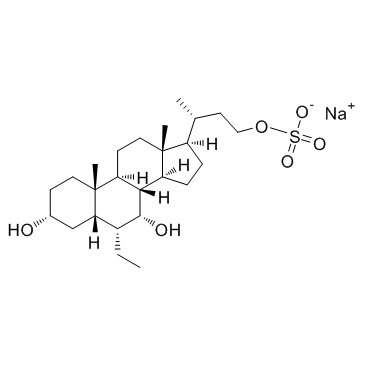
Cas No.: 1000403-03-1
Sample solution is provided at 25 µL, 10mM.
_1-3.$$$39978408@51.jpg');)
_1-9.$$$38538795@65.jpg');)
_1-9.$$$39112701@51.jpg');)
_1-7.$$$37316672@70.jpg');)
_366-372.$$$36198801@70.jpg');)
.$$$38565142@65.jpg');)
_1867-1883.$$$33248023@67.jpg');)
_eads6055.$$$39977546@45.jpg');)
_eadm9805.$$$40080571@45.jpg');)
_eadj3020.$$$39666821@45.jpg');)
_1-20.$$$39757301@28.jpg');)
_1-24.$$$38898113@28.jpg');)
_273-287.$$$36806353@46.jpg');)
_1-16.$$$37156877@44.jpg');)
_1-19.$$$37460805@44.jpg');)
_1291-1307.$$$34518654@46.jpg');)
INT-767 is a potent dual agonist of the farnesoid X receptor (FXR) and the Takeda G protein-coupled receptor 5 (TGR5), with EC50 values of 30nM and 630nM, respectively[1,2]. INT-767 reduces hepatic lipids, improves insulin resistance, and alleviates inflammation, and is commonly used in the treatment and research of non-alcoholic steatohepatitis (NASH) and other metabolic diseases[3,4].
In vitro, treatment of rabbit visceral fat preadipocytes (rPADs) with INT-767 (1μM) for 10 days significantly increased oxygen consumption (from 30.83 ± 3.15 to 69.44 ± 14.74 nmol O2/mL) while decreasing ATP production (from 13.89 ± 0.92 to 9.34 ± 0.59 relative light units (RLU)/cell number)[5].
In vivo, oral administration of INT-767 (10mg/kg; once daily) for 8 weeks in ob/ob mice with NASH reduced hepatic collagen content and lipid area[6]. Treatment of NASH rats with INT-767 (20mg/kg; once daily) by gavage for 4 weeks significantly improved insulin resistance, as indicated by a reduced homeostatic model assessment of insulin resistance index (HOMA-IR) and increased serum glucagon-like peptide-1 (GLP-1) levels [7].
References:
[1] BAGHDASARYAN A, CLAUDEL T, GUMHOLD J, et al. Dual farnesoid X receptor/TGR5 agonist INT-767 reduces liver injury in the Mdr2-/-(Abcb4-/-) mouse cholangiopathy model by promoting biliary HCO output[J]. Hepatology, 2011, 54(4): 1303-1312.
[2] RIZZO G, PASSERI D, DE FRANCO F, et al. Functional characterization of the semisynthetic bile acid derivative INT-767, a dual farnesoid X receptor and TGR5 agonist[J]. Molecular Pharmacology, 2010, 78(4): 617-630.
[3] VIGNOZZI L, CELLAI I, FILIPPI S, et al. HP-01-006 The dual FXR/TGR5 agonist INT-767 counteracts nonalcoholic steatohepatitis and erectile dysfunction in a rabbit model of high fat diet-induced metabolic syndrome[J]. The Journal of Sexual Medicine, 2017, 14(Supplement 4a): e143-e144.
[4] WANG X X, LUO Y, WANG D, et al. A dual agonist of farnesoid X receptor (FXR) and the G protein–coupled receptor TGR5, INT-767, reverses age-related kidney disease in mice[J]. Journal of Biological Chemistry, 2017, 292(29): 12018-12024.
[5] COMEGLIO P, CELLAI I, MELLO T, et al. INT-767 prevents NASH and promotes visceral fat brown adipogenesis and mitochondrial function[J]. Journal of Endocrinology, 2018, 238(2): 107-127.
[6] ROTH J D, FEIGH M, VEIDAL S S, et al. INT-767 improves histopathological features in a diet-induced ob/ob mouse model of biopsy-confirmed non-alcoholic steatohepatitis[J]. World Journal of Gastroenterology, 2018, 24(2): 195.
[7] HU Y B, LIU X Y, ZHAN W. Farnesoid X receptor agonist INT-767 attenuates liver steatosis and inflammation in rat model of nonalcoholic steatohepatitis[EB/OL]. Drug Des Dev Ther, 2018, 12: 2213-2221.
| Cell experiment [1]: | |
Cell lines | rPADs |
Preparation Method | rPADs isolated from high-fat diet (HFD) rabbits were treated with 1μM INT-767 for 10 days, then oxygen consumption was measured using the Oxygraph system, and intracellular ATP levels were quantified using the CellTiter-Glo luminescent cell viability assay. |
Reaction Conditions | 1μM; 10 days |
Applications | INT-767 treatment (1µM) determined a significant increase, when compared to untreated HFD rPADs of oxygen consumption (HFD: 30.83 ± 3.15 nmol O2/mL; HFD + INT-767 1µM: 69.44 ± 14.74 nmol O2/mL), as well as a reduction of ATP formation (HFD: 13.89 ± 0.92 RLU/cell number; HFD + INT-767 1µM: 9.34 ± 0.59 RLU/cell number). |
| Animal experiment [2]: | |
Animal models | NASH male Sprague-Dawley rats |
Preparation Method | Male SD rats were fed a high-fat diet for 16 weeks to establish a NASH model. From week 13 to week 16, INT-767 (20mg/kg) was administered once daily by gavage. At the end of treatment, serum samples were collected. Fasting insulin levels were measured using a rat insulin ELISA kit, and fasting blood glucose levels were measured using a glucose meter. Insulin resistance was assessed by the homeostasis model assessment of HOMA-IR. GLP-1 levels were measured using a GLP-1 total ELISA kit. |
Dosage form | 20mg/kg; once daily; 4 weeks; i.g. |
Applications | Treatment of INT-767 can significantly improve insulin resistance, reduce HOMA-IR, and increase GLP-1 levels. |
References: | |
| Cas No. | 1000403-03-1 | SDF | |
| Canonical SMILES | C[C@H](CCOS(=O)([O-])=O)[C@@]1([H])CC[C@@]2([H])[C@]3([H])[C@H](O)[C@H](CC)[C@]4([H])C[C@H](O)CC[C@]4(C)[C@@]3([H])CC[C@@]21C.[Na+] | ||
| Formula | C25H43NaO6S | M.Wt | 494.66 |
| Solubility | DMSO : ≥ 205.5 mg/mL (415.44 mM) | Storage | Store at -20°C |
| General tips | Please select the appropriate solvent to prepare the stock solution according to the
solubility of the product in different solvents; once the solution is prepared, please store it in
separate packages to avoid product failure caused by repeated freezing and thawing.Storage method
and period of the stock solution: When stored at -80°C, please use it within 6 months; when stored
at -20°C, please use it within 1 month. To increase solubility, heat the tube to 37°C and then oscillate in an ultrasonic bath for some time. |
||
| Shipping Condition | Evaluation sample solution: shipped with blue ice. All other sizes available: with RT, or with Blue Ice upon request. | ||
| Prepare stock solution | |||

|
1 mg | 5 mg | 10 mg |
| 1 mM | 2.0216 mL | 10.108 mL | 20.2159 mL |
| 5 mM | 404.3 μL | 2.0216 mL | 4.0432 mL |
| 10 mM | 202.2 μL | 1.0108 mL | 2.0216 mL |
Step 1: Enter information below (Recommended: An additional animal making an allowance for loss during the experiment)
 g
μL
g
μL
Step 2: Enter the in vivo formulation (This is only the calculator, not formulation. Please contact us first if there is no in vivo formulation at the solubility Section.)
Calculation results:
Working concentration: mg/ml;
Method for preparing DMSO master liquid: mg drug pre-dissolved in μL DMSO ( Master liquid concentration mg/mL, Please contact us first if the concentration exceeds the DMSO solubility of the batch of drug. )
Method for preparing in vivo formulation: Take μL DMSO master liquid, next addμL PEG300, mix and clarify, next addμL Tween 80, mix and clarify, next add μL saline, mix and clarify.
Method for preparing in vivo formulation: Take μL DMSO master liquid, next add μL Corn oil, mix and clarify.
Note: 1. Please make sure the liquid is clear before adding the next solvent.
2. Be sure to add the solvent(s) in order. You must ensure that the solution obtained, in the previous addition, is a clear solution before proceeding to add the next solvent. Physical methods such as vortex, ultrasound or hot water bath can be used to aid dissolving.
3. All of the above co-solvents are available for purchase on the GlpBio website.
Quality Control & SDS
- View current batch:
- Purity: >98.00% Appearance: A solid
- COA (Certificate of Analysis)
- SDS (Safety Data Sheet)
- Datasheet
Average Rating: 5 (Based on Reviews and 4 reference(s) in Google Scholar.)