

Streptozocin (Synonyms: Estreptozocin, NSC 37917, NSC 85998, Streptozocin, STZ, U 9889) |
Catalog No.GC17131
 One-Click Copy Product Info
|

Streptozocin is an antibiotic with pancreatic beta-cell toxicity and can be used to establish type 1 and type 2 diabetes models.
Products are for research use only. Not for human use. We do not sell to patients.
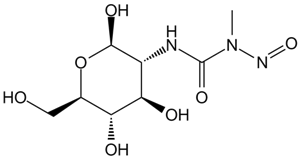
Cas No.: 18883-66-4
Sample solution is provided at 25 µL, 10mM.
Streptozocin is an antibiotic with pancreatic beta-cell toxicity and can be used to establish type 1 and type 2 diabetes models. Streptozocin enters pancreatic islet beta cells through glucose transporter 2 (GLUT2) and releases nitric oxide and free radicals to cause DNA alkylation damage. Streptozocin inhibits DNA synthesis, pyrimidine nucleotide metabolism, and key enzymes of gluconeogenesis[1-4].
In vitro, treatment of mouse insulinoma MIN6 cells with 5mM Streptozocin for 1 hour followed by incubation with fresh medium containing 1mM N-methyl-2-pyridone-5-carboxamide for 1 hour reduced the increase in intracellular ATP and NAD+ levels induced by N-methyl-2-pyridone-5-carboxamide[5]. Treatment of human hepatocellular carcinoma HepG2 cells with 1-20mM Streptozocin for 24-48 hours induced reactive oxygen species and reactive nitrogen species generation and membrane lipid peroxidation in a dose- and time-dependent manner, and induced a decrease in cell viability[6]. Treatment of mouse pancreatic beta cell line INS-1 cells with 15-30mM Streptozocin for 1 hour induced cell apoptosis[7].
In vivo, intraperitoneal injection of Streptozocin (40mg/kg) once daily for 5 consecutive days induced chronic insulitis and insulin deficiency in C57BL/6 mice[8]. Single saphenous vein injection of Streptozocin (25-100mg/kg) in male Wistar rats after 16-hour fasting induced diabetes in a dose-dependent manner[9]. Single intraperitoneal injection, two injections at 24-hour intervals, and three injections at 24-hour intervals of Streptozocin (60mg/kg) in Wistar rats induced diabetes in a dose- and frequency-dependent manner, among which two injections of 60mg/kg at 24-hour interval stably maintained diabetic symptoms in rats for 21 days[10].
References:
[1] Weiss RB. Streptozocin: a review of its pharmacology, efficacy, and toxicity. Cancer Treat Rep. 1982 Mar;66(3):427-38.
[2] Moertel CG, Lefkopoulo M, Lipsitz S, et al. Streptozocin-doxorubicin, streptozocin-fluorouracil or chlorozotocin in the treatment of advanced islet-cell carcinoma. N Engl J Med. 1992 Feb 20;326(8):519-23.
[3] Dickinson JE, Meyer BA, Chmielowiec S, et al. Streptozocin-induced diabetes mellitus in the pregnant ewe. Am J Obstet Gynecol. 1991 Dec;165(6 Pt 1):1673-7.
[4] Moore AS, Nelson RW, Henry CJ, et al. Streptozocin for treatment of pancreatic islet cell tumors in dogs: 17 cases (1989-1999). J Am Vet Med Assoc. 2002 Sep 15;221(6):811-8.
[5] Przygodzki T, Slominska E, Polakowska E, et al. Effects of 1-methylnicotinamide and its metabolite N-methyl-2-pyridone-5-carboxamide on streptozotocin-induced toxicity in murine insulinoma MIN6 cell line. Acta Biochim Pol. 2011;58(1):75-77.
[6] Raza H, John A. Streptozotocin-induced cytotoxicity, oxidative stress and mitochondrial dysfunction in human hepatoma HepG2 cells. Int J Mol Sci. 2012;13(5):5751-5767.
[7] Saini KS, Thompson C, Winterford CM, et al. Streptozotocin at low doses induces apoptosis and at high doses causes necrosis in a murine pancreatic β cell line, INS-1. Biochem Mol Biol Int. 1996;39(6):1229-1236.
[8] Furman BL. Streptozotocin-induced diabetic models in mice and rats. Curr Protoc Pharmacol. 2015 Sep;70:5.47.1-5.47.20.
[9] Junod A, Lambert AE, Stauffacher W, et al. Diabetogenic action of streptozotocin: relationship of dose to metabolic response. J Clin Invest. 1969 Sep;48(12):2129-2139.
[10] Adeleye OE, Ajala T, Adekoya OA, et al. Effective dose regimen of streptozotocin for inducing diabetes in a rat model. Iran J Vet Med. 2024 Jul;18(3):377-386.
| Cell experiment [1]: | |
|
Cell lines |
HepG2 cells (human hepatoma cell line) |
|
Preparation Method |
HepG2 cells were grown in poly-L-lysine coated flasks in DMEM supplemented with 1% nonessential amino acids, 2mM glutamine and 10% heat-inactivated fetal bovine serum at 37°C, 5% CO₂. HepG2 cells were treated with Streptozocin for 24–48h. |
|
Reaction Conditions |
1–20mM; 24–48h |
|
Applications |
Streptozocin decreased HepG2 cell viability in a dose- and time-dependent manner. Streptozocin induced ROS and RNS production and increased NADPH-dependent membrane lipid peroxidation. Streptozocin decreased mitochondrial GSH, inhibited GSH-reductase and GST activities, and reduced mitochondrial membrane potential. Streptozocin inhibited mitochondrial respiratory chain Complex I and Complex IV activities, suppressed ROS-sensitive aconitase activity, and reduced intracellular ATP content. Streptozocin upregulated iNOS expression, promoted NF-κB p65 nuclear translocation, downregulated anti-apoptotic Bcl-2, increased caspase-3 activity, and induced nuclear condensation in HepG2 cells. |
| Animal experiment [2]: | |
|
Animal models |
C57BL/6 or CD-1 male mice |
|
Preparation Method |
Injected Streptozocin (40mg/kg; dissolved in 50mM sodium citrate buffer pH 4.5; freshly prepared) intraperitoneally into C57BL/6 or CD-1 male mice once daily for five consecutive days. During the administration period, provide normal food and 10% sucrose water. On the sixth day, replace the 10% sucrose water with regular water. |
|
Dosage form |
40mg/kg; i.p.; once daily for 5 consecutive days |
|
Applications |
Repeated low-dose Streptozocin induces type 1 diabetes in mice. Streptozocin caused long-term blood glucose greater than 300mg/dL in mice and increased glomerular filtration rate (GFR). |
| Animal experiment [3]: | |
|
Animal models |
C57BL/6 or CD-1 male mice |
|
Preparation Method |
Mice were fasted 6-8h, then intraperitoneally administered nicotinamide (230mg/kg), followed by Streptozocin (dissolved in 50mM sodium citrate buffer pH 4.5; 65mg/kg; i.v.) 15min later. For the high-fat diet combined model, mice were fed 60% fat diet for 3-8 weeks then administered Streptozocin (30-40mg/kg; i.p.) single or twice at weekly interval. |
|
Dosage form |
65mg/kg; i.v.; single Injection; 30-40mg/kg,i.p.; single or double injection. |
|
Applications |
Nicotinamide+Streptozocin caused ~60% β-cell loss, stable moderate hyperglycemia with an insulin-deficient but not insulin-resistant type 2 diabetes phenotype. HFD+STZ caused hyperglycemia associated with hyperinsulinemia and insulin resistance, recapitulating key features of human type 2 diabetes. |
|
References: [1] Raza H, John A. Streptozotocin-induced cytotoxicity, oxidative stress and mitochondrial dysfunction in human hepatoma HepG2 cells. Int J Mol Sci. 2012;13(5):5751-5767. [2] Vallon V, Schroth J, Satriano J et al. Adenosine A(1) receptors determine glomerular hyperfiltration and the salt paradox in early streptozotocin diabetes mellitus. Nephron Physiol. 2009;111(3):p30-8. [3] Furman BL. Streptozotocin-Induced Diabetic Models in Mice and Rats. Curr Protoc. 2021 Apr;1(4):e78. |
|
| Cas No. | 18883-66-4 | SDF | |
| Synonyms | Estreptozocin, NSC 37917, NSC 85998, Streptozocin, STZ, U 9889 | ||
| Chemical Name | 1-methyl-1-nitroso-3-[2,4,5-trihydroxy-6-(hydroxymethyl)oxan-3-yl]urea | ||
| Canonical SMILES | CN(C(=O)NC1C(C(C(OC1O)CO)O)O)N=O | ||
| Formula | C8H15N3O7 | M.Wt | 265.22 |
| Solubility | ≥ 10.3mg/mL in DMSO, ≥ 53.2mg/mL in Water, ≥ 26.5mg/mL in EtOH with gentle warming | Storage | -20°C, protect from light, stored under nitrogen,unstable in solution, ready to use. |
| Shipping Condition | Evaluation sample solution: shipped with blue ice. All other sizes available: with RT, or with Blue Ice upon request. | ||
| Prepare stock solution | |||

|
1 mg | 5 mg | 10 mg |
| 1 mM | 3.7705 mL | 18.8523 mL | 37.7045 mL |
| 5 mM | 754.1 μL | 3.7705 mL | 7.5409 mL |
| 10 mM | 377 μL | 1.8852 mL | 3.7705 mL |
Step 1: Enter information below (Recommended: An additional animal making an allowance for loss during the experiment)
 g
μL
g
μL
Step 2: Enter the in vivo formulation (This is only the calculator, not formulation. Please contact us first if there is no in vivo formulation at the solubility Section.)
Calculation results:
Working concentration: mg/ml;
Method for preparing DMSO master liquid: mg drug pre-dissolved in μL DMSO ( Master liquid concentration mg/mL, Please contact us first if the concentration exceeds the DMSO solubility of the batch of drug. )
Method for preparing in vivo formulation: Take μL DMSO master liquid, next addμL PEG300, mix and clarify, next addμL Tween 80, mix and clarify, next add μL saline, mix and clarify.
Method for preparing in vivo formulation: Take μL DMSO master liquid, next add μL Corn oil, mix and clarify.
Note: 1. Please make sure the liquid is clear before adding the next solvent.
2. Be sure to add the solvent(s) in order. You must ensure that the solution obtained, in the previous addition, is a clear solution before proceeding to add the next solvent. Physical methods such as vortex, ultrasound or hot water bath can be used to aid dissolving.
3. All of the above co-solvents are available for purchase on the GlpBio website.
Quality Control & SDS
- View current batch:
- Purity: >99.00% Appearance: A solid
- COA (Certificate of Analysis)
- SDS (Safety Data Sheet)
- Datasheet
Average Rating: 5 (Based on Reviews and 30 reference(s) in Google Scholar.)