

Wogonin (Synonyms: BRN 0287152) |
Catalog No.GN10017
 One-Click Copy Product Info
|

Wogonin is a potent and competitive inhibitor of CYP1A2 with a Ki value of 0.24μM.
Products are for research use only. Not for human use. We do not sell to patients.
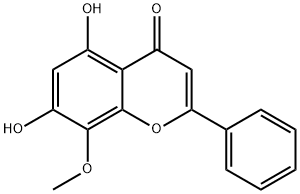
Cas No.: 632-85-9
Sample solution is provided at 25 µL, 10mM.
_1-3.$$$39978408@51.jpg');)
_1-9.$$$38538795@65.jpg');)
_1-9.$$$39112701@51.jpg');)
_1-7.$$$37316672@70.jpg');)
_366-372.$$$36198801@70.jpg');)
.$$$38565142@65.jpg');)
_1867-1883.$$$33248023@67.jpg');)
_eads6055.$$$39977546@45.jpg');)
_eadm9805.$$$40080571@45.jpg');)
_eadj3020.$$$39666821@45.jpg');)
_1-20.$$$39757301@28.jpg');)
_1-24.$$$38898113@28.jpg');)
_273-287.$$$36806353@46.jpg');)
_1-16.$$$37156877@44.jpg');)
_1-19.$$$37460805@44.jpg');)
_1291-1307.$$$34518654@46.jpg');)
Wogonin is a potent and competitive inhibitor of CYP1A2 with a Ki value of 0.24μM [1]. Wogonin activates the expression of PPARγ and subsequently suppresses the nuclear factor-κB pathway [2]. Wogonin has been widely used for anti-angiogenesis and inhibition of the growth of various tumor cells[3].
In vitro, Wogonin treatment for 48h resulted in significant inhibition of S180 cells with an IC50 value of 0.737µM [4]. Treatment with 100μM Wogonin for 72 hours promoted apoptosis of Panc-1 cells by inhibiting the Akt pathway and enhanced the sensitivity of Panc-1 cells to gemcitabine[5]. Treatment with 100μM Wogonin for 8 days induced senescence in MDA-MB-231 cells, accompanied by increased expression of P16, β-galactosidase activity, and accumulation of reactive oxygen species (ROS) [6].
In vivo, Wogonin treatment via intraperitoneal injection at a dose of 50mg/kg every two days for 2 weeks significantly ameliorated bleomycin (BLM)-induced myocardial fibrosis and cardiac dysfunction in mice[7]. A single intraperitoneal injection of 40mg/kg dose of Wogonin reduced the brain contusion volume in traumatic brain injury (TBI) mice within one day, decreased neuronal death, blood-brain barrier permeability and brain edema[8].
References:
[1] Li T, Li N, Guo Q, et al. Inhibitory effects of wogonin on catalytic activity of cytochrome P450 enzyme in human liver microsomes[J]. European journal of drug metabolism and pharmacokinetics, 2011, 36(4): 249-256.
[2] Yamada Y, Saito H, Araki M, et al. Wogonin, a Compound in Scutellaria baicalensis, Activates ATF4–FGF21 Signaling in Mouse Hepatocyte AML12 Cells[J]. Nutrients, 2022, 14(19): 3920.
[3] Tuli H S, Rath P, Chauhan A, et al. Wogonin, as a potent anticancer compound: From chemistry to cellular interactions[J]. Experimental biology and medicine, 2023, 248(9): 820-828.
[4] Wang W, Guo Q L, You Q D, et al. The anticancer activities of wogonin in murine sarcoma S180 both in vitro and in vivo[J]. Biological and Pharmaceutical Bulletin, 2006, 29(6): 1132-1137.
[5] Zhang T, Liu M, Liu Q, et al. Wogonin increases gemcitabine sensitivity in pancreatic cancer by inhibiting Akt pathway[J]. Frontiers in Pharmacology, 2022, 13: 1068855.
[6] Yang D, Guo Q, Liang Y, et al. Wogonin induces cellular senescence in breast cancer via suppressing TXNRD2 expression[J]. Archives of Toxicology, 2020, 94(10): 3433-3447.
[7] Wang L, Lin F, Miao R, et al. Cardiac protection of wogonin in mice with pulmonary fibrosis by regulating Sirt1/γ-H2AX pathway[J]. Frontiers in Pharmacology, 2025, 16: 1551141.
[8] Chen C C, Hung T H, Wang Y H, et al. Wogonin improves histological and functional outcomes, and reduces activation of TLR4/NF-κB signaling after experimental traumatic brain injury[J]. PloS one, 2012, 7(1): e30294.
| Cell experiment [1]: | |
|
Cell lines |
Panc-1 cells |
|
Preparation Method |
PANC-1 cells were grown in DMEM media supplemented with 10% fetal bovine serum in 5% CO2 at 37°C. The exponentially growing PANC-1 cells were seeded into 96-well microplates for 24h. Afterwards, equal volume of medium containing various concentrations of Wogonin (1.25, 2.5, 5, 10, 20, 40, 80, and 160µM) were added to each well. At the end of the incubation period (72h at 37°C), cell viability was analyzed. |
|
Reaction Conditions |
1.25, 2.5, 5, 10, 20, 40, 80, and 160µM; 72h |
|
Applications |
Wogonin treatment significantly reduced the cell viability of PANC-1 cells in a dose-dependent manner. |
| Animal experiment [2]: | |
|
Animal models |
Male C57BL/6J mice |
|
Preparation Method |
Male C57BL/6J mice (8 weeks old) were maintained under 12-h light and 12-h dark cycle at a temperature of 24 C±1°C and humidity of 50%±10%, free with water and diet. Mouse pulmonary fibrosis was induced by a single intratracheal instillation of 1.5U/kg BLM. To test the therapeutic efficacy of Wogonin in BLM-induced established fibrosis, Wogonin was intraperitoneally administered at 50mg/kg every two days for 2 weeks starting at the day 8 after BLM treatment. Control mice received an equal volume of normal saline only. Collect the heart tissues of mice for analysis. |
|
Dosage form |
50mg/kg; every two days for 2 weeks; i.p. |
|
Applications |
Wogonin treatment ameliorated BLM-induced myocardial fibrosis and cardiac dysfunction in mice. |
|
References: |
|
| Cas No. | 632-85-9 | SDF | |
| Synonyms | BRN 0287152 | ||
| Chemical Name | 5,7-dihydroxy-8-methoxy-2-phenylchromen-4-one | ||
| Canonical SMILES | COC1=C(C=C(C2=C1OC(=CC2=O)C3=CC=CC=C3)O)O | ||
| Formula | C16H12O5 | M.Wt | 284.26 |
| Solubility | ≥ 56.33mg/mL in DMSO | Storage | 4°C, protect from light |
| General tips | Please select the appropriate solvent to prepare the stock solution according to the
solubility of the product in different solvents; once the solution is prepared, please store it in
separate packages to avoid product failure caused by repeated freezing and thawing.Storage method
and period of the stock solution: When stored at -80°C, please use it within 6 months; when stored
at -20°C, please use it within 1 month. To increase solubility, heat the tube to 37°C and then oscillate in an ultrasonic bath for some time. |
||
| Shipping Condition | Evaluation sample solution: shipped with blue ice. All other sizes available: with RT, or with Blue Ice upon request. | ||
| Prepare stock solution | |||

|
1 mg | 5 mg | 10 mg |
| 1 mM | 3.5179 mL | 17.5895 mL | 35.1791 mL |
| 5 mM | 703.6 μL | 3.5179 mL | 7.0358 mL |
| 10 mM | 351.8 μL | 1.759 mL | 3.5179 mL |
Step 1: Enter information below (Recommended: An additional animal making an allowance for loss during the experiment)
 g
μL
g
μL
Step 2: Enter the in vivo formulation (This is only the calculator, not formulation. Please contact us first if there is no in vivo formulation at the solubility Section.)
Calculation results:
Working concentration: mg/ml;
Method for preparing DMSO master liquid: mg drug pre-dissolved in μL DMSO ( Master liquid concentration mg/mL, Please contact us first if the concentration exceeds the DMSO solubility of the batch of drug. )
Method for preparing in vivo formulation: Take μL DMSO master liquid, next addμL PEG300, mix and clarify, next addμL Tween 80, mix and clarify, next add μL saline, mix and clarify.
Method for preparing in vivo formulation: Take μL DMSO master liquid, next add μL Corn oil, mix and clarify.
Note: 1. Please make sure the liquid is clear before adding the next solvent.
2. Be sure to add the solvent(s) in order. You must ensure that the solution obtained, in the previous addition, is a clear solution before proceeding to add the next solvent. Physical methods such as vortex, ultrasound or hot water bath can be used to aid dissolving.
3. All of the above co-solvents are available for purchase on the GlpBio website.
Quality Control & SDS
- View current batch:
- Purity: >98.00% Appearance: A solid
- COA (Certificate of Analysis)
- SDS (Safety Data Sheet)
- Datasheet
Average Rating: 5 (Based on Reviews and 30 reference(s) in Google Scholar.)