

A-317491 (Synonyms: A 317491;A317491) |
Catalog No.GC17710
 One-Click Copy Product Info
|

A-317491 is a high-affinity and selective antagonist of P2X3 and P2X2/3 receptor activation, with Ki values of 22 and 92nM for rat P2X3 and P2X2/3, respectively.
Products are for research use only. Not for human use. We do not sell to patients.
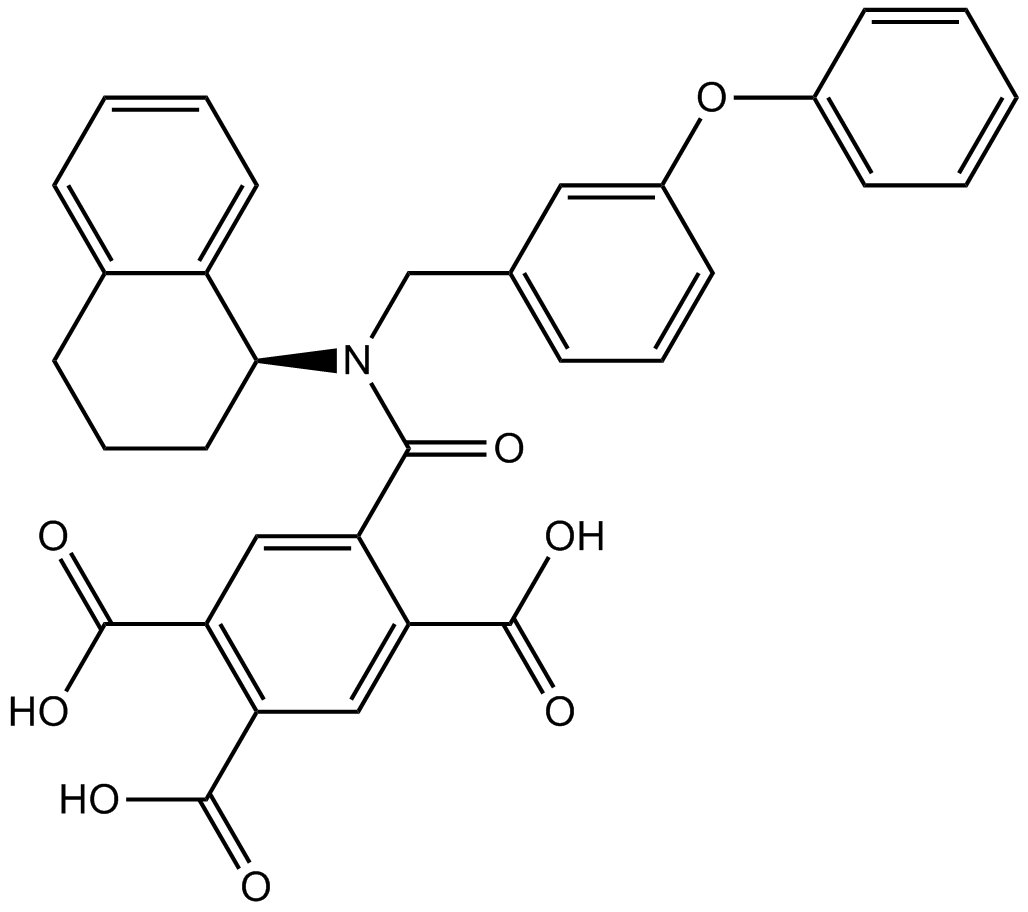
Cas No.: 475205-49-3
Sample solution is provided at 25 µL, 10mM.
A-317491 is a high-affinity and selective antagonist of P2X3 and P2X2/3 receptor activation, with Ki values of 22 and 92nM for rat P2X3 and P2X2/3, respectively [1]. A-317491 acts in the gp120 protein to inhibit the gp120-initiated P2X3 activation, decrease the sensitizing dorsal root ganglia (DRG) primary afferents, and reduce the signal transmission of neuropathic pain in gp120-treated rats[2]. A-317491 can be used to relieve the mechanical and thermal hyperalgesia of endometriotic rats [3].
In vitro, A-317491 (100µM) treatment of bovine chondrocytes for 24 hours reduced α,β-methyleneATP-induced NO production and decreased ATP-mediated PGE2 release in bovine chondrocytes[4].
In vivo, A-317491 treatment (30μmol/kg; s.c.; twice daily) for 10 days alleviated cancer-induced bone pain in NCTC clone 2472 cell-xenograft mouse models[5]. A single intrathecal injection of A-317491 (10μg dissolved in 20μl of normal saline) was administered over 3 days, which alleviated the overactive bladder evoked by 2, 4, 6-trinitrobenzene sulfonic acid (TNBS)-induced colitis[6]. Intramuscular injections of A-317491 (60μg dissolved in normal saline) prevented the mechanical muscle hyperalgesia when administered 30 or 60min after the beginning of static contraction in rats[7].
References:
[1] Jarvis M F, Burgard E C, McGaraughty S, et al. A-317491, a novel potent and selective non-nucleotide antagonist of P2X3 and P2X2/3 receptors, reduces chronic inflammatory and neuropathic pain in the rat[J]. Proceedings of the national academy of sciences, 2002, 99(26): 17179-17184.
[2] Yi Z, Rao S, Ouyang S, et al. A317491 relieved HIV gp120-associated neuropathic pain involved in P2X3 receptor in dorsal root ganglia[J]. Brain Research Bulletin, 2017, 130: 81-89.
[3] Yuan M, Ding S, Meng T, et al. Effect of A-317491 delivered by glycolipid-like polymer micelles on endometriosis pain[J]. International Journal of Nanomedicine, 2017: 8171-8183.
[4] Varani K, De Mattei M, Vincenzi F, et al. Pharmacological characterization of P2X1 and P2X3 purinergic receptors in bovine chondrocytes[J]. Osteoarthritis and cartilage, 2008, 16(11): 1421-1429.
[5] Hansen R R, Nasser A, Falk S, et al. Chronic administration of the selective P2X3, P2X2/3 receptor antagonist, A-317491, transiently attenuates cancer-induced bone pain in mice[J]. European journal of pharmacology, 2012, 688(1-3): 27-34.
[6] Dong X Y, Yang Y, Luo S, et al. Upregulation of P2X3 receptors in primary afferent pathways involves in colon-to-bladder cross-sensitization in rats[J]. Frontiers in Physiology, 2022, 13: 920044.
[7] de Melo Aquino B, da Silva dos Santos D F, Jorge C O, et al. P2X3 receptors contribute to muscle pain induced by static contraction by a mechanism dependent on neutrophil migration[J]. Purinergic signalling, 2019, 15(2): 167-175.
| Cell experiment [1]: | |
Cell lines | Bovine chondrocytes |
Preparation Method | Bovine chondrocytes were cultured in DMEM/F12 medium supplemented with 10% fetal bovine serum (FBS) and antibiotics (penicillin 100U/ml, streptomycin 0.1mg/ml). Seeded at a high density (1.5×10⁶ cells/cm2) in 6-well plates, ATP (500μM) was added to the medium containing 50ng/ml recombinant IL-1β, followed by incubation with 100µM A-317491 for 24h to analyze nitric oxide and PGE2 content. |
Reaction Conditions | 100μM; 24h |
Applications | A-317491 treatment decreased ATP-mediated NO production and PGE2 release in bovine chondrocytes. |
| Animal experiment [2]: | |
Animal models | Male C3H/HeN mice |
Preparation Method | Six-week-old male C3H/HeN mice were housed in a standard environment in groups of seven with a 12h light/dark cycle and ad libitum access to water and standard diet. Bone cancer was induced in C3H/HeN mice by suspension of 1×10⁵ NCTC 2472 clone cells in 10μl PBS. C3H/HeN mice were randomly divided into three groups according to body weight: (i) bone cancer surgery+A-317491 treatment group (30μmol/kg; dissolved in normal saline; subcutaneously injected twice daily); (ii) bone cancer surgery+vehicle control group (subcutaneous injection; twice daily). A-317491 or vehicle control was administered daily at 12:00 and 22:00. Mice were assessed for pain-related behaviors before and 10 days after surgery. |
Dosage form | 30μmol/kg; twice daily for 10 days; s.c. |
Applications | A-317491 treatment alleviated cancer-induced bone pain in NCTC clone 2472 cell-xenograft mouse models. |
References: | |
| Cas No. | 475205-49-3 | SDF | |
| Synonyms | A 317491;A317491 | ||
| Chemical Name | 5-[(3-phenoxyphenyl)methyl-[(1S)-1,2,3,4-tetrahydronaphthalen-1-yl]carbamoyl]benzene-1,2,4-tricarboxylic acid | ||
| Canonical SMILES | C1CC(C2=CC=CC=C2C1)N(CC3=CC(=CC=C3)OC4=CC=CC=C4)C(=O)C5=CC(=C(C=C5C(=O)O)C(=O)O)C(=O)O | ||
| Formula | C33H27NO8 | M.Wt | 565.57 |
| Solubility | ≥ 56.6 mg/mL in DMSO, ≥ 40.73 mg/mL in EtOH with gentle warming | Storage | Store at -20°C |
| General tips | Please select the appropriate solvent to prepare the stock solution according to the
solubility of the product in different solvents; once the solution is prepared, please store it in
separate packages to avoid product failure caused by repeated freezing and thawing.Storage method
and period of the stock solution: When stored at -80°C, please use it within 6 months; when stored
at -20°C, please use it within 1 month. To increase solubility, heat the tube to 37°C and then oscillate in an ultrasonic bath for some time. |
||
| Shipping Condition | Evaluation sample solution: shipped with blue ice. All other sizes available: with RT, or with Blue Ice upon request. | ||
| Prepare stock solution | |||

|
1 mg | 5 mg | 10 mg |
| 1 mM | 1.7681 mL | 8.8406 mL | 17.6813 mL |
| 5 mM | 353.6 μL | 1.7681 mL | 3.5363 mL |
| 10 mM | 176.8 μL | 884.1 μL | 1.7681 mL |
Step 1: Enter information below (Recommended: An additional animal making an allowance for loss during the experiment)
 g
μL
g
μL
Step 2: Enter the in vivo formulation (This is only the calculator, not formulation. Please contact us first if there is no in vivo formulation at the solubility Section.)
Calculation results:
Working concentration: mg/ml;
Method for preparing DMSO master liquid: mg drug pre-dissolved in μL DMSO ( Master liquid concentration mg/mL, Please contact us first if the concentration exceeds the DMSO solubility of the batch of drug. )
Method for preparing in vivo formulation: Take μL DMSO master liquid, next addμL PEG300, mix and clarify, next addμL Tween 80, mix and clarify, next add μL saline, mix and clarify.
Method for preparing in vivo formulation: Take μL DMSO master liquid, next add μL Corn oil, mix and clarify.
Note: 1. Please make sure the liquid is clear before adding the next solvent.
2. Be sure to add the solvent(s) in order. You must ensure that the solution obtained, in the previous addition, is a clear solution before proceeding to add the next solvent. Physical methods such as vortex, ultrasound or hot water bath can be used to aid dissolving.
3. All of the above co-solvents are available for purchase on the GlpBio website.
Quality Control & SDS
- View current batch:
- Purity: >99.00% Appearance: A solid
- COA (Certificate of Analysis)
- SDS (Safety Data Sheet)
- Datasheet
Average Rating: 5 (Based on Reviews and 30 reference(s) in Google Scholar.)