

Emodin (Synonyms: Archin, Frangulic Acid, NSC 408120, NSC 622947, Schuttgelb) |
Catalog No.GC16044
 One-Click Copy Product Info
|

Emodin is a bioactive anthraquinone with anti-tumor, anti-bacterial, and vasorelaxant effects.
Products are for research use only. Not for human use. We do not sell to patients.
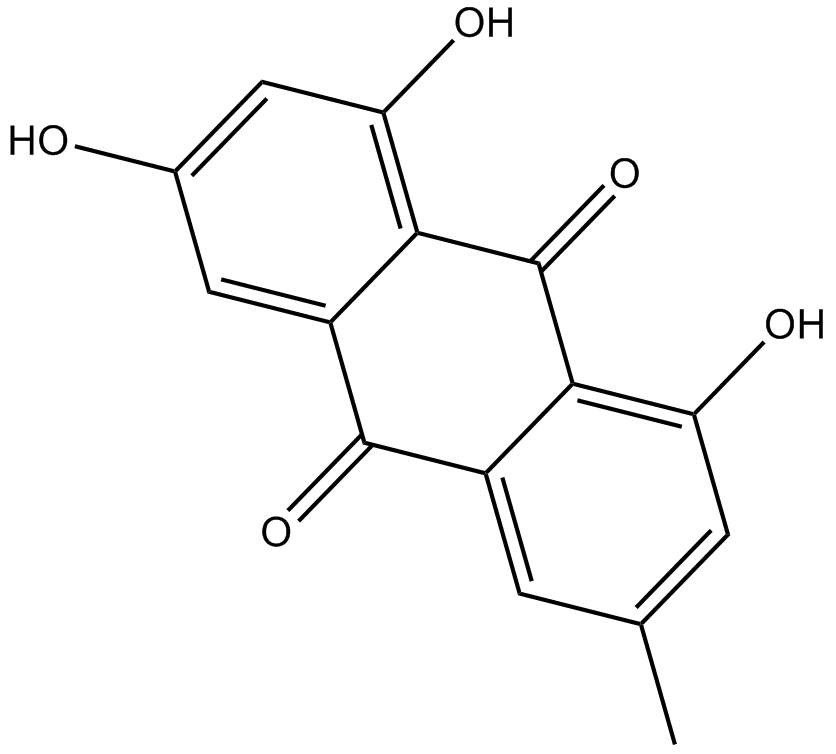
Cas No.: 518-82-1
Sample solution is provided at 25 µL, 10mM.
_1-3.$$$39978408@51.jpg');)
_1-9.$$$38538795@65.jpg');)
_1-9.$$$39112701@51.jpg');)
_1-7.$$$37316672@70.jpg');)
_366-372.$$$36198801@70.jpg');)
.$$$38565142@65.jpg');)
_1867-1883.$$$33248023@67.jpg');)
_eads6055.$$$39977546@45.jpg');)
_eadm9805.$$$40080571@45.jpg');)
_eadj3020.$$$39666821@45.jpg');)
_1-20.$$$39757301@28.jpg');)
_1-24.$$$38898113@28.jpg');)
_273-287.$$$36806353@46.jpg');)
_1-16.$$$37156877@44.jpg');)
_1-19.$$$37460805@44.jpg');)
_1291-1307.$$$34518654@46.jpg');)
Emodin is a bioactive anthraquinone with anti-tumor, anti-bacterial, and vasorelaxant effects [1]. Emodin inhibits the adhesion of many tumor cells by suppressing lipid raft coalescence and interfering with integrin clustering and focal adhesion complex (FAC) formation [2]. Emodin has been widely used to down-regulate the expression of estrogen receptor α (ERα) and inhibit the proliferation of breast cancer cells[3].
In vitro, Emodin treatment for 72 hours significantly inhibited the proliferation of A549 cells, with an IC50 value of 16.85μg/ml, and caused the cells to shrink in size[4]. Treatment with 60µM Emodin for 48 hours significantly increased the p53 protein level in HepG2/C3A cells, activated the expression of Caspase-3, and induced cell arrest at the G2/M phase[5]. Treatment with 3µM Emodin for 5 days significantly inhibited apoptosis of human umbilical vein endothelial cells (HUVECs) induced by high glucose (22.2mM), reduced CCL5 expression, and prevented the activation of p38 MAPK and ERK1/2 caused by high glucose[6].
In vivo, Emodin treatment via intraperitoneal injection at a dose of 10mg/kg, every other day, for 10 days, inhibited the synovial inflammation and joint destruction in mice with collagen-induced arthritis (CIA), and reduced the production of pro-inflammatory cytokines in joint tissues and serum[7]. Oral administration of Emodin at the 100mg/kg dose twice daily for 35 days significantly improved the metabolic abnormalities in diet-induced obese (DIO) mice, and reduced serum insulin levels and lipid levels[8].
References:
[1] Monisha B A, Kumar N, Tiku A B. Emodin and its role in chronic diseases[J]. Anti-inflammatory nutraceuticals and chronic diseases, 2016: 47-73.
[2] Hsu S C, Chung J G. Anticancer potential of emodin[J]. BioMedicine, 2012, 2(3): 108-116.
[3] Huang P H, Huang C Y, Chen M C, et al. Emodin and aloe‐emodin suppress breast cancer cell proliferation through ERα inhibition[J]. Evidence‐based Complementary and Alternative Medicine, 2013, 2013(1): 376123.
[4] Li W Y, Ng Y F, Zhang H, et al. Emodin elicits cytotoxicity in human lung adenocarcinoma A549 cells through inducing apoptosis[J]. Inflammopharmacology, 2014, 22(2): 127-134.
[5] Shieh D E, Chen Y Y, Yen M H, et al. Emodin-induced apoptosis through p53-dependent pathway in human hepatoma cells[J]. Life sciences, 2004, 74(18): 2279-2290.
[6] Gao Y, Zhang J, Li G, et al. Protection of vascular endothelial cells from high glucose-induced cytotoxicity by emodin[J]. Biochemical Pharmacology, 2015, 94(1): 39-45.
[7] Hwang J K, Noh E M, Moon S J, et al. Emodin suppresses inflammatory responses and joint destruction in collagen-induced arthritic mice[J]. Rheumatology, 2013, 52(9): 1583-1591.
[8] Feng Y, Huang S, Dou W, et al. Emodin, a natural product, selectively inhibits 11β‐hydroxysteroid dehydrogenase type 1 and ameliorates metabolic disorder in diet‐induced obese mice[J]. British Journal of Pharmacology, 2010, 161(1): 113-126.
| Cell experiment [1]: | |
Cell lines | A549 cells |
Preparation Method | A549 cells were grown in low-glucose Dulbecco's Modified Eagle Medium (DMEM) with 10% (v/v) fetal bovine serum (FBS), 100μg/ml streptomycin, and 100U/ml penicillin at 37°C in 5% CO2/atmosphere. 3000 A549 cells were seeded into each well of a 96-well plate for 24h, and were treated with different concentrations of Emodin (0, 5, 10, 15, 20, 25, and 30µg/ml) for different incubation periods (24, 48, and 72h), and then the cell viability was analyzed. |
Reaction Conditions | 0, 5, 10, 15, 20, 25, and 30µg/ml; 24, 48, and 72h |
Applications | Emodin treatment significantly decreased the cell viability of A549 cells in a dose-and time-dependent manner. |
| Animal experiment [2]: | |
Animal models | C57BL/6J male mice |
Preparation Method | C57BL/6J male mice (3-4 weeks) were fed a formulated research diet containing 60% of the calories from fat for 12 weeks before and throughout the duration of the experiment. DIO mice were assigned to two groups and subjected to gavage treatment twice per day with vehicle (0.5% CMC) or Emodin 100mg/kg for 35 days. On the last day of treatment, 5h-fasted mice were anaesthetized with an i.p. injection of sodium pentobarbital (40mg/kg). Serum was collected for analysis. |
Dosage form | 100mg/kg; twice a day for 35 days; p.o. |
Applications | Emodin treatment significantly reduced serum insulin levels and lipid levels in DIO mice. |
References: | |
| Cas No. | 518-82-1 | SDF | |
| Synonyms | Archin, Frangulic Acid, NSC 408120, NSC 622947, Schuttgelb | ||
| Chemical Name | 1,3,8-trihydroxy-6-methylanthracene-9,10-dione | ||
| Canonical SMILES | CC1=CC(O)=C2C(C(C3=CC(O)=CC(O)=C3C2=O)=O)=C1 | ||
| Formula | C15H10O5 | M.Wt | 270.24 |
| Solubility | ≥ 27 mg/mL in DMSO | Storage | Store at 2-8°C |
| General tips | Please select the appropriate solvent to prepare the stock solution according to the
solubility of the product in different solvents; once the solution is prepared, please store it in
separate packages to avoid product failure caused by repeated freezing and thawing.Storage method
and period of the stock solution: When stored at -80°C, please use it within 6 months; when stored
at -20°C, please use it within 1 month. To increase solubility, heat the tube to 37°C and then oscillate in an ultrasonic bath for some time. |
||
| Shipping Condition | Evaluation sample solution: shipped with blue ice. All other sizes available: with RT, or with Blue Ice upon request. | ||
| Prepare stock solution | |||

|
1 mg | 5 mg | 10 mg |
| 1 mM | 3.7004 mL | 18.5021 mL | 37.0041 mL |
| 5 mM | 740.1 μL | 3.7004 mL | 7.4008 mL |
| 10 mM | 370 μL | 1.8502 mL | 3.7004 mL |
Step 1: Enter information below (Recommended: An additional animal making an allowance for loss during the experiment)
 g
μL
g
μL
Step 2: Enter the in vivo formulation (This is only the calculator, not formulation. Please contact us first if there is no in vivo formulation at the solubility Section.)
Calculation results:
Working concentration: mg/ml;
Method for preparing DMSO master liquid: mg drug pre-dissolved in μL DMSO ( Master liquid concentration mg/mL, Please contact us first if the concentration exceeds the DMSO solubility of the batch of drug. )
Method for preparing in vivo formulation: Take μL DMSO master liquid, next addμL PEG300, mix and clarify, next addμL Tween 80, mix and clarify, next add μL saline, mix and clarify.
Method for preparing in vivo formulation: Take μL DMSO master liquid, next add μL Corn oil, mix and clarify.
Note: 1. Please make sure the liquid is clear before adding the next solvent.
2. Be sure to add the solvent(s) in order. You must ensure that the solution obtained, in the previous addition, is a clear solution before proceeding to add the next solvent. Physical methods such as vortex, ultrasound or hot water bath can be used to aid dissolving.
3. All of the above co-solvents are available for purchase on the GlpBio website.
Quality Control & SDS
- View current batch:
- Purity: >98.00% Appearance: A solid
- COA (Certificate of Analysis)
- SDS (Safety Data Sheet)
- Datasheet
Average Rating: 5 (Based on Reviews and 30 reference(s) in Google Scholar.)