

Talnetant hydrochloride (Synonyms: SB 223412 hydrochloride; SB 223412-A) |
Catalog No.GC37730
 One-Click Copy Product Info
|

Talnetant (SB 223412) hydrochloride is a selective, competitive, brain-permeable NK3 receptor antagonist with a Ki of 1.4 nM in hNK-3-CHO cells.
Products are for research use only. Not for human use. We do not sell to patients.
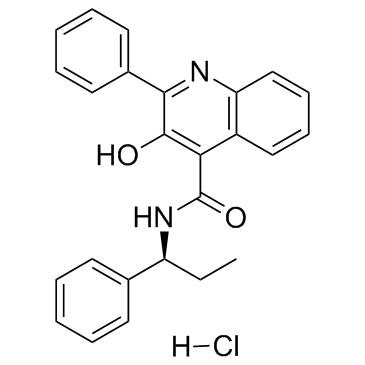
Cas No.: 204519-66-4
Sample solution is provided at 25 µL, 10mM.
_1-3.$$$39978408@51.jpg');)
_1-9.$$$38538795@65.jpg');)
_1-9.$$$39112701@51.jpg');)
_1-7.$$$37316672@70.jpg');)
_366-372.$$$36198801@70.jpg');)
.$$$38565142@65.jpg');)
_1867-1883.$$$33248023@67.jpg');)
_eads6055.$$$39977546@45.jpg');)
_eadm9805.$$$40080571@45.jpg');)
_eadj3020.$$$39666821@45.jpg');)
_1-20.$$$39757301@28.jpg');)
_1-24.$$$38898113@28.jpg');)
_273-287.$$$36806353@46.jpg');)
_1-16.$$$37156877@44.jpg');)
_1-19.$$$37460805@44.jpg');)
_1291-1307.$$$34518654@46.jpg');)
Talnetant Hcl(SB 223412 Hcl) is a potent and selective NK3 receptor antagonist(ki=1.4 nM, hNK-3-CHO); 100-fold selective for the hNK-3 versus hNK-2 receptor, with no affinity for the hNK-1 at concentrations up to 100 uM.IC50 Value: 1.4 nM (hNK-3-CHO binding Ki) [1]Target: NK3 receptorin vitro: In vitro studies demonstrated that 53 is a potent functional antagonist of the hNK-3 receptor (reversal of senktide-induced contractions in rabbit isolated iris sphincter muscles and reversal of NKB-induced Ca2+ mobilization in CHO cells stably expressing the hNK-3 receptor), while in vivo this compound showed oral and intravenous activity in NK-3 receptor-driven models (senktide-induced behavioral responses in mice and senktide-induced miosis in rabbits) [1]. Talnetant has high affinity for recombinant human NK3 receptors (pKi 8.7) and demonstrates selectivity over other neurokinin receptors (pKi NK2 = 6.6 and NK1<4). In native tissue-binding studies, talnetant displayed high affinity for the guinea pig NK3 receptor (pKi 8.5) [3].in vivo: Rectal barostat tests were performed on 102 healthy volunteers, randomized to receive either oral talnetant 25 or 100 mg or placebo over 14-17 days [2]. Talnetant (3-30 mg/kg i.p.) significantly attenuated senktide-induced 'wet dog shake' behaviors in the guinea pig in a dose-dependent manner. Microdialysis studies demonstrated that acute administration of talnetant (30 mg/kg i.p.) produced significant increases in extracellular dopamine and norepinephrine in the medial prefrontal cortex and attenuated haloperidol-induced increases in nucleus accumbens dopamine levels in the freely moving guinea pigs [3].Toxicity: Talnetant had no effect on rectal compliance, sensory thresholds or intensity ratings compared with placebo [2].Clinical trial: Study Of Talnetant Versus Placebo And Risperidone In Schizophrenia. Phase 2
[1]. Giardina GA, et al. Discovery of a novel class of selective non-peptide antagonists for the human neurokinin-3 receptor. 2. Identification of (S)-N-(1-phenylpropyl)-3-hydroxy-2-phenylquinoline-4-carboxamide (SB 223412). J Med Chem. 1999 Mar 25;42(6):1053- [2]. Houghton LA, et al. Effect of the NK(3) receptor antagonist, talnetant, on rectal sensory function and compliance in healthy humans. Neurogastroenterol Motil. 2007 Sep;19(9):732-43. [3]. Dawson LA, et al. In vitro and in vivo characterization of the non-peptide NK3 receptor antagonist SB-223412 (talnetant): potential therapeutic utility in the treatment of schizophrenia. Neuropsychopharmacology. 2008 Jun;33(7):1642-52.
| Cas No. | 204519-66-4 | SDF | |
| Synonyms | SB 223412 hydrochloride; SB 223412-A | ||
| Canonical SMILES | OC1=C(C(N[C@H](C2=CC=CC=C2)CC)=O)C3=C(N=C1C4=CC=CC=C4)C=CC=C3.[H]Cl | ||
| Formula | C25H23ClN2O2 | M.Wt | 418.92 |
| Solubility | Soluble in DMSO | Storage | Store at -20°C |
| General tips | Please select the appropriate solvent to prepare the stock solution according to the
solubility of the product in different solvents; once the solution is prepared, please store it in
separate packages to avoid product failure caused by repeated freezing and thawing.Storage method
and period of the stock solution: When stored at -80°C, please use it within 6 months; when stored
at -20°C, please use it within 1 month. To increase solubility, heat the tube to 37°C and then oscillate in an ultrasonic bath for some time. |
||
| Shipping Condition | Evaluation sample solution: shipped with blue ice. All other sizes available: with RT, or with Blue Ice upon request. | ||
| Prepare stock solution | |||

|
1 mg | 5 mg | 10 mg |
| 1 mM | 2.3871 mL | 11.9355 mL | 23.8709 mL |
| 5 mM | 477.4 μL | 2.3871 mL | 4.7742 mL |
| 10 mM | 238.7 μL | 1.1935 mL | 2.3871 mL |
Step 1: Enter information below (Recommended: An additional animal making an allowance for loss during the experiment)
 g
μL
g
μL
Step 2: Enter the in vivo formulation (This is only the calculator, not formulation. Please contact us first if there is no in vivo formulation at the solubility Section.)
Calculation results:
Working concentration: mg/ml;
Method for preparing DMSO master liquid: mg drug pre-dissolved in μL DMSO ( Master liquid concentration mg/mL, Please contact us first if the concentration exceeds the DMSO solubility of the batch of drug. )
Method for preparing in vivo formulation: Take μL DMSO master liquid, next addμL PEG300, mix and clarify, next addμL Tween 80, mix and clarify, next add μL saline, mix and clarify.
Method for preparing in vivo formulation: Take μL DMSO master liquid, next add μL Corn oil, mix and clarify.
Note: 1. Please make sure the liquid is clear before adding the next solvent.
2. Be sure to add the solvent(s) in order. You must ensure that the solution obtained, in the previous addition, is a clear solution before proceeding to add the next solvent. Physical methods such as vortex, ultrasound or hot water bath can be used to aid dissolving.
3. All of the above co-solvents are available for purchase on the GlpBio website.
Quality Control & SDS
- View current batch:
- Purity: >98.00% Appearance: A solid
- COA (Certificate of Analysis)
- SDS (Safety Data Sheet)
- Datasheet
Average Rating: 5 (Based on Reviews and 40 reference(s) in Google Scholar.)