

Tauroursodeoxycholate (TUDCA) (Synonyms: 3α,7β-dihydroxy-5β-cholanoyl Taurine, TUDCA, UR-906) |
Catalog No.GC34181
 One-Click Copy Product Info
|

Tauroursodeoxycholate (TUDCA) is a cytoprotective agent in a variety of cells including hepatocytes as well as an inducer of apoptosis in cancer cells[1].
Products are for research use only. Not for human use. We do not sell to patients.
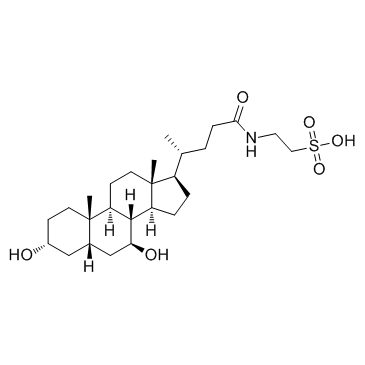
Cas No.: 14605-22-2
Sample solution is provided at 25 µL, 10mM.
_1-3.$$$39978408@51.jpg');)
_1-9.$$$38538795@65.jpg');)
_1-9.$$$39112701@51.jpg');)
_1-7.$$$37316672@70.jpg');)
_366-372.$$$36198801@70.jpg');)
.$$$38565142@65.jpg');)
_1867-1883.$$$33248023@67.jpg');)
_eads6055.$$$39977546@45.jpg');)
_eadm9805.$$$40080571@45.jpg');)
_eadj3020.$$$39666821@45.jpg');)
_1-20.$$$39757301@28.jpg');)
_1-24.$$$38898113@28.jpg');)
_273-287.$$$36806353@46.jpg');)
_1-16.$$$37156877@44.jpg');)
_1-19.$$$37460805@44.jpg');)
_1291-1307.$$$34518654@46.jpg');)
Tauroursodeoxycholate (TUDCA) is a cytoprotective agent in a variety of cells including hepatocytes as well as an inducer of apoptosis in cancer cells[1]. Tauroursodeoxycholate, as an endoplasmic reticulum (ER) stress inhibitor, is effective in protecting the hepatocytes and restoring glucose homeostasis by reducing the endoplasmic reticulum stress[2].
In vitro, 200 µM TUDCA suppressed viability of hVSMCs (vascular smooth muscle cells) by inhibition of ERK (extracellular signal-regulated kinase) phosphorylation, through induction of MKP-1 (MAPK phosphatase-1) via PKCα (protein kinase Cα). And TUDCA inhibited both the proliferation and migration of PDGF-stimulated hVSMCs[1]. In vitro, 25 µM Tauroursodeoxycholate (TUDC) increases plasma membrane multidrug resistance-associated protein 2 (MRP2). And TUDC and cAMP increase Rab11 activity[3].
In vivo, TUDCA prevents the MPTP (1-methyl-4-phenyl-1,2,3,6-tetrahydropyridine)-dependent decrease of dopaminergic fibers and ATP levels, mitochondrial dysfunction and neuroinflammation. TUDCA administration (50 mg/kg), the mice also displayed reduction in foot dragging and an overall improvement in gait[4]. Mice were treated with TUDCA 0.5 mg/g every 3 days, for a total of 7 injections, which showed an increase in neuromuscular junction innervation in the mutated mice[5]. TUDCA treatment (100 mg, 3 times/day) also reduces neurological impairment in rats with acute cerebral infarction[6].
Kim SY, et al. Tauroursodeoxycholate (TUDCA) inhibits neointimal hyperplasia by suppression of ERK via PKCα-mediated MKP-1 induction. Cardiovasc Res. 2011 Nov 1;92(2):307-16.
Kim SY, et al. Tauroursodeoxycholate (TUDCA) inhibits neointimal hyperplasia by suppression of ERK via PKCα-mediated MKP-1 induction. Cardiovasc Res. 2011 Nov 1;92(2):307-16.
Park SW, et al. Rab11, but not Rab4, facilitates cyclic AMP- and tauroursodeoxycholate-induced MRP2 translocation to the plasma membrane. Am J Physiol Gastrointest Liver Physiol. 2014 Oct 15;307(8):G863-70.
[3] Rosa AI, et al. Tauroursodeoxycholic acid improves motor symptoms in a mouse model of Parkinson's disease. Mol Neurobiol. 2018;55(12):9139-9155.
[4] Thams S, et al. A stem cell-based screening platform identifies compounds that desensitize motor neurons to endoplasmic reticulum stress. Mol Ther. 2019;27(1):87-101.
[5] Bian KY, et al. DCA can improve the ACI-induced neurological impairment through negative regulation of Nrf2 signaling pathway. Eur Rev Med Pharmacol Sci. 2019;23(1):343-351.
References:
| Cell experiment [1]: | |
|
Cell lines |
Hepatocytes and HuH‐NTCP cells |
|
Preparation Method |
Hepatocytes and HuH‐NTCP cells were treated with DMSO (Con), 100 µmol/L CPT‐cAMP (cAMP) for 15 min, 10 µmol/L TLC for 25 min, 100 µmol/L CPT‐cAMP + 10 µmol/L TLC for 25 min, or 25 µmol/L TUDC for 15 min or 10 µmol/L TLC for 25 min or 25 µmol/L TUDC + 10 µmol/L TLC for 25 min. |
|
Reaction Conditions |
25 µmol/L; 25 min |
|
Applications |
Cyclic AMP and TUDC inhibit TLC‐induced increases in plasma membrane PKC ε in rat hepatocytes. Cyclic AMP and TUDC inhibit TLC‐induced increases in plasma membrane PKC ε in HuH‐NTCP cells. |
| Animal experiment [2]: | |
|
Animal models |
TNBS(2,4,6-trinitrobenzene sulfonic acid)-induced ulcerative colitis in mice |
|
Preparation Method |
After the induction of colitis for 24h, the mice were administrated orally with tauroursodeoxycholate (20, 40 and 60mg/kg) and sulfasalazine (500mg/kg) by gavage for 7 consecutive days. The inhibition effects were evaluated by the body of weight change, survival rate, macroscopical and histological evaluations. |
|
Dosage form |
20, 40 and 60mg/kg; p.o. |
|
Applications |
Treatment with different doses of tauroursodeoxycholate (20, 40 and 60mg/kg) significantly improved the body weight change, decreased the macroscopic and histopathological scores. Compared with the model group, the accumulation of MPO activity, the colonic tissue levels of IL-1β, IFN-γ and TNF-α were significantly reduced in the tauroursodeoxycholate treated groups. Moreover, tauroursodeoxycholate assuaged the symptoms of colitis. |
|
References: [1] Park SW, et al. Mechanism of inhibition of taurolithocholate-induced retrieval of plasma membrane MRP2 by cyclic AMP and tauroursodeoxycholate. Physiol Rep. 2017 Dec;5(23):e13529. |
|
| Cas No. | 14605-22-2 | SDF | |
| Synonyms | 3α,7β-dihydroxy-5β-cholanoyl Taurine, TUDCA, UR-906 | ||
| Canonical SMILES | C[C@H](CCC(NCCS(=O)(O)=O)=O)[C@H]1CC[C@@]2([H])[C@]3([H])[C@@H](O)C[C@]4([H])C[C@H](O)CC[C@]4(C)[C@@]3([H])CC[C@]12C | ||
| Formula | C26H45NO6S | M.Wt | 499.7 |
| Solubility | 100 mg/mL in DMSO (Need ultrasonic); 100 mg/mL in Water | Storage | Store at RT |
| General tips | Please select the appropriate solvent to prepare the stock solution according to the
solubility of the product in different solvents; once the solution is prepared, please store it in
separate packages to avoid product failure caused by repeated freezing and thawing.Storage method
and period of the stock solution: When stored at -80°C, please use it within 6 months; when stored
at -20°C, please use it within 1 month. To increase solubility, heat the tube to 37°C and then oscillate in an ultrasonic bath for some time. |
||
| Shipping Condition | Evaluation sample solution: shipped with blue ice. All other sizes available: with RT, or with Blue Ice upon request. | ||
| Prepare stock solution | |||

|
1 mg | 5 mg | 10 mg |
| 1 mM | 2.0012 mL | 10.006 mL | 20.012 mL |
| 5 mM | 400.2 μL | 2.0012 mL | 4.0024 mL |
| 10 mM | 200.1 μL | 1.0006 mL | 2.0012 mL |
Step 1: Enter information below (Recommended: An additional animal making an allowance for loss during the experiment)
 g
μL
g
μL
Step 2: Enter the in vivo formulation (This is only the calculator, not formulation. Please contact us first if there is no in vivo formulation at the solubility Section.)
Calculation results:
Working concentration: mg/ml;
Method for preparing DMSO master liquid: mg drug pre-dissolved in μL DMSO ( Master liquid concentration mg/mL, Please contact us first if the concentration exceeds the DMSO solubility of the batch of drug. )
Method for preparing in vivo formulation: Take μL DMSO master liquid, next addμL PEG300, mix and clarify, next addμL Tween 80, mix and clarify, next add μL saline, mix and clarify.
Method for preparing in vivo formulation: Take μL DMSO master liquid, next add μL Corn oil, mix and clarify.
Note: 1. Please make sure the liquid is clear before adding the next solvent.
2. Be sure to add the solvent(s) in order. You must ensure that the solution obtained, in the previous addition, is a clear solution before proceeding to add the next solvent. Physical methods such as vortex, ultrasound or hot water bath can be used to aid dissolving.
3. All of the above co-solvents are available for purchase on the GlpBio website.
Quality Control & SDS
- View current batch:
- Purity: >98.00% Appearance: A solid
- COA (Certificate of Analysis)
- SDS (Safety Data Sheet)
- Datasheet
Average Rating: 5 (Based on Reviews and 19 reference(s) in Google Scholar.)