

25(R)-27-hydroxy Cholesterol (Synonyms: (25R)-26-hydroxy cholesterol) |
Catalog No.GC13887
 One-Click Copy Product Info
|

25(R)-27-hydroxy Cholesterol is an agonist of liver X receptor (LXR) α and LXRβ, with the EC50 of 0.085 and 0.071μM, respectively.
Products are for research use only. Not for human use. We do not sell to patients.
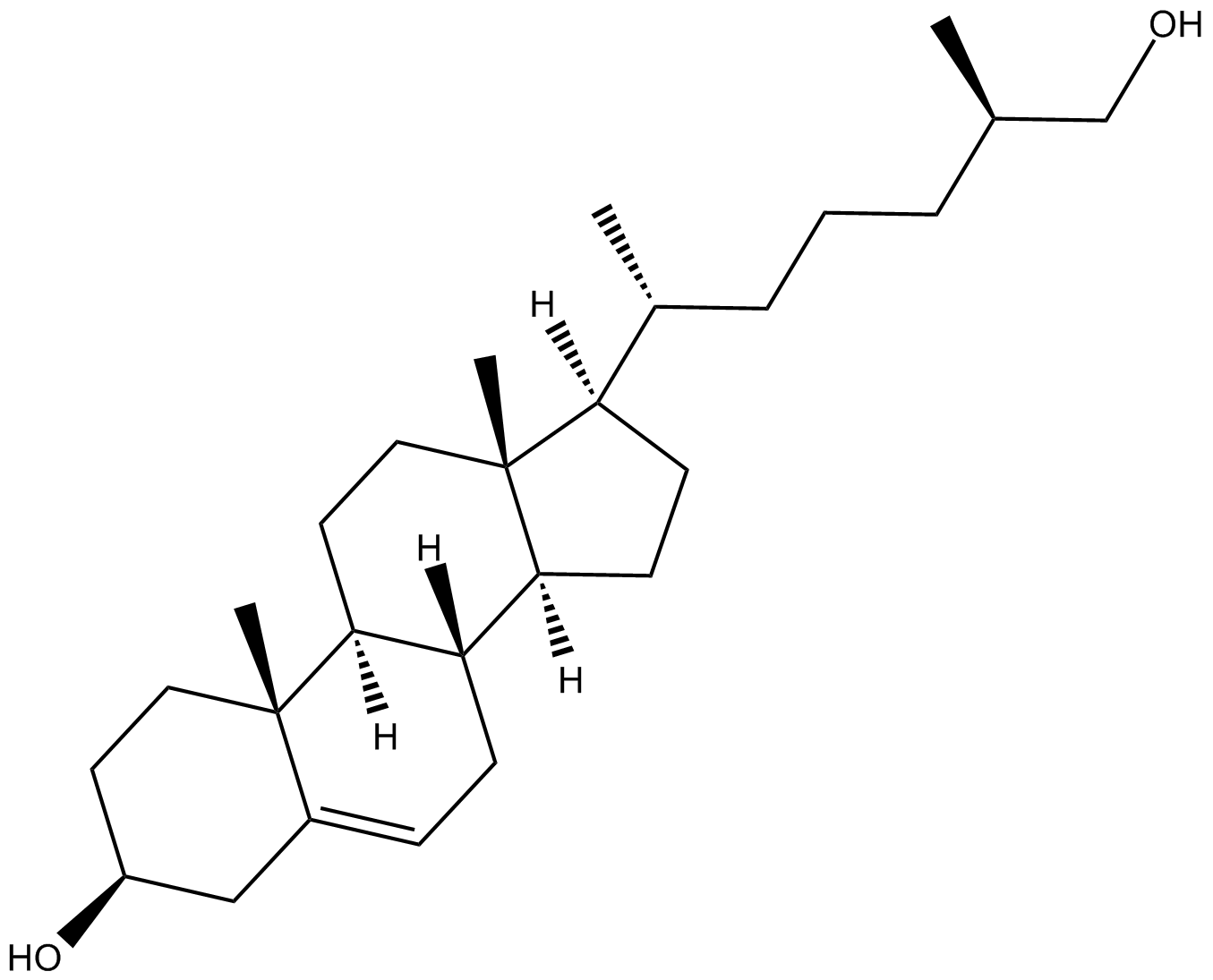
Cas No.: 20380-11-4
Sample solution is provided at 25 µL, 10mM.
_1-3.$$$39978408@51.jpg');)
_1-9.$$$38538795@65.jpg');)
_1-9.$$$39112701@51.jpg');)
_1-7.$$$37316672@70.jpg');)
_366-372.$$$36198801@70.jpg');)
.$$$38565142@65.jpg');)
_1867-1883.$$$33248023@67.jpg');)
_eads6055.$$$39977546@45.jpg');)
_eadm9805.$$$40080571@45.jpg');)
_eadj3020.$$$39666821@45.jpg');)
_1-20.$$$39757301@28.jpg');)
_1-24.$$$38898113@28.jpg');)
_273-287.$$$36806353@46.jpg');)
_1-16.$$$37156877@44.jpg');)
_1-19.$$$37460805@44.jpg');)
_1291-1307.$$$34518654@46.jpg');)
25(R)-27-hydroxy Cholesterol is an agonist of liver X receptor (LXR) α and LXRβ, with the EC50 of 0.085 and 0.071μM, respectively[1]. 25(R)-27-hydroxy Cholesterol, also known as (25R)-26-hydroxycholesterol or, 27-hydroxycholesterol, is the major stereoisomer of the endogenous oxygen sterol 27-hydroxycholesterol (comprising about 80% of the natural mixture)[2]. 25(R)-27-hydroxycholesterol can impact the stability of cholesterol and has been widely used in studies on lipid metabolism control and regulation of the expression of genes related to inflammation[3].
In vitro, 25(R)-27-hydroxy Cholesterol treatment 1μM at for 48 hours significantly promoted the proliferation of LNCaP cells and markedly increased their metabolic activity by activating the activity of estrogen receptor α (ERα)[4]. Treatment with 5.6μM of 25(R)-27-hydroxy Cholesterol for 24 hours can inhibit human rhinovirus (HRV) infection in HeLa cells and reduce the markers of HRV replication[5].
In vivo, 25(R)-27-hydroxy Cholesterol treatment (20mg/kg/day; s.c.) for 8 days increased the number of γδ-T cells and reduced cytotoxic T cells, promoting tumor progression in xenograft tumor mouse models[6]. Before the dark cycle began, intraperitoneal injection of a single dose of 20mg/kg 25(R)-27-hydroxy Cholesterol resulted in a rapid decrease in food intake in both male and female C57BL/6J wild-type mice, and increased the inter-meal interval of female mice, the entire effect lasted for 6 hours[7]. After 25(R)-27-hydroxy Cholesterol (5.5mg/kg/day) was administered by subcutaneous injections to APP/PS1 transgenic mice for 3 weeks, severe lesions occurred in the ileum and colon, and the integrity of the intestinal barrier was impaired, accompanied by the dilation of tight junctions and the downregulation of tight junction proteins (including occludin, tight junction protein 1, tight junction protein 5, and ZO-1) [8].
References:
[1] Fu X, Menke J G, Chen Y, et al. 27-hydroxycholesterol is an endogenous ligand for liver X receptor in cholesterol-loaded cells[J]. Journal of Biological Chemistry, 2001, 276(42): 38378-38387.
[2] Javitt N B. 25R, 26-Hydroxycholesterol revisited: synthesis, metabolism, and biologic roles[J]. Journal of lipid research, 2002, 43(5): 665-670.
[3] Kim D, Lee K M, Lee C, et al. Pathophysiological role of 27-hydroxycholesterol in human diseases[J]. Advances in biological regulation, 2022, 83: 100837.
[4] Raza S, Meyer M, Goodyear C, et al. The cholesterol metabolite 27-hydroxycholesterol stimulates cell proliferation via ERβ in prostate cancer cells[J]. Cancer cell international, 2017, 17(1): 52.
[5] Civra A, Costantino M, Cavalli R, et al. 27-Hydroxycholesterol inhibits rhinovirus replication in vitro and on human nasal and bronchial histocultures without selecting viral resistant variants[J]. Antiviral Research, 2022, 204: 105368.
[6] Baek A E, Yu Y R A, He S, et al. The cholesterol metabolite 27 hydroxycholesterol facilitates breast cancer metastasis through its actions on immune cells[J]. Nature communications, 2017, 8(1): 864.
[7] Ye H, Yang X, Feng B, et al. 27-Hydroxycholesterol acts on estrogen receptor α expressed by POMC neurons in the arcuate nucleus to modulate feeding behavior[J]. Science Advances, 2024, 10(28): eadi4746.
[8] Wang Y, An Y, Ma W, et al. 27-Hydroxycholesterol contributes to cognitive deficits in APP/PS1 transgenic mice through microbiota dysbiosis and intestinal barrier dysfunction[J]. Journal of neuroinflammation, 2020, 17(1): 199.
| Cell experiment [1]: | |
|
Cell lines |
LNCaP cells |
|
Preparation Method |
LNCaP cells were grown in RPMI 1640 medium supplemented with 10% FBS. All cells were maintained with 100U/ml penicillin, 100μg/ml streptomycin 0.25μg/ml amphotericin and were cultured at 5% CO2 and 37 °C. Stock solutions of 25(R)-27-hydroxy Cholesterol were prepared in 100% ethanol and stored at −80 °C. 25(R)-27-hydroxy Cholesterol stock solution was dissolved in appropriate volumes of media to prepare the working solutions of 1μM. Proliferation assays were performed on black 96 well plates using cell proliferation assay which is based on quantifying cell number by DNA content and membrane integrity. Cells at 50–60% confluence were treated and incubated for 48h in the presence of 1μM 25(R)-27-hydroxy Cholesterol. Cell metabolic activity was determined. |
|
Reaction Conditions |
1μM; 48h |
|
Applications |
25(R)-27-hydroxy Cholesterol significantly promotes the proliferation of LNCaP cells and significantly increases the metabolic activity of the cells. |
| Animal experiment [2]: | |
|
Animal models |
C57Bl/6 mice |
|
Preparation Method |
C57Bl/6 mice were randomized into the designated diet or treatment groups before graft. For EO771 tumor implantation experiments, female 8-week-old C57Bl/6 mice were ovariectomized and allowed 1 week for recovery. EO771 cells were then injected into an axillary mammary fat pad. Mice received daily subcutaneous injections of either 25(R)-27-hydroxy Cholesterol (20mg/kg) or vehicle (cyclodextrin) two days after EO771 cell engraftment. Mice were euthanized and tumors removed 8 days after engraftment for flow cytometric analysis. |
|
Dosage form |
20mg/kg/day for 8 days; s.c. |
|
Applications |
25(R)-27-hydroxy Cholesterol treatment increased the presence of γδ-T cells and reduced cytotoxic T cells, promoting tumor progression in mice. |
|
References: |
|
| Cas No. | 20380-11-4 | SDF | |
| Synonyms | (25R)-26-hydroxy cholesterol | ||
| Chemical Name | (25R)-cholest-5-ene-3β,26-diol | ||
| Canonical SMILES | O[C@@H]1CC2=CC[C@]3([H])[C@@](CC[C@]4([C@@]3([H])CC[C@]4([H])[C@@H](CCC[C@@H](C)CO)C)C)([H])[C@](C)2CC1 | ||
| Formula | C27H46O2 | M.Wt | 402.7 |
| Solubility | ≤20mg/ml in ethanol;0.1mg/ml in DMSO;2mg/ml in dimethyl formamide | Storage | Store at 2-8°C |
| General tips | Please select the appropriate solvent to prepare the stock solution according to the
solubility of the product in different solvents; once the solution is prepared, please store it in
separate packages to avoid product failure caused by repeated freezing and thawing.Storage method
and period of the stock solution: When stored at -80°C, please use it within 6 months; when stored
at -20°C, please use it within 1 month. To increase solubility, heat the tube to 37°C and then oscillate in an ultrasonic bath for some time. |
||
| Shipping Condition | Evaluation sample solution: shipped with blue ice. All other sizes available: with RT, or with Blue Ice upon request. | ||
| Prepare stock solution | |||

|
1 mg | 5 mg | 10 mg |
| 1 mM | 2.4832 mL | 12.4162 mL | 24.8324 mL |
| 5 mM | 496.6 μL | 2.4832 mL | 4.9665 mL |
| 10 mM | 248.3 μL | 1.2416 mL | 2.4832 mL |
Step 1: Enter information below (Recommended: An additional animal making an allowance for loss during the experiment)
 g
μL
g
μL
Step 2: Enter the in vivo formulation (This is only the calculator, not formulation. Please contact us first if there is no in vivo formulation at the solubility Section.)
Calculation results:
Working concentration: mg/ml;
Method for preparing DMSO master liquid: mg drug pre-dissolved in μL DMSO ( Master liquid concentration mg/mL, Please contact us first if the concentration exceeds the DMSO solubility of the batch of drug. )
Method for preparing in vivo formulation: Take μL DMSO master liquid, next addμL PEG300, mix and clarify, next addμL Tween 80, mix and clarify, next add μL saline, mix and clarify.
Method for preparing in vivo formulation: Take μL DMSO master liquid, next add μL Corn oil, mix and clarify.
Note: 1. Please make sure the liquid is clear before adding the next solvent.
2. Be sure to add the solvent(s) in order. You must ensure that the solution obtained, in the previous addition, is a clear solution before proceeding to add the next solvent. Physical methods such as vortex, ultrasound or hot water bath can be used to aid dissolving.
3. All of the above co-solvents are available for purchase on the GlpBio website.
Quality Control & SDS
- View current batch:
- Purity: >98.00% Appearance: A solid
- COA (Certificate of Analysis)
- SDS (Safety Data Sheet)
- Datasheet
Average Rating: 5 (Based on Reviews and 34 reference(s) in Google Scholar.)