

Brefeldin A (Synonyms: Ascotoxin, BFA, Cyanein, Decumbin, Nectrolide, NSC 56310, NSC 89671, NSC 107456, NSC 244390, Synergisidin) |
Catalog No.GC17683
 One-Click Copy Product Info
|

Brefeldin A is a macrocyclic lactone compound derived from fungi with protein transport inhibitory activity.
Products are for research use only. Not for human use. We do not sell to patients.
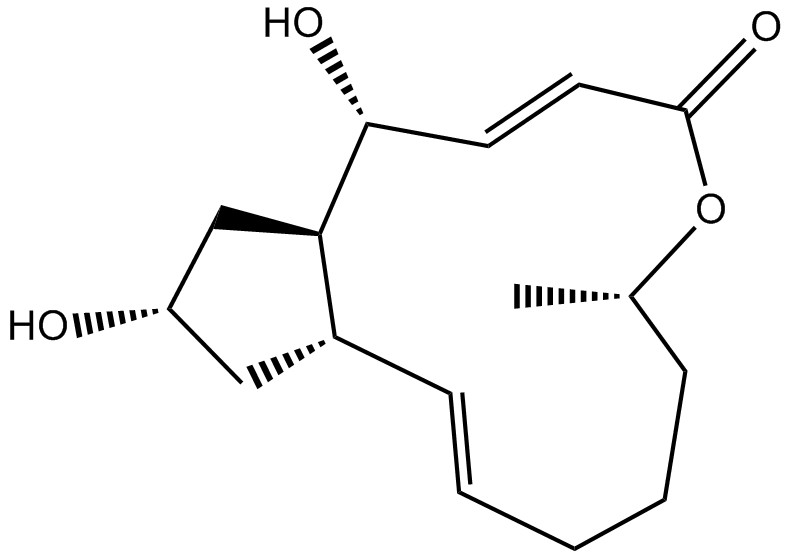
Cas No.: 20350-15-6
Sample solution is provided at 25 µL, 10mM.
Brefeldin A is a macrocyclic lactone compound derived from fungi with protein transport inhibitory activity. Brefeldin A can inhibit Arf-GEFs (such as GBF1) activity to inactivate Arf1, thereby blocking ER-to-Golgi vesicle transport and disrupting Golgi structure. Brefeldin A induces ER stress to activate UPR and promote apoptosis. Brefeldin A can be used in research related to cancer, virology, and cellular secretion pathways[1-4].
In vitro, Brefeldin A (0-500nM) treated human colorectal cancer HCT116, HT29, DLD-1, SW620, SW480 cells for 24h. Brefeldin A significantly inhibited proliferation and colony formation of colorectal cancer cells, induced apoptosis and Bip/Akt-mediated autophagic cell death. Brefeldin A upregulated Bip expression and promoted Bip-Akt interaction to reduce Akt phosphorylation level, inhibited Akt/mTOR pathway, and activated ER stress[5]. Brefeldin A (0.005–50μg/mL) treated MDA-MB-231 human breast cancer cells for 24–48h, and treated them in soft agar for 7 day. Brefeldin A induced cell death, increased sub-G1 cell proportion and promoted PARP cleavage. Brefeldin A inhibited cell colony formation in soft agar and two-dimensional clonogenicity, suppressed cell migration and reduced MMP-9 activity[6].
In vivo, Brefeldin A (0.5mg/mL; 500μL per mouse; single dose) was injected via tail vein into C57BL/6J mice infected with Burkholderia thailandensis (2×10⁷CFU; administered 12h after infection). Brefeldin A blocked the Golgi secretory pathway, inducing accumulation of cytokines such as IFN-γ in splenic lymphocytes[7]. Brefeldin A (5, 10, 15, 20mg/kg) was intraperitoneally injected every other day into 3-week-old female C57BL/6J mice, and (15mg/kg) every other day into 12-month-old female C57BL/6J mice for 1 month. Brefeldin A significantly inhibited oocyte maturation, induced granulosa cell apoptosis, and reduced corpus luteum number. In 3-week-old mice, Brefeldin A elevated serum estradiol and luteinizing hormone levels, upregulated apoptosis-related genes Caspase-3/P53/BAX and senescence markers p21/p16. In 12-month-old mice, Brefeldin A further reduced estradiol and steroid hormones such as 7-hydroxycholesten-3-one and progesterone, disrupted GnRH signaling and FOXO pathway, and interfered with meiosis-related gene expression[8].
References:
[1] Paek SM. Recent Synthesis and Discovery of Brefeldin A Analogs. Mar Drugs. 2018 Apr 18;16(4):133.
[2] Chardin P, McCormick F. Brefeldin A: the advantage of being uncompetitive. Cell. 1999 Apr 16;97(2):153-5.
[3] Nebenführ A, Ritzenthaler C, Robinson DG. Brefeldin A: deciphering an enigmatic inhibitor of secretion. Plant Physiol. 2002 Nov;130(3):1102-8.
[4] Pelham HR. Multiple targets for brefeldin A. Cell. 1991 Nov 1;67(3):449-51.
[5] Zhou L, Gao W, Wang K, et al. Brefeldin A inhibits colorectal cancer growth by triggering Bip/Akt-regulated autophagy. FASEB J. 2019 Apr;33(4):5520-5534.
[6] Tseng CN, Hong YR, Chang HW, et al. Brefeldin A reduces anchorage-independent survival, cancer stem cell potential and migration of MDA-MB-231 human breast cancer cells. Molecules. 2014 Oct 29;19(11):17464-77.
[7] Kovacs SB, Oh C, Aachoui Y, et al. Evaluating cytokine production by flow cytometry using brefeldin A in mice. STAR Protoc. 2020 Dec 30;2(1):100244.
[8] Jiang Y, Lv M, Fan H, et al. Disruption of ovarian function and induction of apoptosis in female mice by Brefeldin A: Mechanistic insights into reproductive toxicity. Animal Model Exp Med. 2025 Nov;8(11):2053-2068.
| Cell experiment [1]: | |
Cell lines | Human colorectal cancer cell lines HCT116, HT29, DLD-1, SW620, SW480, and normal colonic epithelial cell line NCM460 |
Preparation Method | Cells were maintained in DMEM supplemented with 10% fetal bovine serum at 37°C, 5% CO₂. Cells were treated with Brefeldin A at indicated concentrations for 24h. |
Reaction Conditions | 0-500nM; 24h |
Applications | Brefeldin A decreased cell viability and colony formation, reduced EdU incorporation, increased LDH release, induced TUNEL positivity and Annexin V/PI staining, elevated cleaved caspase-3 and cleaved PARP levels. Brefeldin A increased LC3-II turnover, LC3 puncta accumulation, and ATG5/Beclin1 expression, decreased p62 levels, and enhanced LC3-LAMP1 colocalization. Brefeldin A upregulated Bip, CHOP, PERK, IRE1α, eIF2α, promoted Bip dissociation from PERK/IRE1α, and increased Bip-Akt interaction while reducing Akt, mTOR, 4E-BP1, and p70S6K phosphorylation. Autophagy inhibition by CQ, 3-MA, or ATG5 siRNA partly reversed BFA-induced growth inhibition. Brefeldin A also sensitized CRC cells to 5-fluorouracil and paclitaxel. |
| Animal experiment [2]: | |
Animal models | C57BL/6J mice, Rag1-/- mice, infected with Burkholderia thailandensis (E264 strain, 2×10⁷CFU per mouse) via intraperitoneal injection |
Preparation Method | Mice were intraperitoneally inoculated with 200μL of 2×10⁷CFU Burkholderia thailandensis (uninfected controls received 200μL PBS instead). 12h post inoculation, mice were intravenously injected with 500μL of Brefeldin A working solution (0.5mg/mL). All mice were euthanized 6h after Brefeldin A administration, and spleens were harvested for flow cytometric analysis of in situ cytokine production. |
Dosage form | 0.5mg/mL of 500μL per mouse; i.v.; single injection 6h |
Applications | Brefeldin A inhibited the Golgi-dependent secretory pathway in mice to block cytokine secretion, leading to accumulation of IFN-γ and other cytokines within splenic lymphocytes of infected mice, which enabled flow cytometric detection of in situ cytokine production during bacterial infection without relying on cytokine reporter mice. This approach was applicable to mice of any genotype and could be extended to other cytokines and other infectious and immune mouse models. |
References: | |
| Cas No. | 20350-15-6 | SDF | |
| Synonyms | Ascotoxin, BFA, Cyanein, Decumbin, Nectrolide, NSC 56310, NSC 89671, NSC 107456, NSC 244390, Synergisidin | ||
| Chemical Name | (1S,2E,7S,10E,12R,13R,15S)-12,15-dihydroxy-7-methyl-8-oxabicyclo[11.3.0]hexadeca-2,10-dien-9-one | ||
| Canonical SMILES | CC1CCCC=CC2CC(CC2C(C=CC(=O)O1)O)O | ||
| Formula | C16H24O4 | M.Wt | 280.36 |
| Solubility | ≥ 4.67mg/mL in DMSO | Storage | Store at -20°C |
| Shipping Condition | Evaluation sample solution: shipped with blue ice. All other sizes available: with RT, or with Blue Ice upon request. | ||
| Prepare stock solution | |||

|
1 mg | 5 mg | 10 mg |
| 1 mM | 3.5668 mL | 17.8342 mL | 35.6684 mL |
| 5 mM | 713.4 μL | 3.5668 mL | 7.1337 mL |
| 10 mM | 356.7 μL | 1.7834 mL | 3.5668 mL |
Step 1: Enter information below (Recommended: An additional animal making an allowance for loss during the experiment)
 g
μL
g
μL
Step 2: Enter the in vivo formulation (This is only the calculator, not formulation. Please contact us first if there is no in vivo formulation at the solubility Section.)
Calculation results:
Working concentration: mg/ml;
Method for preparing DMSO master liquid: mg drug pre-dissolved in μL DMSO ( Master liquid concentration mg/mL, Please contact us first if the concentration exceeds the DMSO solubility of the batch of drug. )
Method for preparing in vivo formulation: Take μL DMSO master liquid, next addμL PEG300, mix and clarify, next addμL Tween 80, mix and clarify, next add μL saline, mix and clarify.
Method for preparing in vivo formulation: Take μL DMSO master liquid, next add μL Corn oil, mix and clarify.
Note: 1. Please make sure the liquid is clear before adding the next solvent.
2. Be sure to add the solvent(s) in order. You must ensure that the solution obtained, in the previous addition, is a clear solution before proceeding to add the next solvent. Physical methods such as vortex, ultrasound or hot water bath can be used to aid dissolving.
3. All of the above co-solvents are available for purchase on the GlpBio website.
Quality Control & SDS
- View current batch:
- Purity: >99.50% Appearance: A solid
- COA (Certificate of Analysis)
- SDS (Safety Data Sheet)
- Datasheet

Average Rating: 5 (Based on Reviews and 5 reference(s) in Google Scholar.)