

Memantine hydrochloride (Synonyms: Akatinol, Axura, Ebix, Namenda, NSC 102290, SUN Y7017) |
Catalog No.GC10198
 One-Click Copy Product Info
|

Memantine hydrochloride is a non-competitive N-methyl-D-aspartate receptor (NMDAR) antagonist, with the IC50 values of 0.5-1μM.
Products are for research use only. Not for human use. We do not sell to patients.
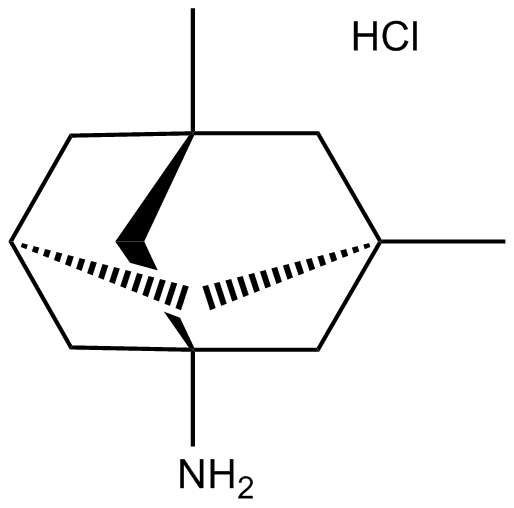
Cas No.: 41100-52-1
Sample solution is provided at 25 µL, 10mM.
_1-3.$$$39978408@51.jpg');)
_1-9.$$$38538795@65.jpg');)
_1-9.$$$39112701@51.jpg');)
_1-7.$$$37316672@70.jpg');)
_366-372.$$$36198801@70.jpg');)
.$$$38565142@65.jpg');)
_1867-1883.$$$33248023@67.jpg');)
_eads6055.$$$39977546@45.jpg');)
_eadm9805.$$$40080571@45.jpg');)
_eadj3020.$$$39666821@45.jpg');)
_1-20.$$$39757301@28.jpg');)
_1-24.$$$38898113@28.jpg');)
_273-287.$$$36806353@46.jpg');)
_1-16.$$$37156877@44.jpg');)
_1-19.$$$37460805@44.jpg');)
_1291-1307.$$$34518654@46.jpg');)
Memantine hydrochloride is a non-competitive N-methyl-D-aspartate receptor (NMDAR) antagonist, with the IC50 values of 0.5-1μM[1]. Memantine hydrochloride protects neurons against toxicity caused by overactivation of NMDAR and blocks the effects of tonic pathologically elevated levels of glutamate that may lead to neuronal dysfunction[2]. Memantine hydrochloride has been used in animal models to treat various types of dementia and neurodegenerative diseases[3].
In vitro, Memantine hydrochloride treatment at 50μM for 24 hours significantly alleviated the decrease in rat hippocampal cell viability induced by amyloid protein β1-42, increased the number of living cells, and enhanced cell viability[4]. Treatment with 10μM Memantine hydrochloride for 6 hours attenuated the oxidative stress induced by oxygen-glucose deprivation/reperfusion in human umbilical vein endothelial cells (HUVECs), increased the expression of Nrf2 and HO-1, and enhanced cell viability[5]. Treatment with 250μM Memantine hydrochloride for 48 hours resulted in a significant increase in the expression level of the pro-apoptotic protein Bax in LNCaP cells, and induced cell cycle arrest at the G0/G1 phase[6].
In vivo, Memantine hydrochloride treatment (20mg/kg) by gavage daily for 2 months can improve the spatial learning ability of APP/PS1 mice and alleviate memory impairment[7]. Continuous intraperitoneal injection of 10mg/kg/day dose of Memantine hydrochloride for 10 consecutive days could alleviate the parasitemia in BALB/c mice infected with Trypanosoma cruzi, resulting in a reduction in cardiac parasitic load and inflammatory infiltration, and an increase in the survival rate of the mice[8].
References:
[1] Kotermanski S E, Johnson J W. Mg2+ imparts NMDA receptor subtype selectivity to the Alzheimer's drug memantine[J]. Journal of Neuroscience, 2009, 29(9): 2774-2779.
[2] Witt A, Macdonald N, Kirkpatrick P. Memantine hydrochloride[J]. Nature reviews Drug discovery, 2004, 3(2): 109-110.
[3] Peng D, Yuan X, Zhu R. Memantine hydrochloride in the treatment of dementia subtypes[J]. Journal of Clinical Neuroscience, 2013, 20(11): 1482-1485.
[4] Rozumna N M, Hanzha V V, Lukyanetz E A. Memantine protects the cultured rat hippocampal neurons treated by NMDA and amyloid β1–42[J]. Frontiers in Neuroscience, 2023, 17: 1269664.
[5] Lv X, Li Q, Mao S, et al. The protective effects of memantine against inflammation and impairment of endothelial tube formation induced by oxygen-glucose deprivation/reperfusion[J]. Aging (Albany NY), 2020, 12(21): 21469.
[6] Albayrak G, Konac E, Dikmen A U, et al. Memantine induces apoptosis and inhibits cell cycle progression in LNCaP prostate cancer cells[J]. Human & experimental toxicology, 2018, 37(9): 953-958.
[7] Li P, Xu J, Gu H, et al. Memantine ameliorates cognitive deficit in AD mice via enhancement of entorhinal–CA1 projection[J]. BMC neuroscience, 2021, 22(1): 41.
[8] Santos Souza H F, Rocha S C, Damasceno F S, et al. The effect of memantine, an antagonist of the NMDA glutamate receptor, in in vitro and in vivo infections by Trypanosoma cruzi[J]. PLoS neglected tropical diseases, 2019, 13(9): e0007226.
| Cell experiment [1]: | |
Cell lines | LNCaP cells |
Preparation Method | 3 × 10³ LNCaP cells were inoculated into 100μL of culture medium in a 96-well plate and cultured for 24 hours. Different concentrations of Memantine hydrochloride (250, 500, 750, 1000, and 2000μM) were added to the culture medium, and the cells were further cultivated for 48h. MTT solution (5mg/mL PBS) was added to each well, and the culture plate was incubated at 37°C for 4 hours. The absorbance ratio was measured at 570nm on a microplate reader. |
Reaction Conditions | 250, 500, 750, 1000, and 2000μM; 48h |
Applications | Memantine hydrochloride treatment significantly inhibited cell proliferation of LNCaP cells in a concentration-dependent manner. |
| Animal experiment [2]: | |
Animal models | G93A transgenic mice |
Preparation Method | G93A transgenic mice were raised in a controlled environment (temperature 20-22℃, humidity 40-60%, light duration 07:00 to 19:00), with free access to food and water. The mice were randomly divided into a control group and a Memantine hydrochloride group (30mg/kg/day; p.o), with 10 mice in each group. The Memantine hydrochloride treatment was initiated at 75 days of age in mice, and the behavioral performance was evaluated twice a week using the rotating beam test, paw grip endurance (PaGE), and hindlimb extension reflex. The survival rate of the mice was recorded. The entire experiment lasted for 5 months. |
Dosage form | 30mg/kg/day for 5 months; p.o. |
Applications | Memantine hydrochloride treatment prolonged the survival period of transgenic mice and improved the motor ability of mice. |
References: | |
| Cas No. | 41100-52-1 | SDF | |
| Synonyms | Akatinol, Axura, Ebix, Namenda, NSC 102290, SUN Y7017 | ||
| Chemical Name | 3,5-dimethyladamantan-1-amine;hydrochloride | ||
| Canonical SMILES | CC12CC3CC(C1)(CC(C3)(C2)N)C.Cl | ||
| Formula | C12H22ClN | M.Wt | 215.76 |
| Solubility | ≥ 12.6mg/mL in DMSO; ≥20 mg/mL in Water | Storage | Store at RT |
| General tips | Please select the appropriate solvent to prepare the stock solution according to the
solubility of the product in different solvents; once the solution is prepared, please store it in
separate packages to avoid product failure caused by repeated freezing and thawing.Storage method
and period of the stock solution: When stored at -80°C, please use it within 6 months; when stored
at -20°C, please use it within 1 month. To increase solubility, heat the tube to 37°C and then oscillate in an ultrasonic bath for some time. |
||
| Shipping Condition | Evaluation sample solution: shipped with blue ice. All other sizes available: with RT, or with Blue Ice upon request. | ||
| Prepare stock solution | |||

|
1 mg | 5 mg | 10 mg |
| 1 mM | 4.6348 mL | 23.1739 mL | 46.3478 mL |
| 5 mM | 927 μL | 4.6348 mL | 9.2696 mL |
| 10 mM | 463.5 μL | 2.3174 mL | 4.6348 mL |
Step 1: Enter information below (Recommended: An additional animal making an allowance for loss during the experiment)
 g
μL
g
μL
Step 2: Enter the in vivo formulation (This is only the calculator, not formulation. Please contact us first if there is no in vivo formulation at the solubility Section.)
Calculation results:
Working concentration: mg/ml;
Method for preparing DMSO master liquid: mg drug pre-dissolved in μL DMSO ( Master liquid concentration mg/mL, Please contact us first if the concentration exceeds the DMSO solubility of the batch of drug. )
Method for preparing in vivo formulation: Take μL DMSO master liquid, next addμL PEG300, mix and clarify, next addμL Tween 80, mix and clarify, next add μL saline, mix and clarify.
Method for preparing in vivo formulation: Take μL DMSO master liquid, next add μL Corn oil, mix and clarify.
Note: 1. Please make sure the liquid is clear before adding the next solvent.
2. Be sure to add the solvent(s) in order. You must ensure that the solution obtained, in the previous addition, is a clear solution before proceeding to add the next solvent. Physical methods such as vortex, ultrasound or hot water bath can be used to aid dissolving.
3. All of the above co-solvents are available for purchase on the GlpBio website.
Quality Control & SDS
- View current batch:
- Purity: >98.00% Appearance: A solid
- COA (Certificate of Analysis)
- SDS (Safety Data Sheet)
- Datasheet
Average Rating: 5 (Based on Reviews and 10 reference(s) in Google Scholar.)